

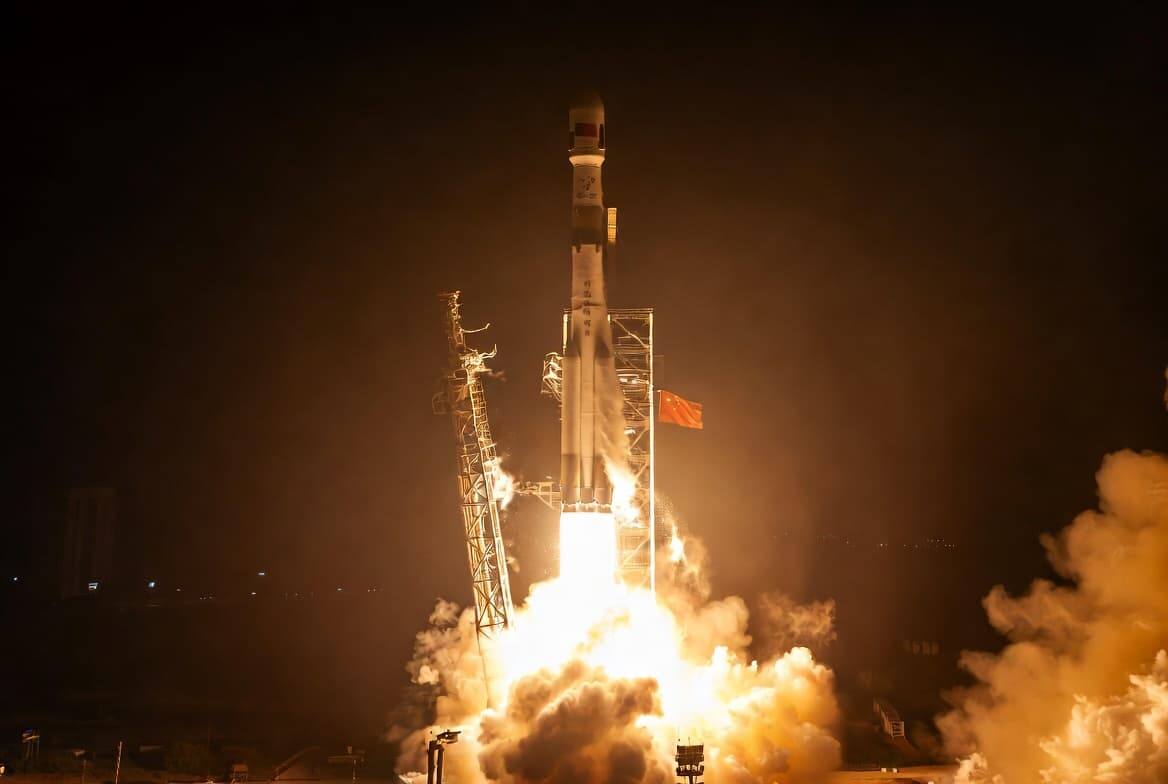
China has put the Haiyang-2E ocean satellite into orbit, adding another ocean-observation satellite to its expanding remote-sensing fleet. The spacecraft launched aboard a Long March 4B from the Jiuquan Satellite Launch Center and reached a sun-synchronous orbit. The mission was declared fully successful, and Haiyang-2E will join the Haiyang family used to track the state of the global ocean, gather environmental data, and support marine research.
The launch is a reminder that China’s space program is not just about the headline-grabbing lunar and Martian ambitions. It is also steadily building practical infrastructure in orbit, where weather, navigation, communications, and Earth-observation satellites do the unglamorous work that governments and scientists use every day. Ocean monitoring may sound niche, but it feeds climate models, fisheries management, shipping forecasts, and disaster response.
Long March 4B lifts off from Jiuquan
Long March 4B, or CZ-4B, is a three-stage liquid-fueled rocket developed by the Shanghai Academy of Spaceflight Technology. It can carry payloads of up to 2.5 tons to orbit, which is enough for a specialized environmental satellite like Haiyang-2E.
That competence is the point. China has been broadening its orbital constellation for years, and missions like this show how the country keeps layering capabilities rather than betting everything on a single flagship project. The strategy is less glamorous than a moon landing, but far more useful if you care about what is happening over the oceans between ports, storms, and coastlines.
What Haiyang-2E adds to the Haiyang family
- Monitors ocean conditions and marine environments
- Collects environmental data for research and services
- Expands China’s remote-sensing coverage over the sea
China’s satellite buildout is happening alongside work on lunar, Martian, and asteroid missions, plus continued use of its own space station. That mix matters because it shows the country is pursuing prestige projects and infrastructure at the same time, and the infrastructure is the part that keeps delivering whether or not the next deep-space headline lands.
More ocean satellites are likely on the way
If the pace holds, expect more specialized satellites rather than fewer. Earth observation is one of the easiest ways for space agencies to turn launches into daily utility, and ocean-focused payloads are especially valuable as coastal economies face tighter pressure from weather, shipping demand, and environmental monitoring needs.