

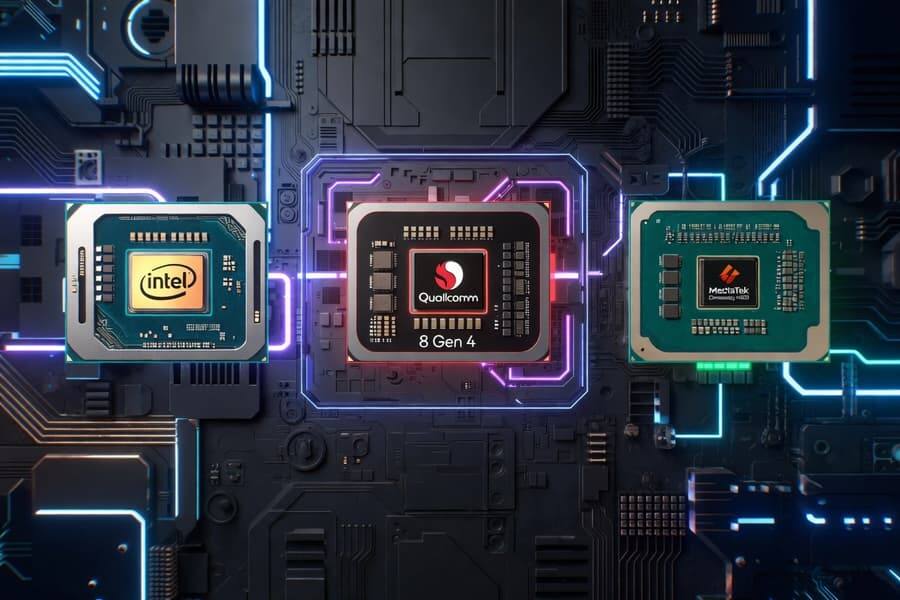
Google is preparing a new GoogleBook laptop line with a deliberately mixed processor strategy: some models will use Intel chips, while others will rely on Arm silicon from Qualcomm and MediaTek. The pitch is obvious enough. If Google wants Gemini-focused laptops across different price bands, it cannot bet on a single architecture and hope the market politely cooperates.
Intel has already confirmed the collaboration, and the company’s third-generation Core family, codenamed Wildcat Lake, is the most likely candidate for at least part of the GoogleBook lineup. Those chips are said to bring up to 6 CPU cores, Xe3 graphics, and an NPU 5 block for AI workloads, plus support for DDR5-6400, LPDDR5X-7467, Thunderbolt 4, PCIe 4.0, Wi-Fi 7, and Bluetooth 6.0. That is a very familiar list of laptop checkboxes, but with the AI accelerator now shoved into the front row.
Intel’s Wildcat Lake looks aimed at mainstream AI laptops
The Intel side of the story matters because it gives Google an x86 option that feels safe for enterprise buyers and traditional Windows-adjacent laptop specs, even if Google is obviously chasing its own ecosystem here. The inclusion of newer wireless standards and an NPU suggests these machines are being positioned as practical, always-connected devices rather than halo products for keynote slides.
Google is also not stopping at Intel. By bringing in Qualcomm and MediaTek, it can cover lighter, cheaper, and more battery-friendly machines, which is exactly where Arm laptops have been making their case for years. That is the real story here: Google is borrowing the playbook that made Chromebooks useful in the first place, then trying to graft Gemini onto it without forcing every buyer into the same hardware lane.
Acer, Asus, Dell, HP and Lenovo are in the mix
The GoogleBook lineup will be made by Acer, Asus, Dell, HP, and Lenovo, which gives Google broad distribution from day one. That is smart, and slightly overdue. After fifteen years of Chromebook history, Google seems to have decided that a serious laptop push needs real hardware partners, not just an operating-system sermon.
- Intel models: likely based on Wildcat Lake
- Arm models: chips from Qualcomm and MediaTek
- AI focus: Gemini integration across the lineup
- Manufacturers: Acer, Asus, Dell, HP and Lenovo
The open question is whether Google can make ”AI laptop” mean something beyond marketing gloss. If these notebooks land with real differentiation in battery life, pricing, and Gemini features, the multi-chip approach could look shrewd rather than fragmented. If not, it will just be another reminder that a lot of laptops now have NPUs and almost nobody knows what to do with them.