

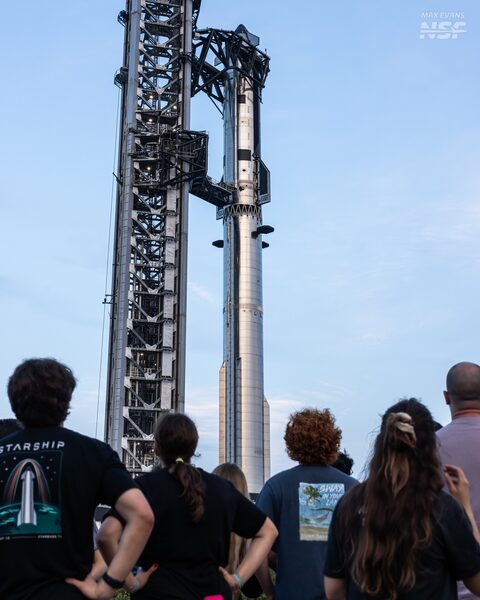
SpaceX says the 12th Starship test flight is slated to lift off on the night of May 22, with a launch window from 01:30 to 03:00 Moscow time. If the weather behaves, the company will put its fully refreshed Starship V3 and Super Heavy stack through its first flight from the updated Starbase pad, testing whether the redesigns actually work outside the slide deck.
The company’s own forecast gives the attempt a 55% chance of good weather at the opening of the window. That is hardly a lock, but it is better than the usual space-race ritual of staring at clouds and pretending optimism is a strategy.
What Starship V3 is supposed to prove
This flight is the first for the next-generation ship and booster with upgraded Raptor 3 engines. SpaceX’s goal is straightforward: prove the vehicle can do the full job of a reusable heavy-lift system, from launch and stage separation to controlled return.
The Super Heavy booster is expected to launch, separate, perform its return maneuver, and splash down in the Gulf of Mexico. This time, though, SpaceX will not try to catch it with the tower’s mechanical arms, because the booster architecture has been heavily reworked.
That matters because Starship has been inching from a dramatic test article toward something closer to a repeatable system. SpaceX has already carried out a second Wet Dress Rehearsal for the Starship V3 prototype, and that kind of testing usually means the company is done with hand-waving and ready to learn what breaks first.
20 Starlink simulators and two test satellites
The upper stage will carry 20 Starlink V3 simulators plus two dedicated test satellites. Those spacecraft are meant to photograph the vehicle’s heat shield during flight, giving SpaceX a closer look at how the protection behaves under stress.
SpaceX even painted some tiles white and deliberately removed one heat-shield tile to study the effects of a damaged surface. That is a very SpaceX way to answer the question ”what happens if the heat shield is not perfect?” by making it imperfect on purpose.
- Launch window: 01:30 to 03:00 Moscow time
- Weather chance at window opening: 55%
- Payload: 20 Starlink V3 simulators and 2 test satellites
- Booster landing target: Gulf of Mexico
Raptor 3, heat shield tests and harder maneuvers
Other planned checks include an in-space restart of a Raptor engine and aggressive maneuvers that will load the rear flaps to their limits. In other words, this is not a polite demo flight; it is a stress test with a deadline.
Elon Musk has said that almost every part of Starship V3 differs from Starship V2, which has been used in test flights for the past several years. That makes this mission less about one launch and more about whether SpaceX has finally built a version that can survive the company’s own ambitions.
Starship V3 launch from Starbase
This is also the first launch from the newly updated Starbase pad, so the rocket is not the only thing under evaluation. Ground systems have a habit of exposing weaknesses that engine charts politely ignore, and SpaceX is now asking both hardware and infrastructure to behave on the same day.
If the weather cooperates, the mission will tell us whether Starship V3 is ready to move from ”promising prototype” to ”flying machine.” If it does not, SpaceX will get one more reminder that even the biggest rocket in history still answers to the oldest launch constraint of all: the sky.