

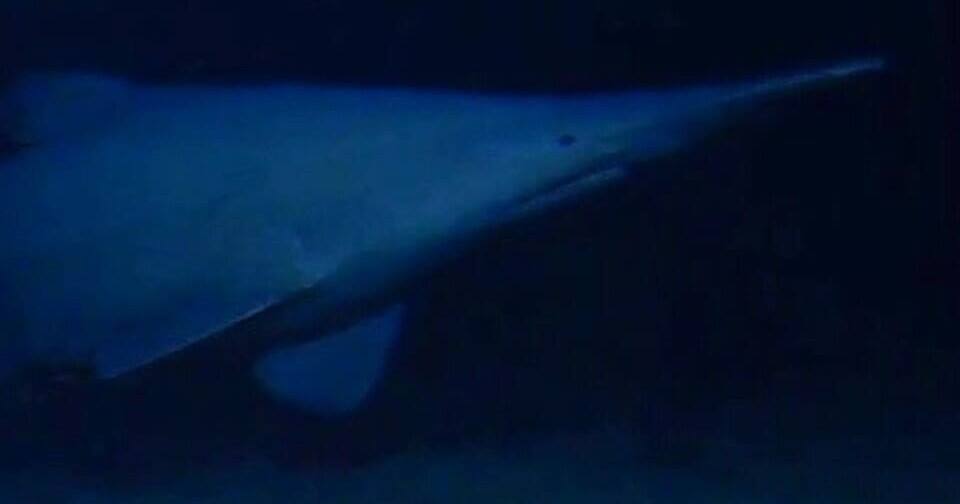
For years, goblin sharks were the stuff of deep-sea dead ends: specimens hauled up by accident, most of them already dead, and a species known more from anatomy diagrams than from behavior. Now ichthyologists have logged the first confirmed videos of goblin sharks in their natural habitat, with one filmed in the central Pacific at 1,237 meters in 2019 and another spotted in the southwest Pacific at a record 1,997 meters in 2024.
The new observations, published in the Journal of Fish Biology, do more than add a few rare clips to the archive. They push the known range of Mitsukurina owstoni farther across the Pacific and deeper than researchers had expected, and they give a better clue to why a shark with a retractable jaw and a long, flattened snout has spent so much of its life out of sight. In deep-sea biology, that usually means one thing: we have been underestimating both where a species lives and how far it can roam.
Two goblin shark sightings 5 years apart
The first encounter came during a 2019 expedition near Kingman Reef, Palmyra Atoll, and Jarvis Island in the central Pacific. On July 4, a remotely operated vehicle surveyed the slopes of an unnamed seamount northeast of Jarvis and recorded a solitary male goblin shark moving beside the machine for 25 seconds. Researchers estimated the animal at 343 centimeters long and 51.5 years old.
The second sighting happened in 2024 during work in the Tonga Trench. From August to October, scientists deployed 104 baited camera rigs across depths ranging from 854 to 10,755 meters. On August 9, a lone female goblin shark appeared at 1,997 meters and stayed in view for 50 seconds before returning 10 minutes later for another 101 seconds. It ignored the bait both times, which is probably rude if you are the bait, but very useful if you are trying to learn how the animal behaves.
What makes goblin sharks so unusual
Goblin sharks are among the strangest living sharks, and the only surviving member of the family Mitsukurinidae. They typically measure 2.5 to 4 meters long, though they may grow to more than 6 meters, and they are known for a long, flattened rostrum and jaws that shoot forward with impressive speed. They live on continental shelves, in submarine canyons, and on seamount slopes across the Indian, Pacific, and Atlantic oceans, usually between 100 and 1,300 meters.
That depth range now looks conservative. The new record from 1,997 meters is not just a goblin shark milestone; it is also a depth record for the entire order Lamniformes, which includes the species. Deep-sea records are often broken quietly, but this one matters because it comes from direct observation rather than a lucky haul in a trawl net.
Why the deep Pacific matters
Before these videos, goblin sharks were mostly known from accidental catches, with only a few individuals ever kept alive for short periods in aquariums. A pair caught in 2008 and 2011 was later released into shallow water, where divers recorded their feeding behavior, but that was not the same thing as seeing the species where it actually lives. The new footage closes part of that gap and suggests the shark’s Pacific range is broader than documented for decades.
- Central Pacific sighting: 1,237 meters, 2019
- Southwest Pacific sighting: 1,997 meters, 2024
- Deepest confirmed record for goblin sharks and Lamniformes
Deep-sea work tends to reward patience rather than spectacle, but it also keeps rewriting the map. The next question is whether more camera systems on seamounts and trench edges will turn goblin sharks from an almost mythical oddity into a species with a much clearer, and probably larger, oceanic footprint.