• 2 min read
Federated learning could reshape private language models
A Pusan National University review links federated and reinforcement learning to more private, adaptive and deployable language models.
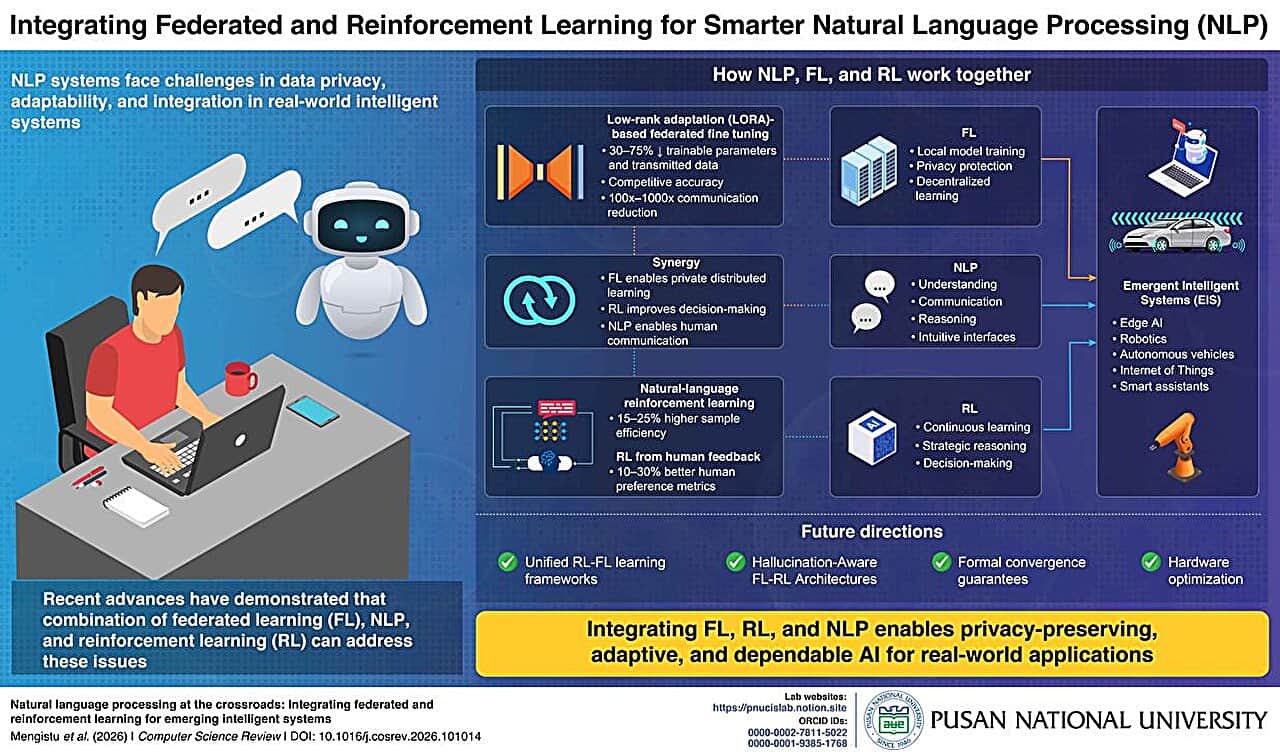
Image: TechXplore
A review from Pusan National University argues that natural language processing (NLP), federated learning (FL) and reinforcement learning (RL) should be treated as three interdependent pillars for building more private, adaptable and deployable intelligent systems.
Modern language models power chatbots, virtual assistants and translation tools, but they still struggle with privacy, changing environments and operation on resource-constrained devices. The review, led by Taewoon Kim and Tesfahunegn Minwuyelet Mengistu of the university’s Department of Information Convergence Engineering, examines how FL and RL could address those constraints. It was published in Computer Science Review.
“Today’s language models are caught in a privacy–adaptability–deployability trilemma. We show that this trilemma is now breakable, and we offer the first unified taxonomy for combining NLP, federated learning, and reinforcement learning that is absent in previous works.”
Federated learning reduces data exposure
Federated learning keeps sensitive data on local devices or within organizations. Instead of sending raw information to a central server, participants train models locally and share model updates, helping protect privacy, support regulatory compliance and reduce communication costs.
The review highlights Low-Rank Adaptation (LoRA)-based federated learning as an efficient approach to fine-tuning large language models. Compared with conventional methods, the authors report:

Recommended reading
Recursive Superintelligence signs $410 million AWS deal
- Up to 100-fold lower communication costs
- 30%–75% reductions in transmitted data and trainable parameters
Reinforcement learning, especially reinforcement learning from human feedback (RLHF), improves language models through feedback. The studies reviewed report 15%–25% higher sample efficiency and 10%–30% gains in human preference scores when language and reinforcement learning are combined.
The authors propose a six-dimensional taxonomy for integrating NLP, FL and RL, while measuring trade-offs among privacy, communication efficiency and model performance. They also note that federated and reinforcement learning can either contribute to or reduce hallucinations through different mechanisms, making system design critical.
“The most immediate applications lie wherever data is too sensitive to move yet too valuable to ignore. Hospitals could privately train clinical language models on sensitive patient notes. At home, language models can run entirely on local hardware. Moreover, finance, law, and defense can utilize offline domain-specific models. Importantly, this would make privacy a structural property of AI systems, redistributing who gets to build AI.”
Potential applications include health care, robotics, autonomous vehicles and Internet of Things devices. The researchers also point to private clinical models, locally operated home assistants, and offline systems for finance, law and defense.
The paper is titled “Natural language processing at the crossroads: Integrating federated and reinforcement learning for emerging intelligent systems,” published in Computer Science Review in 2026. DOI: 10.1016/j.cosrev.2026.101014.
AI Editor
Ava covers the rapidly evolving world of artificial intelligence, from foundational models and research labs to the real-world economics of intelligence. With a background in computational linguistics, she cuts through the hype to find out what actually works. She firmly believes that benchmarks are just marketing until reproduced in the wild.
via TechXplore