

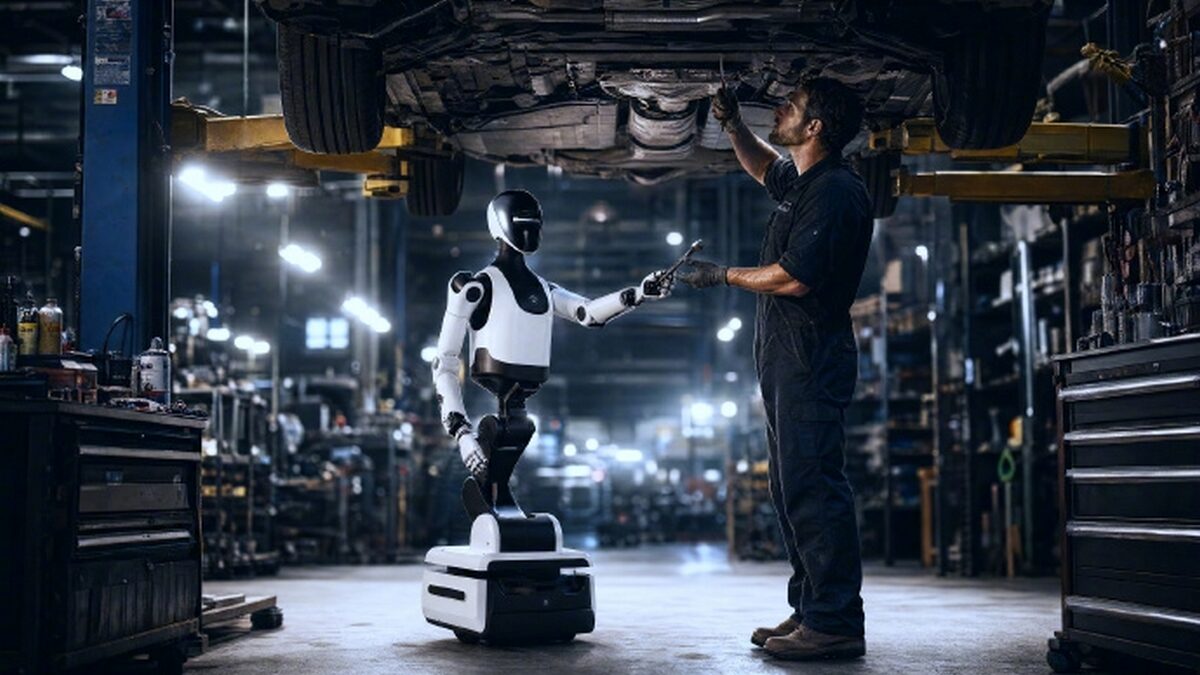
Faraday Future has started taking orders in the US for Faber, a wheeled industrial robot line the company says is its first EAI humanoid-style system available for direct purchase and delivery. The range is built for factories, utilities, and data-heavy sites, where a robot that can move around on wheels is often more useful than one trying to cosplay as a human.
The Faber family comes in three versions, each tuned for a different job. That split is telling: instead of one do-everything machine, Faraday Future is betting on specialization, which is usually how robotics products move from demo stage to actual deployments.
Faber U, Faber T and Faber S
Faber U is the most advanced model in the lineup. It uses Faraday Future’s Thor chip, two LiDAR systems, and multiple cameras to read its surroundings, with the main emphasis on autonomous navigation and obstacle avoidance. That makes it the obvious candidate for large, complicated industrial sites where routes change and people, machines, and hazards all share the same space.
Faber T is aimed at inspection work, especially in power plants and data centers. Those are exactly the sort of places that reward remote operation and punish mistakes, so a robot that can take on risky checks without sending in a person has an easy pitch.
Faber S takes a different tack, with a robot arm that reaches farther than the others. Faraday Future says it can collect data about equipment conditions and the surrounding environment at the same time, which should make later analysis easier for industrial customers that already drown in sensor output.
Why the US rollout matters
The bigger story here is not the naming gimmick, though ”Faber” does mean ”master.” It is that industrial robotics is becoming less about lab-bound prototypes and more about packaged products with clearly defined jobs, especially in the US, where companies want something they can order rather than merely admire on a stage.
That also puts Faraday Future in a crowded race. Industrial robotics is already full of strong incumbents and aggressive startups, so the company will need more than a clever chassis and a fresh chip to win real contracts. What matters now is whether these robots can actually show up, work safely, and justify the purchase order.
What buyers will look at next
- Autonomy in crowded industrial spaces
- Inspection performance in power plants and data centers
- Whether the robot arm in Faber S adds real value beyond extra reach
If Faraday Future can prove the robots are durable and easy to deploy, Faber could become a practical foothold in enterprise automation. If not, it risks joining the long line of robotics announcements that sounded sharper than the field results.