

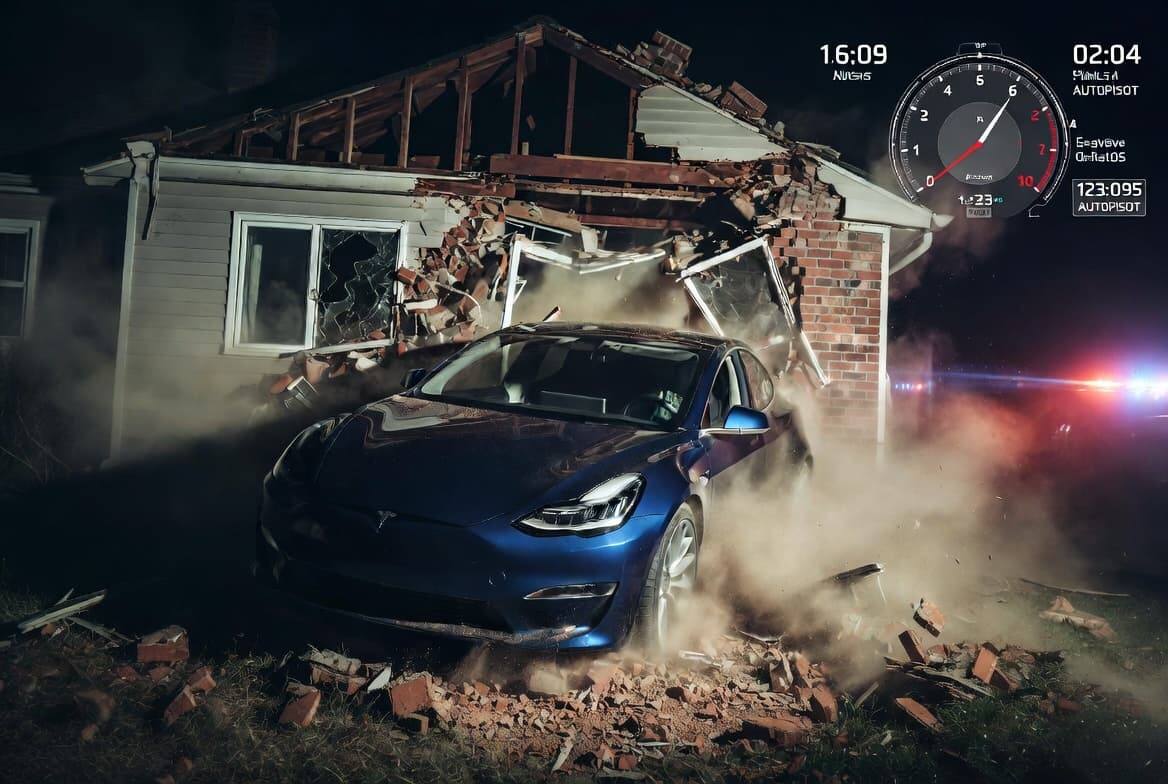
Tesla says a fatal crash in Katy, Texas, was caused by the driver, not its Full Self-Driving system. The company’s telemetry from the June 19 incident shows the accelerator was pushed to 100%, which disabled FSD, and the car then hit 117 km/h in a residential area before slamming through a brick wall and killing a 76-year-old woman inside the home.
That is the opposite of the first wave of reporting that blamed Tesla’s driver-assistance software. Tesla’s telemetry also points to the driver holding the accelerator fully down, which shifts the focus back to the person behind the wheel rather than the system in the car.
What Tesla says the telemetry shows
Ashok Elluswamy, Tesla’s head of AI, said the onboard data indicates FSD was not active at the moment of impact. According to the company, the driver held the accelerator fully down even after the crash, which is the kind of detail that makes the car look less like a runaway robot and more like a very fast, very bad decision.
- Crash date: June 19, 2026
- Location: Katy, Texas
- Reported speed: 117 km/h
- FSD status: not active at the time, according to Tesla
Why the Tesla crash will draw more scrutiny
The National Highway Traffic Safety Administration and local authorities are still investigating, and that matters because Tesla has spent years defending its driver-assistance stack against accusations that marketing and reality sometimes drift apart. Automakers from Mercedes-Benz to GM have pushed similar systems, but Tesla’s naming and branding have made every serious crash feel like a test case.
For now, Tesla’s position is simple: the software was not driving, the pedal was floored, and the vehicle was traveling far too fast for a neighborhood street. If the logs hold up, the company gets a cleaner defense than many expected. If they don’t, this story gets a lot uglier very quickly.