

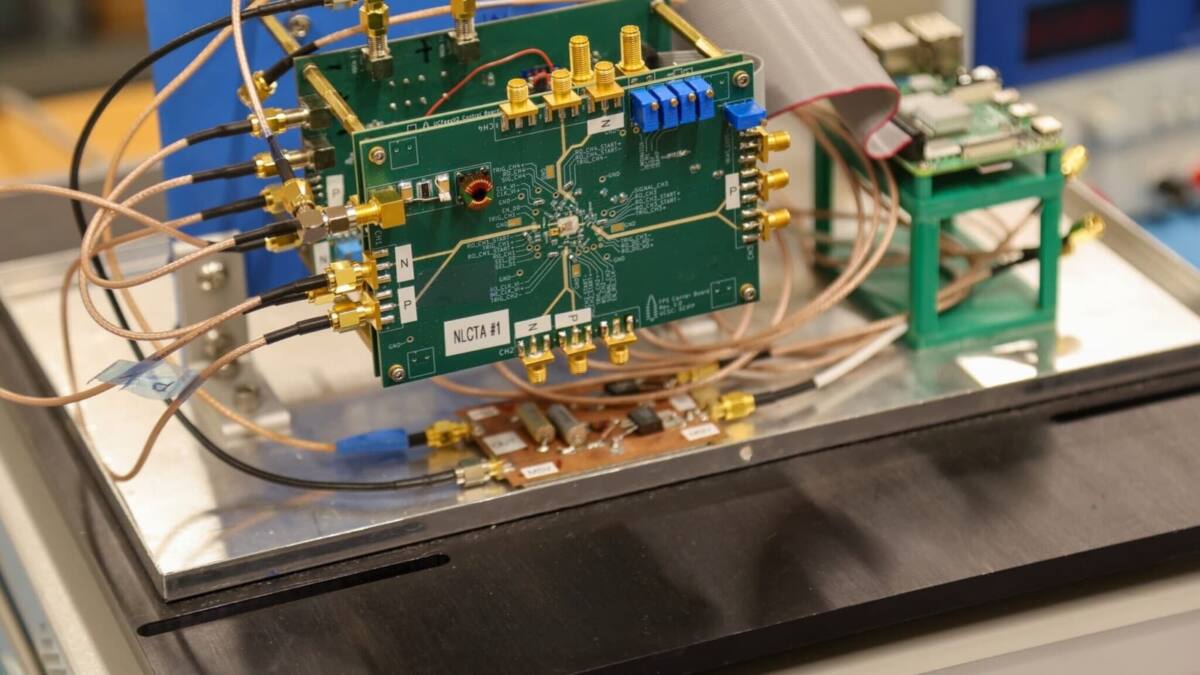
A team of physicists in California and New Mexico has tested a compact beam-diagnostics system that can keep up with the next generation of particle accelerators, where pulses may arrive at a rate of up to a million per second. That is a brutal jump from the roughly 120 pulses per second handled by today’s systems, and it is exactly the kind of gap that leaves older detectors looking antique before they have even worn out.
The diamond detector combines diamond sensors, a custom chip, and fast readout electronics in a package designed for machines such as the Linac Coherent Light Source II at SLAC. The bigger story is not just the sensor material, which is hardy enough for harsh beam environments, but the signal-processing architecture that lets the system keep extracting useful data when events start piling up at absurd speed.
How the diamond detector was built
Instead of relying on off-the-shelf electronics, the team built its own integrated circuit to read the diamond sensor’s response under extreme event rates. That matters because the bottleneck in these systems is often not the detector itself, but how quickly the signal can be captured, cleaned up, and turned into something a control room can actually use.
The first full tests took place at SLAC last year, where the detector was exposed to electron bunches lasting about one picosecond. It handled thousands of pulses across different accelerator settings and produced a stable signal lasting about one-eighth of a nanosecond, with measurements matching calculations closely and sensitivity coming in even better than expected.
A small detector aimed at very large machines
That performance is useful now, but the real pressure comes later. Future accelerators may push beyond a million pulses per second, and at that scale even tiny measurement errors start eating into the data needed to understand beam behavior. The project’s appeal is that it is compact enough to be treated as a practical tool, not a bespoke lab trophy.
- Diamond sensors for beam detection in harsh conditions
- A custom microchip for fast signal readout
- Stable operation during tests at SLAC
- Designed with a plug-and-play format in mind
A second chip version is due for testing in 2026
A second version of the system is already being developed with a new chip generation and is due for testing in 2026. If that works, the technology could move beyond accelerator diagnostics into high-energy physics, powerful laser systems, and fusion research – all places where timing is measured in the tiny slivers of time that make ordinary electronics sweat.