

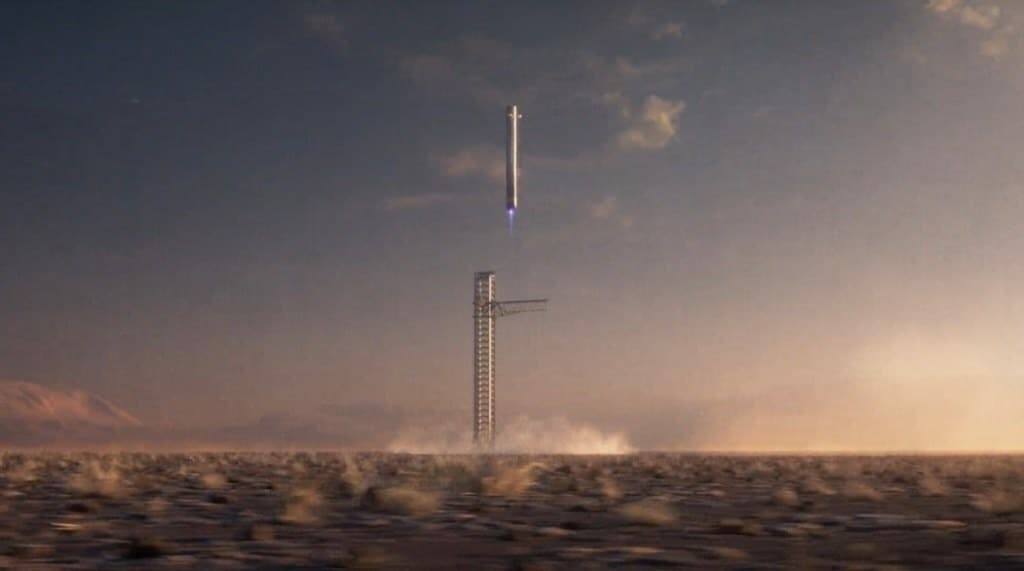
Chinese launch startup Cosmoleap has secured 500 million yuan, or about $73 million, to build Yueqian-1, a reusable rocket that aims to borrow SpaceX-style tower recovery and reach first launch in 2027. That is an aggressive timetable for a company that only began operating in March 2024, but it fits a wider Chinese push to turn reusable rocketry from a prestige project into a production line.
The Cosmoleap funding round closed on 29 April and will support development of the rocket, plus what Cosmoleap says will be China’s first booster-return system using a service tower fitted with ”chopsticks”-style manipulators. If that sounds familiar, it should: SpaceX has made the concept famous, and everyone else now has to prove they can make it work without the same head start, engineering scars, and launch cadence.
Yueqian-1 specifications and payload
Yueqian-1, also called Leap-1, is designed to stand 70 meters tall with a diameter of 4.2 meters. Cosmoleap says it should lift up to 18,000 kg to low Earth orbit in an expendable configuration, or 12,000 kg if the first stage is recovered. That places it in the serious mid-to-heavy lift bracket, not the hobbyist end of the market where big promises usually go to die.
- Length: 70 meters
- Diameter: 4.2 meters
- Payload to low Earth orbit: up to 18,000 kg expendable
- Payload to low Earth orbit: up to 12,000 kg with first-stage recovery
Engines and testing plans
The rocket will use in-house Qingyu-11 methane-oxygen engines with variable thrust, each rated in the 100-ton thrust class. Cosmoleap had previously tested YF-209 engines rated at 80 tons, built by state-owned CASC for commercial use, so the startup is not starting from a blank sheet of paper. Even so, moving from engine tests to a full reusable launcher is where many Chinese private-space companies discover that metal and ambition do not automatically get along.
Cosmoleap plans final assembly and testing in the second half of 2026. That leaves very little room before the target 2027 debut, especially as competitors such as Landspace, Space Pioneer, and CAS Space are already deeper into trials of reusable medium-lift vehicles. CASC is also expected to launch Long March 10B in May, while Landspace is preparing a second flight of the steel Zhuque-3.
China’s reusable rocket race is getting crowded
The bigger story is not Cosmoleap alone, but the speed at which China’s commercial launch sector is trying to close the gap with SpaceX’s reuse model. Beijing is backing the field because it needs far higher launch rates for broadband megaconstellations and orbital data centres, and that puts pressure on every serious entrant to move beyond paper designs and into hardware that can actually land, catch, and fly again. Cosmoleap has funding now; the harder part is making the tower catch look easy the first time it matters.