

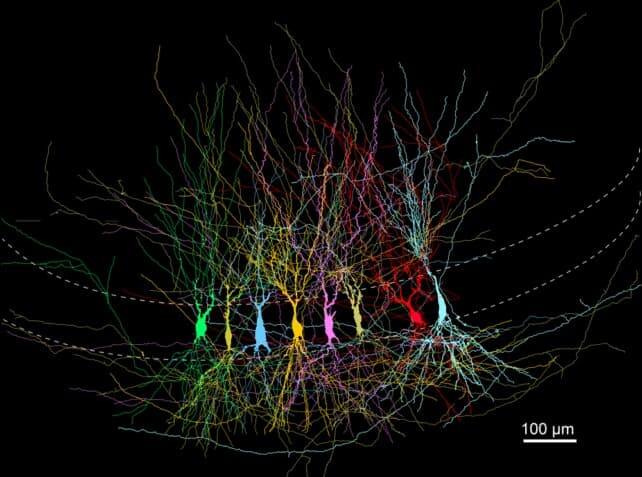
The brain does not start life as a tidy blank slate. New research on hippocampal wiring suggests the opposite: early neural networks are overloaded with connections, and development turns that noisy mess into a sharper memory machine by pruning away the excess.
That matters because it flips a familiar intuition on its head. Instead of memory getting better simply by adding more wiring, the system appears to improve by becoming more selective. In biology, as in computing, too much input is not a virtue if it all fires at once.
How the hippocampus gets reshaped
The study, led by Peter Jonas, used multicellular patch-clamp recordings to inspect the CA3 region of the hippocampus, an area central to episodic memory, spatial orientation, and sharp-wave generation. Researchers mapped activity across as many as eight living neurons at a time, following the same microcircuit from newborn mice to adults.
At the start, neurons were surprisingly trigger-happy: even weak signals could set them off, and the network was crowded with local, messy links. Over time, the system shed redundant connections in a process known as pruning, leaving behind a sparser structure that was harder to excite and far better at filtering signal from noise.
The result is a memory circuit that behaves less like a pile of wires and more like a tuned instrument. A mature network needs coordinated input from several sources to fire, which helps explain how the brain can reconstruct a face, a place, or an event from a fragment instead of reacting to every stray spark.
Why less wiring helps memory
Computational models backed up the lab work: moving from dense chaos to sparse connectivity improved both storage and retrieval of information. That is a neat reminder that the brain’s strength is not raw volume, but compression, filtering, and pattern completion. Silicon engineers have been preaching some version of this for years; the nervous system seems to have gotten there first.
The practical angle is bigger than a neuroscience curiosity. A clearer picture of healthy memory circuits could help researchers study neurodivergent conditions and age-related change, where wiring and signal selection may drift in different directions. The open question now is how precisely this pruning program is guided, and whether therapies can nudge it without breaking the very balance that makes memory work.