

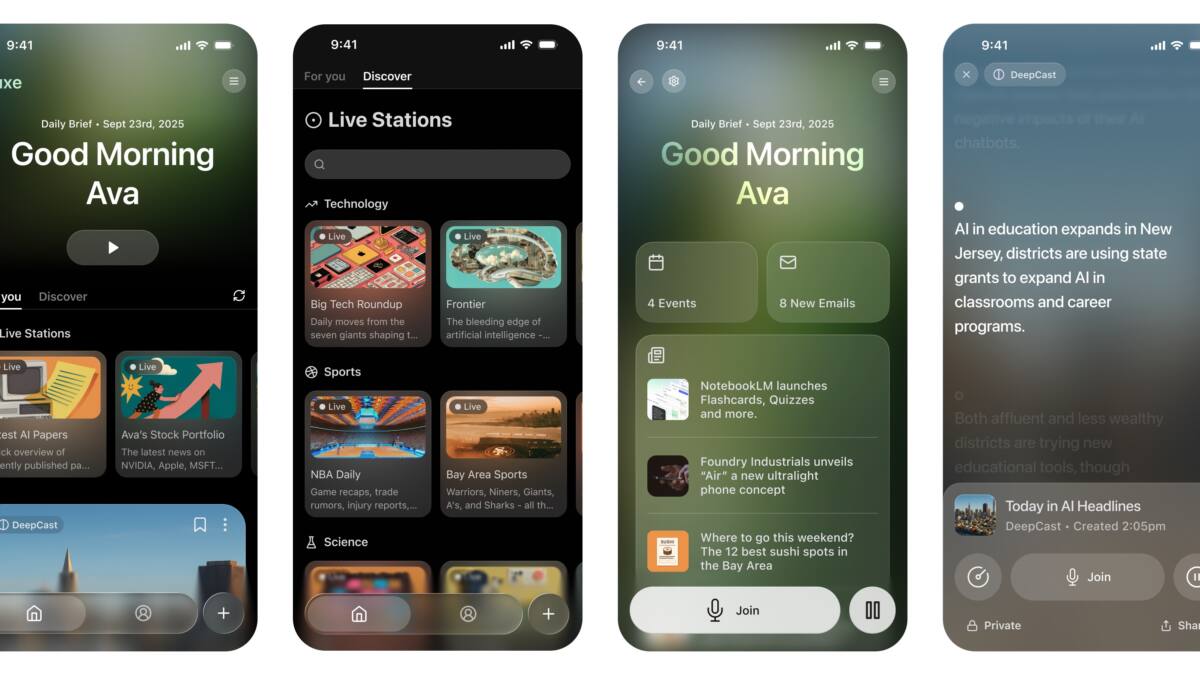
Huxe, the AI audio app built by former NotebookLM developers, is shutting down just one day after Spotify introduced a similar personal podcast feature. The startup is pulling the app from the App Store and Play Store, and existing installs will keep working for seven days before all user data is deleted.
The company did not give a detailed reason for the shutdown, but the timing says plenty on its own. Huxe was trying to sell a neat piece of AI magic: type in a topic, get back a podcast or a podcast series. In a market where bigger platforms can copy that trick fast, neat is not always enough.
What Huxe was trying to sell
Huxe launched in late 2024, founded by former Google employees Raiza Martin, Jason Spielman, and Stephen Hughes. The startup raised $4.6 million from Conviction, Genius Ventures, Figma CEO Dylan Field, and Google Research chief scientist Jeff Dean.
Its pitch was straightforward: turn prompts into audio lessons, summaries, or podcast-style episodes. That idea first gained traction through NotebookLM, then quickly spread outward as other companies moved to add their own versions. Spotify, Adobe, Amazon, ElevenLabs, Meta, and Google have all shipped some flavor of AI-generated audio content, which leaves a small startup fighting for attention in a crowd of much louder names.
- Huxe offered prompt-to-podcast and podcast-series generation
- The app will stay usable for seven days after removal
- All user data will then be deleted
Spotify’s personal podcast feature
Spotify’s new personal podcast feature gives users a similar way to generate audio from a topic, which makes Huxe’s shutdown look even more like a case of a larger platform absorbing a startup’s core idea. For users, the practical answer is simple: if you want Huxe’s app itself, it will only remain available for seven days after removal before the data deletion process starts.
There is a familiar pattern here. Startups prove that a consumer AI feature works, then a larger company folds the same idea into an existing product with a built-in audience. That is especially rough for single-purpose apps, because once the feature becomes good enough inside Spotify, Google, or Adobe, many users stop asking for a separate download.
Audio is not the only battleground. As AI models get better at converting text to audio and audio to video, the line between product and feature gets thinner. Other startups, including Oboe and Sun, are still trying to build an audience around audio learning, but they now have to prove something bigger than novelty: durable usage, habit, and a reason to pay.
Who gets squeezed next
Huxe’s shutdown is a warning for any app built around one flashy conversion trick. If the core experience can be bundled into a major platform in a matter of months, the startup has to move fast into workflow, community, or something harder to clone. Otherwise the product turns into a demo, and demos do not usually make great subscription businesses.
The bigger question is whether this kind of AI audio generation becomes a standalone category at all, or just another feature buried inside the apps people already use. Right now, the larger companies seem to be betting that distribution beats specialization. Huxe just became another data point in their favor.