

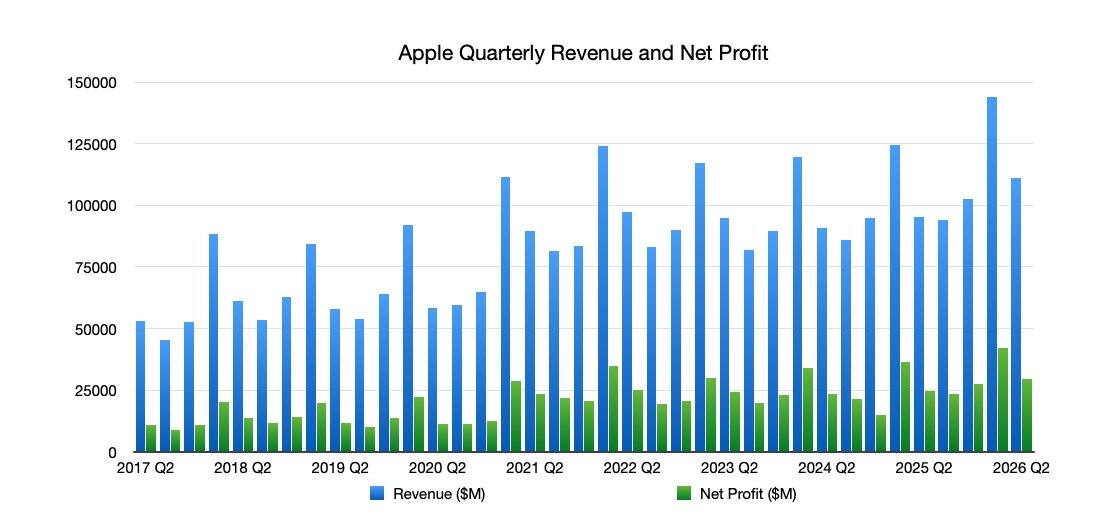
Apple’s Q2 revenue hit $111.2 billion, a new second-quarter record and comfortably above the $109.69 billion consensus tracked on April 29. The result came as Apple continued to post stronger iPhone demand, steady Services growth, and broad gains across nearly every major product line.
The timing gives the Apple Q2 revenue report extra weight. This is usually a quieter stretch for Apple after the holiday-heavy first quarter, yet the company still managed to deliver a record result while keeping cash generation strong and margins resilient.
Apple’s Q2 revenue by product line
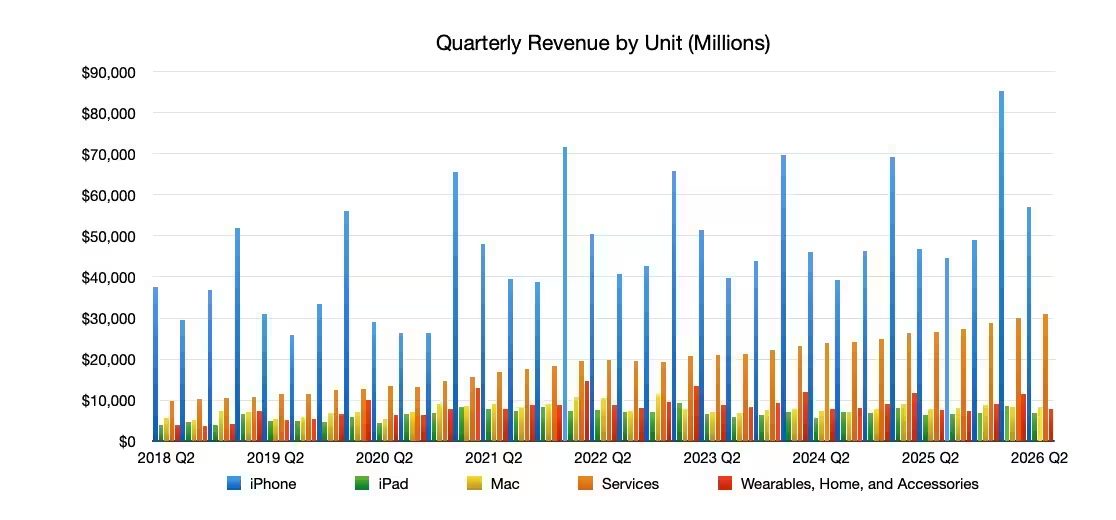
The biggest engine was still iPhone, which brought in $56.99 billion, up from $46.84 billion in the prior-year quarter. Services climbed from $26.6 billion to $30.9 billion, which is exactly the sort of recurring revenue Apple likes to point at when hardware cycles get lumpy. Mac rose to $8.4 billion from $7.95 billion, iPad to $6.9 billion from $5.56 billion, and Wearables, Home, and Accessories ticked up to $7.9 billion from $7.5 billion.
That performance matters because Apple is still navigating rising memory and component costs without showing visible strain in the quarter’s numbers. Competitors with slimmer margins have been far more vocal about supply pressure, so Apple’s ability to keep revenue climbing while shielding itself from that bill is a useful reminder of how much pricing power it still has.
The March quarter records Apple wants to talk about
Tim Cook said Apple saw double-digit growth across every geographic segment, and that iPhone reached a March quarter revenue record thanks to demand for iPhone 17. CFO Kevan Parekh added that Apple set new March quarter records for operating cash flow and EPS. The company also said its installed base reached a new all-time high, which is corporate-speak, yes, but also the kind of metric that underpins Services growth for years.
John Ternus inherits the hard part
The real conversation, though, is not the earnings beat. It is the CEO handoff later in 2026: on September 1, Tim Cook becomes executive chairman and hardware chief John Ternus takes over. That is the sort of transition investors like to pretend is orderly right up until the first strategic pivot lands.
Ternus will not join the usual analyst call, but his name will hang over it anyway. The questions are obvious: how Apple responds to component inflation, how aggressively it pushes AI, and whether the next phase looks like continuity or a mild reset with better haircuts. Apple likes to present these moments as smooth succession; analysts usually treat them as an invitation to ask what gets protected and what gets changed next.