

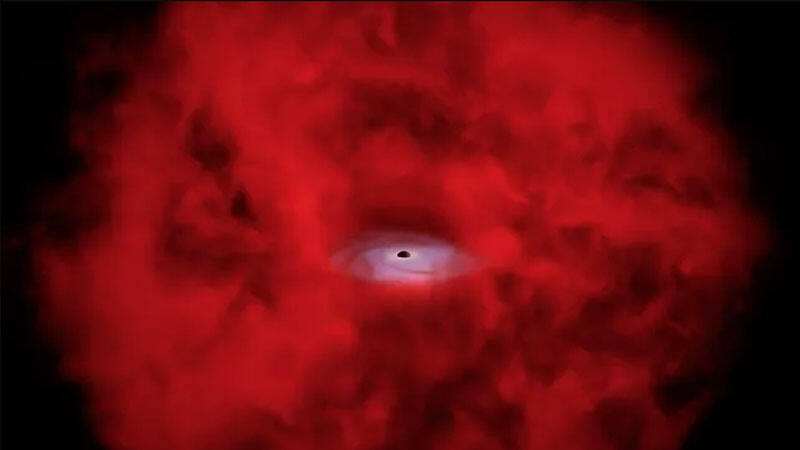
The James Webb Space Telescope has helped crack one of the strangest puzzles in the early universe: the so-called ”little red dots.” By matching Webb data with archival X-ray observations from Chandra, astronomers have found a red dot whose position lines up with X-ray emission, a strong sign that at least some of these compact objects may hide growing black holes.
That matters because these little red dots, seen more than 12 billion years ago, are tiny by galaxy standards – only a few hundred light-years across – yet stubbornly bright and oddly cold-looking. For years, they looked like a class of cosmic misfits. Now they are starting to look like an early stage in the formation of the monster black holes that sit in galaxy centers today, including the one in the Milky Way.
Webb source matches an X-ray signal
The object, catalogued as 3DHST-AEGIS-12014, was found in the same spot as an X-ray source buried in Chandra archives. The signal resembles the kind of emission astronomers associate with quasars, where a supermassive black hole powers a blazing core. Until now, little red dots had not been tied to X-rays at all, which is why this detection stands out.
A neat wrinkle: the X-ray source appears in old Chandra data but not in more recent observations. The simplest explanation is that the black hole is still wrapped in dense gas, and only occasionally do ”windows” open as the material shifts. That would make the object a transitional phase, not a finished product.
Why little red dots look so strange
Little red dots got their nickname for a reason. Their red color and the water vapor detected in them point to relatively low temperatures, which do not fit the usual picture of ordinary stars or active galactic nuclei. If a black hole is really buried inside, much of the hot radiation could be trapped by the surrounding envelope, hiding the engine while still letting a bit of X-ray light leak out.
- Object type: compact early-universe source
- Age: more than 12 billion years
- Size: no more than several hundred light-years
- Key clue: X-ray emission matching a Chandra source
A vote for the big-black-hole-first idea
The real fight here is over how supermassive black holes got so big so fast. One camp says they grew from small stellar-mass black holes. The other says they began with the direct collapse of a giant gas cloud, then fed aggressively from the top down. This new candidate leans toward the second scenario, because a buried black hole inside a gas cocoon is exactly the kind of seed that could grow quickly in the young universe.
If that interpretation holds, astronomers may have caught one of the clearest early signs yet that the universe was building giant black holes faster, and in a messier way, than the tidy textbook version suggests. The next question is obvious: how many more of these red dots are secretly X-ray sources waiting in the archives?