

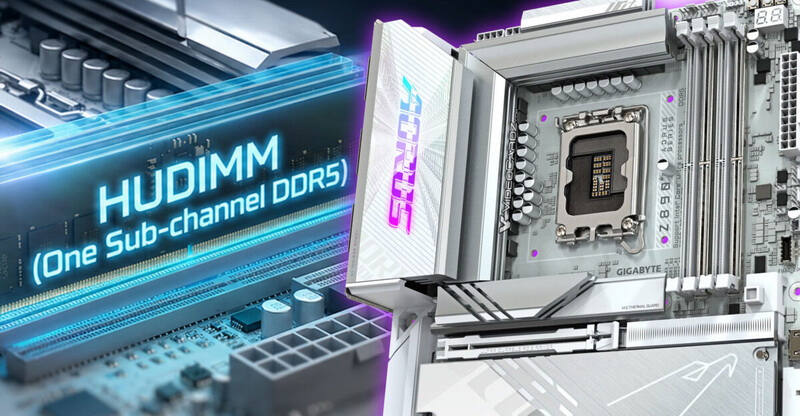
Gigabyte has pushed BIOS updates for motherboards based on Intel 800-, 700-, and 600-series chipsets, bringing support for HUDIMM memory, which the company brands as One Sub-channel DDR5. The move widens the reach of a lower-cost DDR5 design that trims DRAM count inside each module, at the expense of capacity and bandwidth per stick.
HUDIMM uses a single 32-bit DDR5 sub-channel instead of the two 32-bit sub-channels found in standard DDR5 UDIMMs. That trade-off is the whole point: less silicon in each module, and a path to cheaper memory kits while the price of full-fat DDR5 sticks stays stubbornly high.
Automatic detection and mixed memory setups
Gigabyte says the new BIOS handles HUDIMM automatically, detecting and initializing the modules without extra setup from the user. The update is also compatible with mixed configurations, so an 8GB HUDIMM can be paired with a 16GB UDIMM to create a 24GB system.
In that mixed setup, the company says three DDR5 sub-channels can be used. That is a neat workaround for buyers who want more RAM without replacing every stick, and it also makes the format easier to adopt on older Intel platforms, including boards that can run Alder Lake processors.
Support across Gigabyte, Asus, MSI, and ASRock boards
Gigabyte is not arriving alone. ASRock, which helped develop the standard with TeamGroup, had already announced support for Intel 800-, 700-, and 600-series motherboards. Asus has started rolling out beta BIOS support on Intel Z890, B860, Q870, and H810 boards, and MSI has also signaled support on selected models.
Put together, that means the big motherboard vendors are now aligned behind HUDIMM on Intel platforms. The format still comes with a performance compromise, but for buyers staring at expensive DDR5 pricing, a slightly smaller slice of memory is looking better than no slice at all.
What HUDIMM changes for buyers
- Supported on Intel 800-, 700- and 600-series motherboards
- Works with standard DDR5 UDIMMs in mixed configurations
- 8GB HUDIMM + 16GB UDIMM can produce 24GB total memory
- BIOS update enables automatic detection and initialization
The next question is whether HUDIMM becomes a real mainstream option or stays a clever stopgap for price-sensitive builds. If motherboard vendors keep shipping BIOS support and memory makers keep the modules flowing, it has a decent shot at becoming the ugly little compromise PC builders learn to live with.