

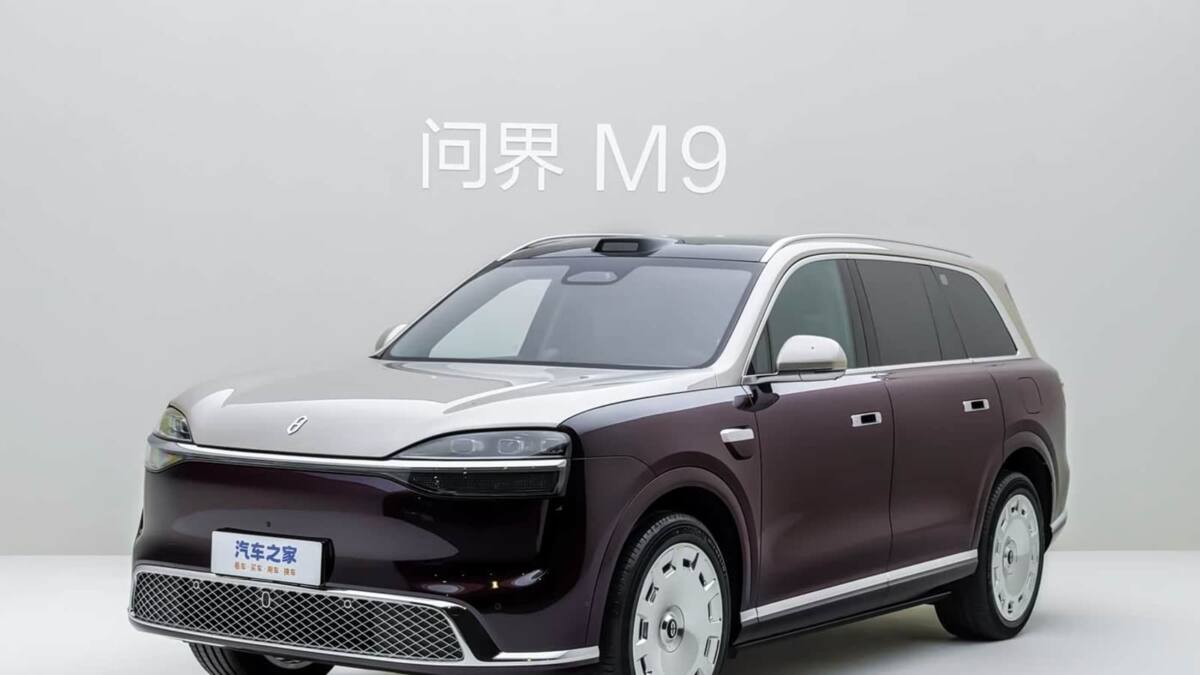
Huawei-backed Aito has pulled the wraps off the updated M9, and the message is pretty blunt: this is a luxury full-size SUV built to show off everything a Chinese premium EV can cram in, from six lidars and 40 sensors to a 32-inch laser TV and a 7.1-liter fridge. Prices start at 479,800 yuan and rise to 649,800 yuan for the top Ultimate Extended Edition, which puts it squarely in Mercedes-Maybach GLS territory on ambition, if not on badge prestige.
The new Aito M9 is bigger than before, gets more than 140 changes, and leans hard into the current Chinese playbook: more screens, more driver assistance hardware, more comfort gimmicks, more power. That formula has been working well for domestic brands while legacy luxury names scramble to answer with software, range, and rear-seat theater of their own.
Aito M9 prices and versions
The lineup is straightforward. The Max+ starts at 479,800 yuan, the Ultra costs 539,800 yuan, and the range-topping Ultimate Extended Edition reaches 649,800 yuan. For buyers, that spread buys not just trim levels but a visibly more extravagant spec sheet, including a unique black-and-gold exterior on the flagship and electrically deployed side steps.
- Max+: 479,800 yuan
- Ultra: 539,800 yuan
- Ultimate Extended Edition: 649,800 yuan
Interior screens, seats, and rear-seat toys
Inside, the M9 is clearly designed to keep passengers busy. The dashboard carries a 10.25-inch instrument display, two 17.2-inch 3.4K screens, and an augmented-reality head-up display, all running HarmonyOS Cockpit 4.0. Seating can be arranged in five- or six-seat layouts, with heated, ventilated, and massaging Hysoft seats, plus a graphene-based foot-heating system that sounds more like a lab demo than car equipment.
Rear passengers get the real flex: a 32-inch pull-out laser TV, a 7.1-liter refrigerator, gesture control, and a Huawei Sound Ultimate system with 39 speakers and 2,920 watts. The Ultimate trim pushes that speaker count to 43. Western rivals have rear-seat entertainment, sure, but this is the kind of spec sheet that makes traditional luxury product planners reach for aspirin.
Six lidars and 903 hp
The hardware under the skin is just as aggressive. Aito says the M9 uses 40 sensors, including six lidars of different types, five 4D millimeter-wave radars, 11 cameras, and six exterior microphones, all feeding Huawei’s Qiankun ADS 5 driver-assistance system. The car is also capable of autonomous driving on highways and in cities, along with self-parking.
There are two main powertrain directions. The range-extended version pairs a 1.5-liter turbo engine acting as a generator with dual motors producing 676 hp, while the Ultimate Extended Edition adds a 2.0-liter engine and three motors for a combined 903 hp. A pure electric version is also offered with dual motors making 530 hp and a 100 kWh battery, good for up to 605 km of range.
- REEV dual-motor version: 676 hp
- Ultimate Extended Edition: 903 hp
- BEV dual-motor version: 530 hp
- BEV range: up to 605 km
Range, size, and chassis tech
The extended-range versions use 52 kWh or 75 kWh batteries and claim 225 km or 290 km of electric range, with total range stretching to 1,310-1,414 km. The standard body measures 5,230 x 2,000 x 1,800 mm with a 3,130 mm wheelbase, while the Ultimate Extended Edition stretches to 5,303 mm in length and 3,200 mm between the axles. That is enough to make it feel less like a crossover and more like a rolling private lounge.
Underneath, the M9 rides on a fully independent suspension with double wishbones up front, a multi-link rear setup, air suspension, adaptive dampers, rear-wheel steering of up to +/- 8 degrees, and active stabilization. Huawei’s DATS 3.0S system can also read the road surface and adjust the chassis for mud, snow, sand, or a ford before the driver has time to complain.
Aito M9 vs Maybach-style luxury SUVs
The real competition here is not just against other Chinese electric SUVs, but against imported luxury flagships that have built their reputation on quiet cabins and rear-seat indulgence. Aito is betting that Chinese buyers now want those same badges of comfort with a lot more tech, a lot more automation, and a lot less patience for old-school prestige.
The question now is whether Huawei and Aito can keep this spec-sheet arms race meaningful as rivals copy the formula. For the moment, the M9 looks like a reminder that in China, luxury increasingly means screens, sensors, and horsepower in one oversized package.