

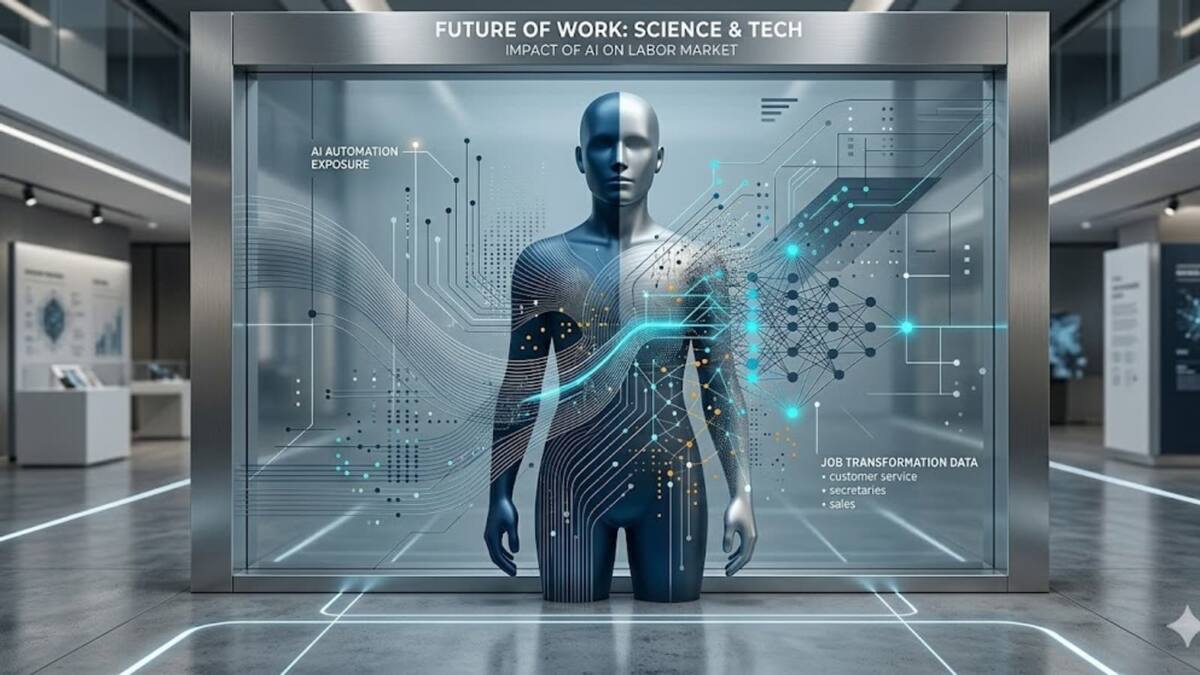
The first hard numbers are in, and they are not flattering for workers in roles that software can already mimic. U.S. employment fell in a basket of 18 AI-exposed occupations between May 2024 and May 2025, even as the broader labor market kept growing, a sign that automation is no longer just a boardroom talking point but a hiring problem.
The pattern is not evenly spread. Customer support, general office work, and sales are taking the hit first, while healthcare-adjacent roles are still being lifted by separate demand. That split matters: AI is not ”replacing jobs” in the abstract so much as chewing through repetitive, text-heavy work where companies can measure savings quickly and cut headcount without much drama.
Customer support and office jobs are losing ground
Among the most exposed occupations, customer support operators saw the steepest annual drop, down 130,180 jobs, or 4.8%. General secretaries and administrative assistants lost 31,030 positions, while wholesale and industrial sales representatives fell by 28,670. Those are exactly the kinds of jobs where chatbots, document tools, and automated workflows do the boring parts first – and then start making the human part look optional.
The official numbers also show that the 18 vulnerable professions collectively cover about 10 million jobs, so even a mild percentage decline points to a sizable labor shift. Strip out medical secretaries and assistants, whose numbers are being boosted by healthcare demand, and employment in the remaining 17 occupations fell 1.6% for a second straight year.
AI-era declines look sharper in clerical and media work
Looking back to May 2022, the picture becomes harsher. Credit investigators, verifiers, and clerks recorded the biggest drop in the vulnerable group, down 26.2%. Broadcasters and radio DJs fell 20.8%, while sales managers were down 13.2%. That is a useful reminder that AI adoption rarely arrives as a dramatic switch; it usually shows up as fewer openings, slower backfilling, and more tasks pushed onto fewer people.
Goldman Sachs has reached a similar conclusion from a different angle, finding that vacancies in high-risk jobs have already slipped below pre-pandemic levels. By contrast, roles where AI is used as a helper rather than a replacement have seen slower declines, which is corporate speak for ”we can still justify hiring humans here.”
The jobs list is only the first warning sign
Officials are right to be cautious about overreading one year of data. The 18 occupations singled out by the Bureau of Labor Statistics are not a final list, just the clearest early examples of work where AI pressure was already expected. But that restraint cuts both ways: if this is the opening act, companies that treat AI purely as a productivity toy may soon find they have built a very efficient way to hire fewer people.
The next question is whether the same pattern spreads beyond clerical and support work into more white-collar roles that still look safe on paper. If the last few hiring cycles are any guide, the answer will depend less on what AI can technically do and more on how fast finance chiefs decide they like the savings.