

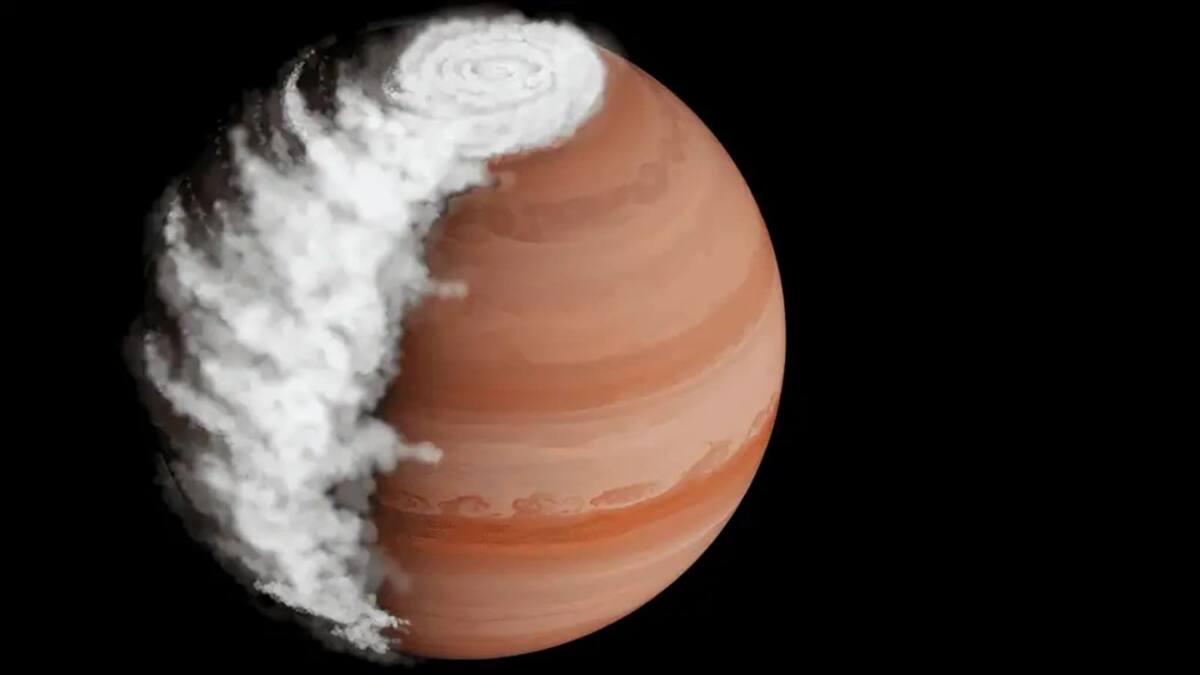
NASA’s James Webb Space Telescope has spotted something awkward for neat textbook models: the hot Jupiter WASP-94A b appears to have two distinct atmospheric zones, with the morning side and evening side showing very different chemistry and cloud cover. The planet sits about 600 light years from Earth, and the new transit spectroscopy data suggest its atmosphere is not a smooth shell at all, but a lopsided system shaped by brutal heat, winds, and clouds.
That matters because hot Jupiters are already strange by design. These gas giants orbit so close to their stars that they are tidally locked, leaving one side baked in permanent daylight and the other in permanent night. Webb’s data now show that even the daylit hemisphere can split into two very different regimes, which is exactly the kind of complication exoplanet models love to pretend does not exist.
Morning side clouds, evening side clarity
The clearest divide is between the planet’s ”morning” and ”evening” sides. On the morning side, the spectrum looks muted and poor in molecular signatures, which points to thick mineral clouds blocking a view of deeper layers. On the evening side, the spectrum is much cleaner, and water vapor plus other chemical markers stand out far more clearly.
That kind of contrast is a headache for anyone trying to average a planet into a single atmospheric profile. It also explains why the same world can look chemically bland in one part of the transit and much richer in another. In exoplanet science, geography now apparently matters even when the geography is mostly gas.
Three-dimensional models point to moving clouds
To make sense of the observations, researchers built three-dimensional climate models. Their picture is straightforward and a little brutal: clouds form on the colder night side, get pushed by strong winds toward the morning hemisphere, then begin to evaporate as they move into hotter regions.
The temperature difference between the two sides reaches about 126 °C, enough to change both the state of cloud particles and the chemistry of the upper atmosphere. The result is a spectrum that depends on where you are looking across the planet, not just on the planet as a whole.
What Webb changes for hot Jupiter studies
The broader lesson is uncomfortable for simpler atmospheric models: exoplanet atmospheres may be far less uniform than scientists once hoped. That is not just a technical footnote. It affects how researchers read water signatures, cloud properties, and temperature structure across a growing list of worlds that Webb can now dissect in detail.
Expect this to sharpen the split between planets that are merely exotic and planets that are dynamically messy enough to defeat one-size-fits-all models. WASP-94A b may end up being a reminder that the first clean-looking spectrum from a distant world is often hiding a much messier story underneath.