• 2 min read
Acoustic waves give AI hardware separate memory controls
A Sungkyunkwan University device uses electrical signals for long-term memory and acoustic waves to reset short-term signals.
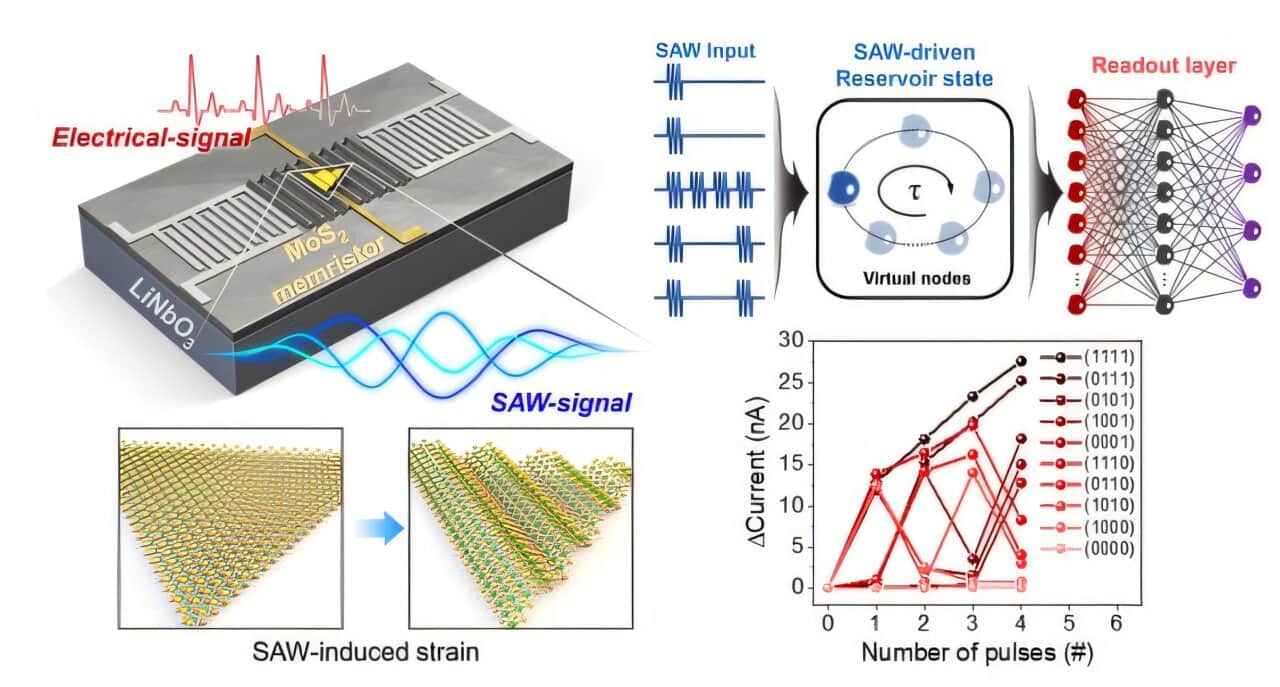
Image: TechXplore
A research team at Sungkyunkwan University has developed an artificial synapse that separates long-term and short-term memory inside a single device. The system uses electrical signals to store long-term information and surface acoustic waves (SAWs) to control short-term signals.
Led by Professor Il Jeon of the university’s Department of Nano Engineering and the Sungkyunkwan Advanced Institute of Nanotechnology, the team included Dr. Sihyeok Kim and Dr. Jang Woo Lee. Their findings were published in ACS Nano.
How acoustic waves control short-term memory
The device combines a monolayer molybdenum disulfide (MoS₂) memristor with a SAW device on one platform. Electrical stimulation establishes long-term memory, while noncontact acoustic waves selectively create or erase short-term memory without disturbing the stored state.
By adjusting SAW intensity, pulse width and interval, the researchers reproduced biological short-term synaptic plasticity. They also repeatedly manipulated short-term memory without damaging the electrically stored long-term memory—a limitation of conventional memristors, which typically use electrical stimulation for both functions.
Recommended reading
Federated learning could reshape private language models
96.1% accuracy in reservoir computing
The device operated without performance degradation after more than 10,000 seconds of repeated use. In a reservoir-computing character-classification task, it achieved 96.1% recognition accuracy.
“This study is significant because it presents a new neuromorphic device platform in which electrically stored long-term memory can be preserved while only short-term memory is selectively controlled in a noncontact manner using surface acoustic waves.”
The researchers said they plan to combine large-area integration with SAW control across a wide range of frequencies to develop more energy-efficient AI semiconductors and neuromorphic computing systems.
The paper, “Surface Acoustic Wave-Guided Reconfigurable Memristor,” was published in ACS Nano in 2026. DOI: 10.1021/acsnano.6c01958.
AI Editor
Ava covers the rapidly evolving world of artificial intelligence, from foundational models and research labs to the real-world economics of intelligence. With a background in computational linguistics, she cuts through the hype to find out what actually works. She firmly believes that benchmarks are just marketing until reproduced in the wild.
via TechXplore