

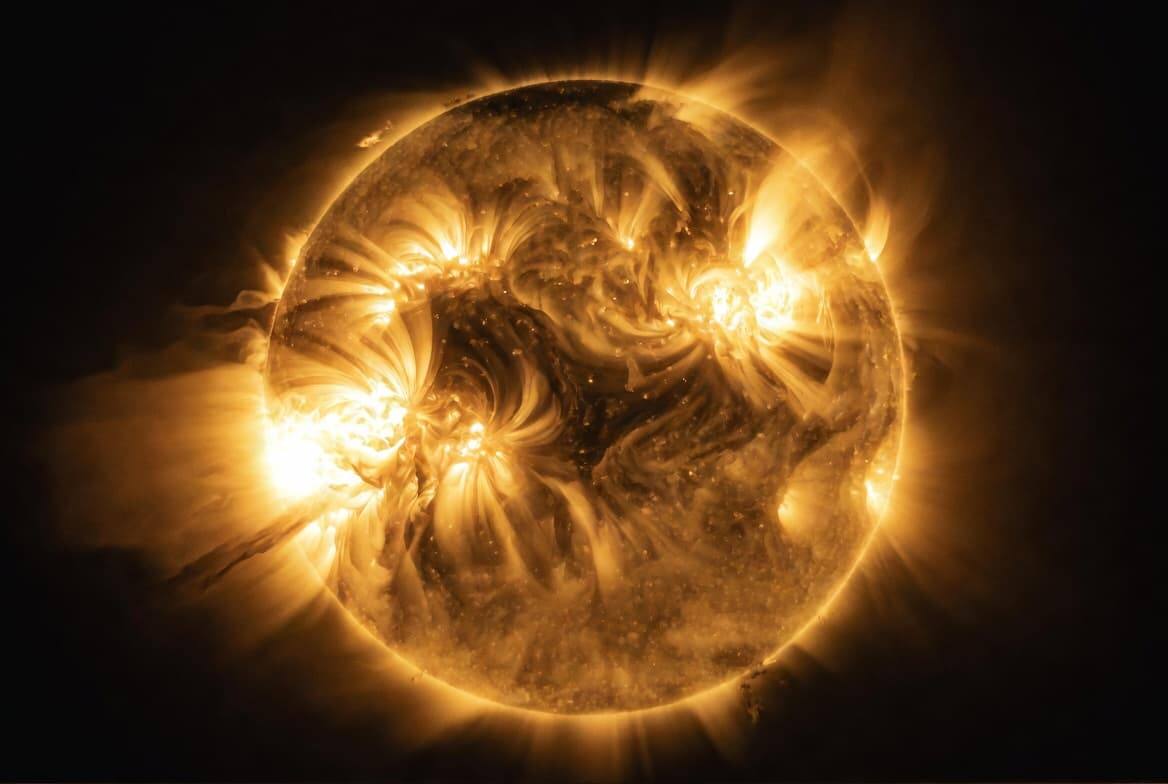
Two solar active regions are now facing Earth, while a giant sunspot near the center of the Sun appears to be breaking apart. That setup does not guarantee trouble, but it does raise the odds of stronger solar flares in the coming days, especially if one of those regions produces an X-class burst.
What makes this worth watching is the combination, not any single patch of magnetism. A large sunspot complex is shedding fragments into the solar plasma, and at the same time, two active zones are visible on the Earth-facing side of the Sun. That overlap is exactly how seemingly benign solar weather can turn into a space-weather headache for satellites, radio systems, and occasionally power grids.
A giant sunspot is falling apart
Observers say the central spot was once comparable in scale to Jupiter, which is a dramatic way of saying this was not a minor blemish. It is now fragmenting and sinking back into the solar plasma, a sign that the structure is losing coherence rather than building toward something cleaner and more stable.
That does not automatically make the Sun safer. Decaying active regions can still carry plenty of magnetic energy, and broken-up sunspots often leave behind a messy field configuration that can keep producing eruptions.
Two active regions now face Earth
On the Earth-facing side of the Sun, the lower of the two active zones is being described as the largest of the year in terms of size and energy potential. One of the regions sits north of the solar equator, underlining how widespread the current activity is across the visible disk.
So far, neither region has shown major flare activity. That is the calm part of the story, and it may not last. Solar forecasters will be watching for any jump in magnetic complexity, because an X-class flare from the wrong place would send charged particles directly toward Earth.
What an X-class solar flare would mean for Earth
- Two active zones are currently visible on the side of the Sun facing Earth.
- The lower region is described as the largest of the current year by scale and energy potential.
- A giant sunspot in the central area is fragmenting and fading into solar plasma.
- If an X-class flare erupts in the next few days, the resulting particle stream could head straight toward Earth.
There is a useful comparison here: earlier this year, sunspot group 4478 reached 825 millionths of the visible solar hemisphere and became the second-largest since the start of the year. That gives a sense of just how large the current features are, and why the Sun is once again reminding everyone that ”quiet” is a relative term.
The next question is whether these regions stay mostly dormant or start tightening their magnetic fields fast enough to produce a serious flare. If they do, Earth may get more than a pretty solar show.