

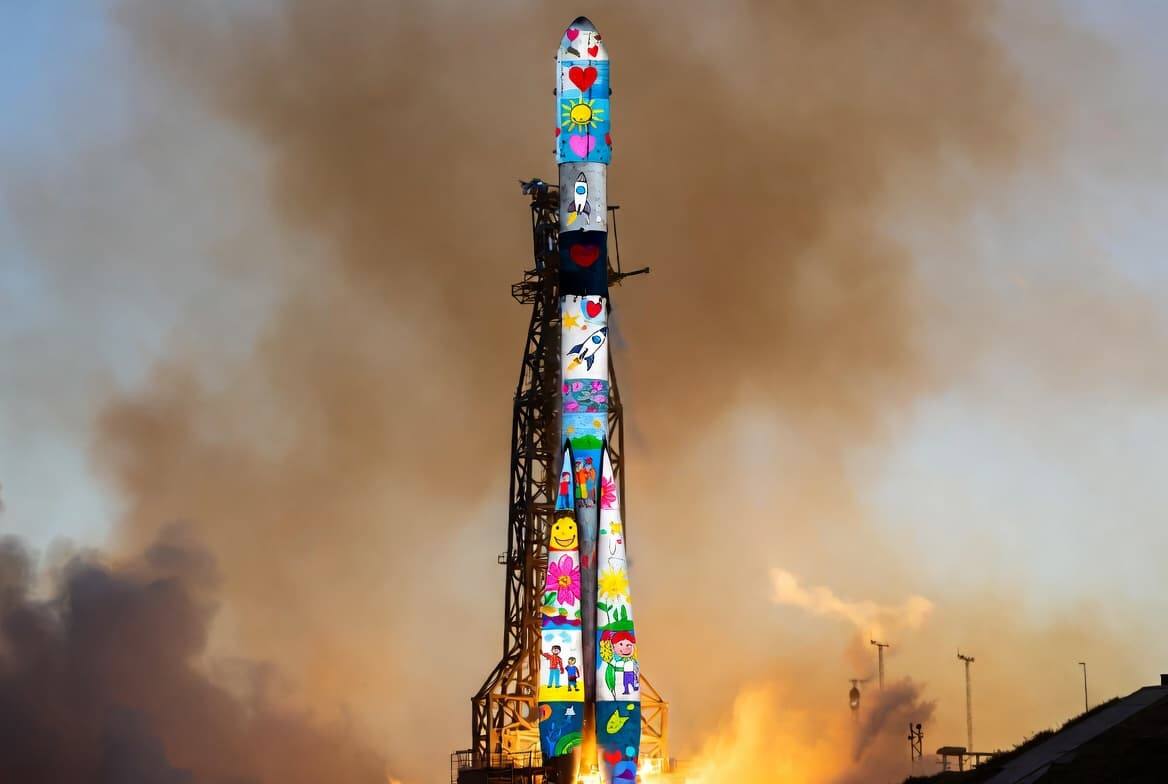
Dream Rocket II will fly from Baikonur on 14 July aboard a Russian Soyuz-2.1a rocket, carrying a collage made from drawings by children with cancer in El Salvador. The artwork will decorate the rocket’s body as part of an international charity project that turns a launch vehicle into a moving billboard for a cause.
The drawings were created during a workshop at the Aristides Maltez oncology hospital, where the children were asked to sketch their biggest dreams. Those individual pieces were later merged into one collective collage for the rocket’s exterior. The hospital also received a space photograph of El Salvador taken by Russian cosmonaut Sergey Kud-Sverchkov, a reminder that this is as much about outreach as it is about launch-day paint.
Dream Rocket II project in El Salvador
The project did not stop at the collage. Representatives from Brazil’s and Colombia’s space communities spoke to the children about space technology, future careers, and their own experience in the industry. Artist Agatha Souza also created a themed mural for the hospital, while the institution received tactile copies from the international ”Angels of the World” art project and more space-themed paintings.
That mix of art, education, and astronomy is becoming a familiar template for outreach projects around launches. Space agencies and private operators have learned that public attention is easier to win when a mission carries a human story, and charity branding gives that story a sharper edge than a standard press photo ever could.
Soyuz MS-29 crew cleared for the ISS mission
There is also the business of actually flying. The state commission has already declared the prime and backup crews for the crewed Soyuz MS-29 spacecraft fully ready for their upcoming flight to the International Space Station after checks at the Cosmonaut Training Center. That kind of sign-off is routine, but it matters: while the rocket gets the artwork, the crew gets the real job of making sure the mission works.
A Soyuz-2.1a launch with two audiences
For Baikonur, the launch will serve two audiences at once: space watchers tracking the mission itself and families in El Salvador seeing children’s drawings carried onto a rocket. Projects like this are not solving cancer or changing launch economics, but they do something the space sector is often bad at doing on its own – making the machinery feel human.
If the flight goes as planned, expect more programs to borrow the same formula: a standard mission wrapped in a local story, a charity angle, and a payload of soft power painted on the outside.