

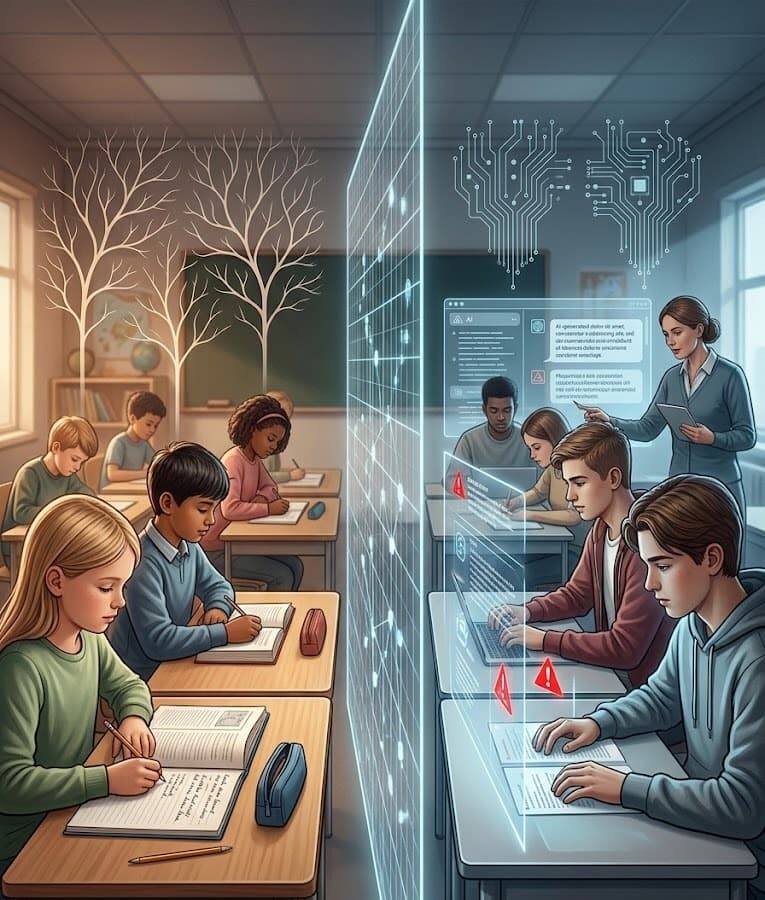
Norway is drawing a hard line around AI in schools: from late August, children in primary school aged 6-13 will be barred from using generative AI, while pupils aged 14-16 will only be allowed to use these tools under direct teacher supervision. Older students, 17-19, will be allowed to use AI as preparation for further study and work, turning Norway into one of Europe’s strictest test cases for age-based AI policy in education.
The move is less about banning technology than about sequence. Oslo is betting that reading, writing, and maths need to be built before a chatbot starts filling in the blanks, a view that echoes a broader argument now spreading through schools far beyond Scandinavia. The logic is simple enough: if software can do the thinking too early, students may never learn the slower, messier part that comes first.
A staged approach to AI in schools
Prime Minister Jonas Gahr Støre framed the decision as a way to avoid skipping essential stages of learning. That puts Norway in the camp of countries treating AI more like a regulated classroom tool than a universal default, and it is a sharper stance than the rush to bolt generative features onto everything from school platforms to homework apps.
- Ages 6-13: generative AI banned in primary school
- Ages 14-16: AI allowed only with direct teacher control
- Ages 17-19: AI allowed for preparation for education and work
Books are back in the school policy conversation
Norway is also preparing legal changes to strengthen the role of traditional teaching materials, including books, in school curricula. That may sound quaint in an era of instant summaries and AI tutors, but it lines up with a growing worry that digital convenience is quietly replacing the habits schools are supposed to teach, not just the answers students are supposed to produce.
The backdrop is not abstract. Research cited in the debate, including studies in the US, has raised concerns that heavy dependence on generative AI can weaken independent thinking, social communication, and information analysis. Norway has already shown a willingness to push against easy tech defaults: previous restrictions on smartphones in schools were linked in some studies with better average grades and fewer mental health referrals, especially among girls.
The global split over classroom AI
Elsewhere, the pressure is moving the other way. In the US, parents and teachers are pushing back against unrestricted AI in schools, and The New Yorker reported that community groups are seeking a moratorium on generative AI in New York classrooms. That leaves policymakers with an awkward choice: either treat AI as an educational accelerator, or slow it down long enough to make sure students still learn without it.
Norway has picked the slower route, at least for younger children. The open question is whether other education ministries will copy the age-gated model, or whether schools will keep lurching between caution and enthusiasm until the first generation raised alongside AI starts grading the experiment for everyone else.