

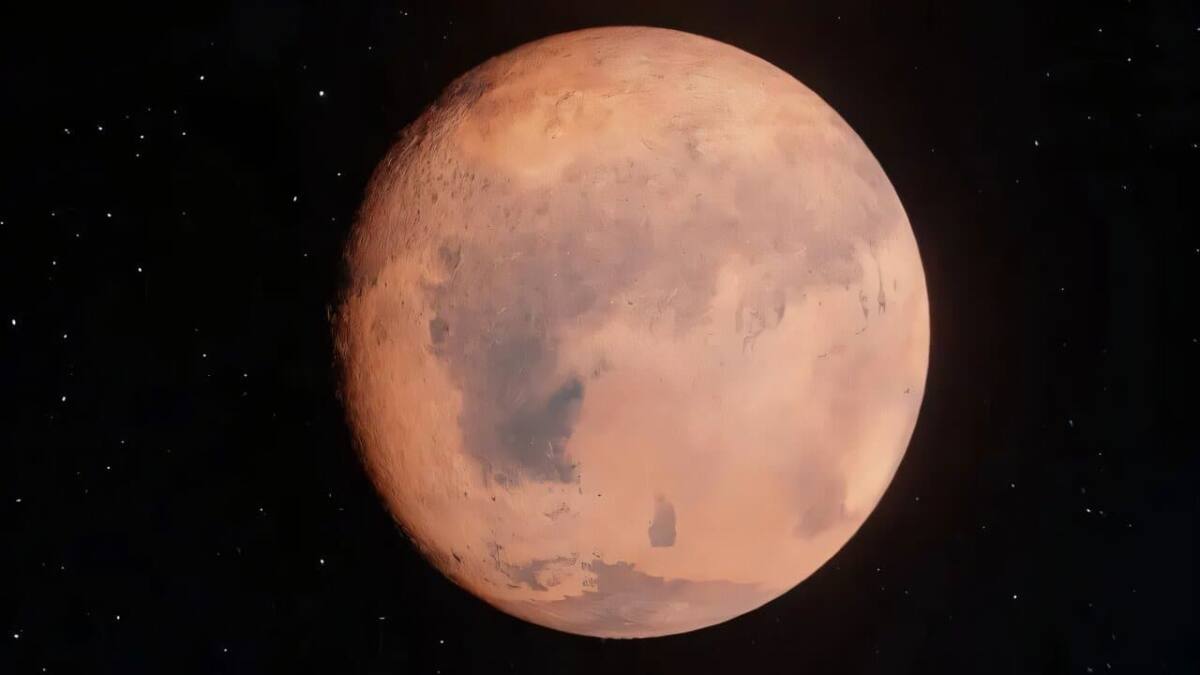
A fragment of a Martian meteorite has turned up something scientists did not expect: the first garnet ever identified in a Mars-origin sample, plus a previously unknown type of Martian rock. The find comes from NWA 8171, a meteorite kept in the Royal Ontario Museum collection, and it adds a small but awkward detail to the story of Mars: the planet has likely been more geologically rowdy than the neat textbook version suggests.
The analysis was published in Geochemical Perspectives Letters and led by an international team working with researchers from Brock University, the University of Portsmouth, the Royal Ontario Museum, and the University of Trieste. Garnet is common on Earth, where it usually forms under high temperatures and pressure, so finding it in a Martian sample points to either intense heating, powerful impact events, or both.
Why garnet matters on Mars
On Earth, garnet often grows during metamorphism, when rock is transformed deep underground by heat and pressure. That process is closely tied to plate tectonics, magma movement, and major impacts – all of which make the mineral a useful marker for violent geology. Mars does not have Earth-style plate tectonics, which is part of why this discovery is interesting: it suggests the red planet still had localized conditions capable of producing extreme pressure or strong heating.
The sample was first mistaken for pyroxene, a much more familiar mineral, before electron microscopy and laser spectroscopy showed the true structure. That kind of correction is exactly why old meteorite collections still matter; the rock has been sitting there, but the tools have finally caught up.
What could have formed it
The researchers say the garnet may have formed through metamorphism triggered by an asteroid impact, through magma rising inside Mars, or through a combination of the two. There is also a less convenient possibility: the mineral may have formed elsewhere and arrived on Mars inside another meteorite. To distinguish between those scenarios, scientists want oxygen isotope data, but that would require partially destroying the sample.
- Sample: NWA 8171
- New mineral finding: garnet
- Publication: Geochemical Perspectives Letters
- Main institutions: Brock University, University of Portsmouth, Royal Ontario Museum, University of Trieste
A small crystal with a big story
The big payoff here is not the crystal itself but what it implies: Mars may have experienced more complex internal evolution than scientists once assumed, including bursts of high-energy geological activity. The team also thinks the sample could be unique, which makes the usual temptation to test everything a bit of a problem. If this is the only known Martian rock with garnet, the next question is whether more of these hidden clues are waiting in plain sight inside museum drawers.