

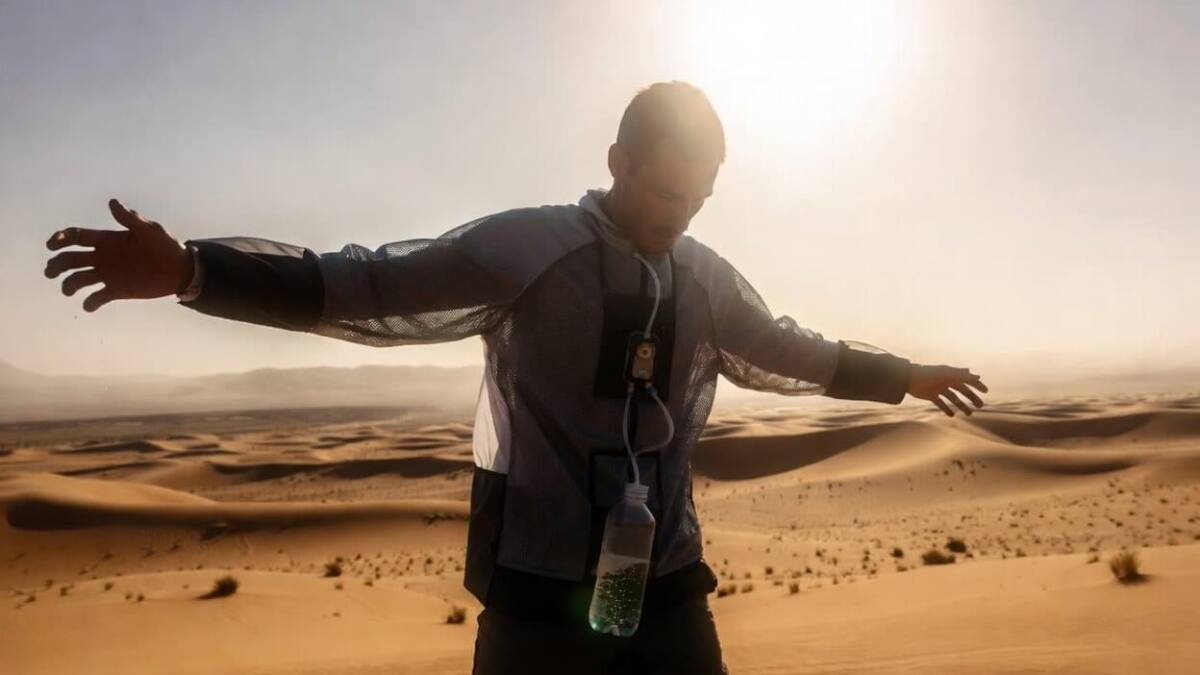
A jacket that makes drinking water sounds like a stunt, but researchers at the University of Texas at Austin have built a water-harvesting jacket that can pull moisture from the air and turn it into usable water. Depending on weather and humidity, the garment can produce 400 to 900 milliliters a day, which is enough to matter for hikers, rescue crews, farmers, and anyone working far from a reliable tap.
The basic trick is simple enough to explain and annoying enough to engineer: the fabric captures water vapor, the collected moisture moves into removable modules, and a compact foldable collector heats it so the vapor condenses into drinking water. In a world where atmospheric water harvesting is usually discussed as a lab demo, putting the system into clothing is the kind of practical move that separates a flashy prototype from something people might actually carry.
How the water-harvesting jacket works
The team says the jacket uses a special textile designed to trap moisture straight from the surrounding air. Once the water is gathered, it is stored in detachable modules before being heated and condensed into clean drinking water. That makes the design less like a sci-fi gadget and more like a portable version of a dehumidifier, except one that is worn rather than plugged into a wall.
- Daily output: 400 to 900 milliliters
- Collection method: moisture-absorbing fabric plus removable modules
- Final step: heat and condensation in a foldable collector
Atmospheric water harvesting is abundant, but hard to capture
The appeal is obvious: Earth’s atmosphere holds about 12,900 km3 of water vapor at any given moment, enough to fill millions of large reservoirs. The problem has never been scarcity in the sky. It is distribution. The moisture is spread thinly, and that makes harvesting it efficiently a much tougher engineering problem than the headline number suggests.
That is also why this project is getting attention beyond outdoor gear. The same research group has already shown an autonomous system that produced 1.3 liters of drinking water in both the dry Chihuahuan Desert in New Mexico and Austin’s wetter climate. The broader idea is straightforward: if atmospheric moisture can be captured reliably, it becomes a backup water source for places that can least afford to go without one.
Backpacks, tents, and emergency shelters
The jacket is only the first obvious application. The researchers are already looking at backpacks, tents, emergency shelters, and other field gear, which makes sense because those are the places where portable water generation is most valuable and where power access is often limited or nonexistent.
If the material survives the jump from prototype to mass production, the real winner may not be the jacket itself but the idea behind it: personal equipment that does a second job without asking the user to notice. That is the sort of quiet utility tech companies love to brag about after the fact, assuming they can manufacture it without turning the price tag into a joke.