

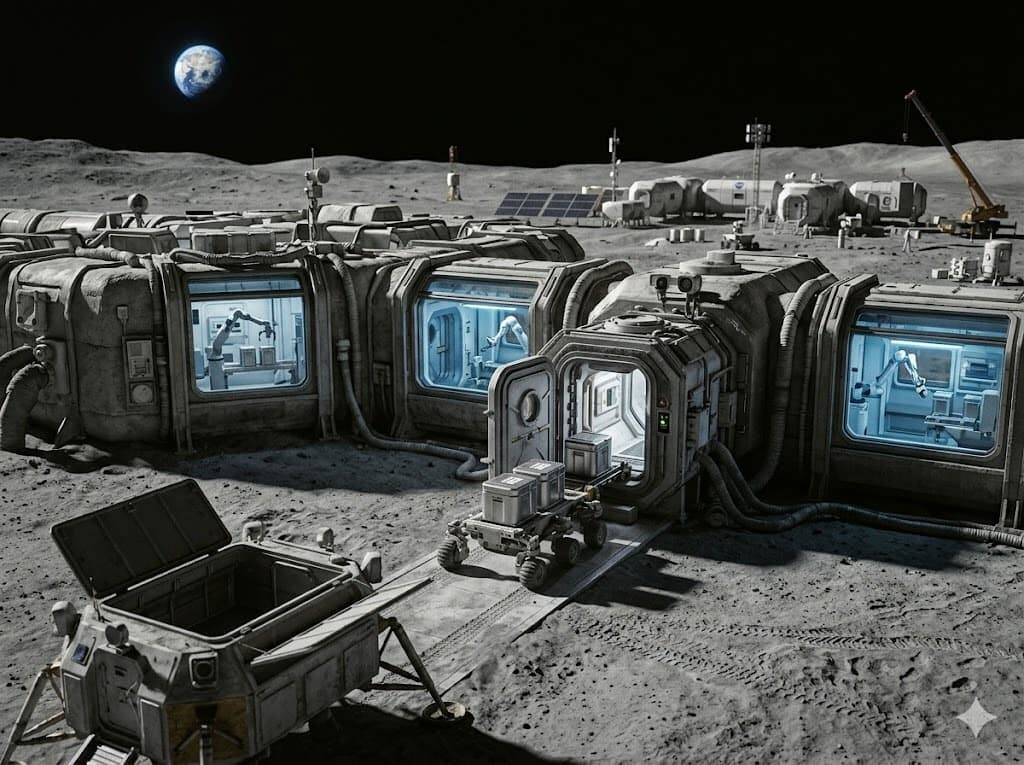
Scientists want to turn the Moon into something far less romantic than a flag-planting outpost: a biosecure quarantine hub for samples brought back from the Moon, Mars, and beyond. The idea is simple, if a little bleak – keep anything extraterrestrial out of Earth’s biosphere until it has been checked in an isolated facility that never lets humans touch the material directly.
The proposal appears in Ambio and comes from Frederick I. Moxley of Strategic Threat Analysis and Research Laboratories and Anthony Ricciardi of McGill University. Their pitch sits at the intersection of planetary science and old-fashioned risk management, and it arrives as both government and commercial missions are ramping up the pace of sample return. More missions mean more cargo, more handling, and more chances for a mistake – the sort of detail space agencies love to underestimate until the paperwork gets thick.
Why the Moon gets the quarantine job
Under their concept, a future NASA lunar base would include a biological isolation facility that works as a ”border filter” between space and Earth. All returned material would be processed by robotics inside that infrastructure, with no direct human contact. That is a much stricter posture than the usual laboratory biosecurity playbook, and the authors argue it is justified by one awkward unknown: no one can yet rule out life beyond Earth.
That uncertainty is the point. The authors compare the risk to biological invasions on Earth, where a single introduced species can disrupt an ecosystem for good. It is a fair comparison, and also a reminder that interplanetary contamination does not need a Hollywood monster to be a problem; a microscopic one would do nicely.
What could go wrong on the return trip
The paper highlights scenarios that are easy to imagine and annoying to prevent: an accident during sample return, or contamination of crew members who have already been exposed to an alien environment. The authors say even a tiny chance of that outcome demands infrastructure that blocks any material from entering Earth’s biosphere before analysis is complete.
Here is the larger trend behind the proposal. Sample-return science has become more ambitious, not less, and the private sector is pushing into the same territory that used to belong almost entirely to national agencies. That makes the question of where to do the risky part less academic than it sounds – especially if future missions bring back more diverse material from more places.
The case for a lunar biosecure facility
- Keep potentially hazardous samples off Earth until they are fully screened.
- Use robotic handling instead of direct human contact.
- Build the quarantine system on the Moon as an external filter for interplanetary research.
The authors’ final claim is blunt: the Moon could become Earth’s first line of biological defense for the next era of exploration. If that sounds extreme, remember that space agencies have already spent decades trying to avoid contaminating Mars on the way in; the argument here is that the return journey deserves the same paranoia, just one hop farther out.
The open question is whether anyone will pay to build such a facility before the first truly tricky sample comes back. If sample-return missions keep multiplying, the Moon may end up looking less like a destination and more like the planet-sized quarantine desk nobody wanted to staff.