

Divergent says the system also adds automatic metal powder feeding, temperature control, and built-in optical monitoring to keep print quality in check. That matters because the aerospace sector is famously allergic to guesswork, and not without reason.
A new Long Beach factory with 64 printers
The company plans to build a new plant in Long Beach of about 40,000 square meters, where dozens of Monolith One printers will form the core of future production lines. In Torrance, six systems are already running; over the next two years, Divergent wants to add 64 more at the new site.
Once fully ramped, the factory is expected to produce thousands of rocket engine housings and hundreds of thousands of metal parts for aviation, space, and defense hardware each year. That puts Divergent in direct step with a broader industry push: aerospace suppliers from Europe to the US have been racing to industrialize additive manufacturing, but few have tried to do it at this scale.
Why aerospace buyers care about the speed claim
Chief executive Lukas Chinger says the company’s digital manufacturing platform can cut lead times from months to weeks, and in some cases to just a few days. If that holds up under production demand, it is the sort of speed advantage that can beat conventional machining even before you start talking about inventory savings.
Divergent already works with Lockheed Martin, RTX, and CoAspire, which gives the company a credible customer list for a technology that still has to prove itself in large-scale industrial use. It also says the printers are assembled in the US with key components from American suppliers, a tidy sales point in an era when supply-chain resilience has become a boardroom obsession.
What comes next for metal printing
The real test is whether a fleet of giant printers can move from impressive demo to dependable production line without becoming a very expensive science project. If Divergent can keep quality high while churning out aerospace-grade parts at this pace, rivals will have to answer a blunt question: why build slow when you can print fast?
Divergent says the system also adds automatic metal powder feeding, temperature control, and built-in optical monitoring to keep print quality in check. That matters because the aerospace sector is famously allergic to guesswork, and not without reason.
A new Long Beach factory with 64 printers
The company plans to build a new plant in Long Beach of about 40,000 square meters, where dozens of Monolith One printers will form the core of future production lines. In Torrance, six systems are already running; over the next two years, Divergent wants to add 64 more at the new site.
Once fully ramped, the factory is expected to produce thousands of rocket engine housings and hundreds of thousands of metal parts for aviation, space, and defense hardware each year. That puts Divergent in direct step with a broader industry push: aerospace suppliers from Europe to the US have been racing to industrialize additive manufacturing, but few have tried to do it at this scale.
Why aerospace buyers care about the speed claim
Chief executive Lukas Chinger says the company’s digital manufacturing platform can cut lead times from months to weeks, and in some cases to just a few days. If that holds up under production demand, it is the sort of speed advantage that can beat conventional machining even before you start talking about inventory savings.
Divergent already works with Lockheed Martin, RTX, and CoAspire, which gives the company a credible customer list for a technology that still has to prove itself in large-scale industrial use. It also says the printers are assembled in the US with key components from American suppliers, a tidy sales point in an era when supply-chain resilience has become a boardroom obsession.
What comes next for metal printing
The real test is whether a fleet of giant printers can move from impressive demo to dependable production line without becoming a very expensive science project. If Divergent can keep quality high while churning out aerospace-grade parts at this pace, rivals will have to answer a blunt question: why build slow when you can print fast?
Divergent says the system also adds automatic metal powder feeding, temperature control, and built-in optical monitoring to keep print quality in check. That matters because the aerospace sector is famously allergic to guesswork, and not without reason.
A new Long Beach factory with 64 printers
The company plans to build a new plant in Long Beach of about 40,000 square meters, where dozens of Monolith One printers will form the core of future production lines. In Torrance, six systems are already running; over the next two years, Divergent wants to add 64 more at the new site.
Once fully ramped, the factory is expected to produce thousands of rocket engine housings and hundreds of thousands of metal parts for aviation, space, and defense hardware each year. That puts Divergent in direct step with a broader industry push: aerospace suppliers from Europe to the US have been racing to industrialize additive manufacturing, but few have tried to do it at this scale.
Why aerospace buyers care about the speed claim
Chief executive Lukas Chinger says the company’s digital manufacturing platform can cut lead times from months to weeks, and in some cases to just a few days. If that holds up under production demand, it is the sort of speed advantage that can beat conventional machining even before you start talking about inventory savings.
Divergent already works with Lockheed Martin, RTX, and CoAspire, which gives the company a credible customer list for a technology that still has to prove itself in large-scale industrial use. It also says the printers are assembled in the US with key components from American suppliers, a tidy sales point in an era when supply-chain resilience has become a boardroom obsession.
What comes next for metal printing
The real test is whether a fleet of giant printers can move from impressive demo to dependable production line without becoming a very expensive science project. If Divergent can keep quality high while churning out aerospace-grade parts at this pace, rivals will have to answer a blunt question: why build slow when you can print fast?
Divergent says the system also adds automatic metal powder feeding, temperature control, and built-in optical monitoring to keep print quality in check. That matters because the aerospace sector is famously allergic to guesswork, and not without reason.
A new Long Beach factory with 64 printers
The company plans to build a new plant in Long Beach of about 40,000 square meters, where dozens of Monolith One printers will form the core of future production lines. In Torrance, six systems are already running; over the next two years, Divergent wants to add 64 more at the new site.
Once fully ramped, the factory is expected to produce thousands of rocket engine housings and hundreds of thousands of metal parts for aviation, space, and defense hardware each year. That puts Divergent in direct step with a broader industry push: aerospace suppliers from Europe to the US have been racing to industrialize additive manufacturing, but few have tried to do it at this scale.
Why aerospace buyers care about the speed claim
Chief executive Lukas Chinger says the company’s digital manufacturing platform can cut lead times from months to weeks, and in some cases to just a few days. If that holds up under production demand, it is the sort of speed advantage that can beat conventional machining even before you start talking about inventory savings.
Divergent already works with Lockheed Martin, RTX, and CoAspire, which gives the company a credible customer list for a technology that still has to prove itself in large-scale industrial use. It also says the printers are assembled in the US with key components from American suppliers, a tidy sales point in an era when supply-chain resilience has become a boardroom obsession.
What comes next for metal printing
The real test is whether a fleet of giant printers can move from impressive demo to dependable production line without becoming a very expensive science project. If Divergent can keep quality high while churning out aerospace-grade parts at this pace, rivals will have to answer a blunt question: why build slow when you can print fast?
- 12 lasers
- 24 kW total power
- More than eight meters tall
- Works with aluminium, steel, titanium, and nickel alloys
Divergent says the system also adds automatic metal powder feeding, temperature control, and built-in optical monitoring to keep print quality in check. That matters because the aerospace sector is famously allergic to guesswork, and not without reason.
A new Long Beach factory with 64 printers
The company plans to build a new plant in Long Beach of about 40,000 square meters, where dozens of Monolith One printers will form the core of future production lines. In Torrance, six systems are already running; over the next two years, Divergent wants to add 64 more at the new site.
Once fully ramped, the factory is expected to produce thousands of rocket engine housings and hundreds of thousands of metal parts for aviation, space, and defense hardware each year. That puts Divergent in direct step with a broader industry push: aerospace suppliers from Europe to the US have been racing to industrialize additive manufacturing, but few have tried to do it at this scale.
Why aerospace buyers care about the speed claim
Chief executive Lukas Chinger says the company’s digital manufacturing platform can cut lead times from months to weeks, and in some cases to just a few days. If that holds up under production demand, it is the sort of speed advantage that can beat conventional machining even before you start talking about inventory savings.
Divergent already works with Lockheed Martin, RTX, and CoAspire, which gives the company a credible customer list for a technology that still has to prove itself in large-scale industrial use. It also says the printers are assembled in the US with key components from American suppliers, a tidy sales point in an era when supply-chain resilience has become a boardroom obsession.
What comes next for metal printing
The real test is whether a fleet of giant printers can move from impressive demo to dependable production line without becoming a very expensive science project. If Divergent can keep quality high while churning out aerospace-grade parts at this pace, rivals will have to answer a blunt question: why build slow when you can print fast?
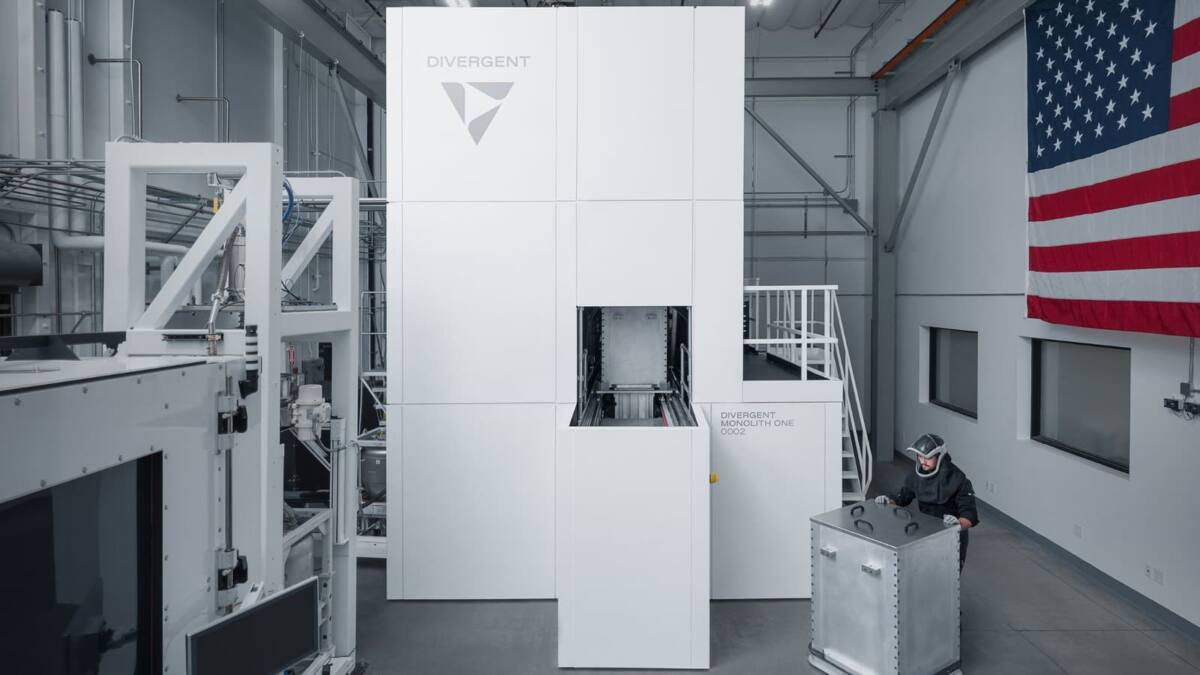
A US startup is trying to turn industrial 3D printing from a prototyping tool into real factory muscle. Divergent Technologies has unveiled Monolith One, a huge new metal printer built for serial production, and paired the launch with plans for a major expansion in Southern California aimed at aerospace and defense parts.
The pitch is simple enough: make complicated metal components faster, in larger numbers, and with less dependence on long supply chains. That is exactly the kind of promise that gets attention from aircraft and rocket makers, especially when traditional manufacturing can take months and every delay lands on someone else’s schedule.
Monolith One specs and production setup
Monolith One is one of the largest systems in its class. The machine stands at more than eight meters tall and uses 12 lasers with combined power of 24 kW, a setup Divergent says roughly doubles output compared with its previous generation of equipment.
- 12 lasers
- 24 kW total power
- More than eight meters tall
- Works with aluminium, steel, titanium, and nickel alloys
Divergent says the system also adds automatic metal powder feeding, temperature control, and built-in optical monitoring to keep print quality in check. That matters because the aerospace sector is famously allergic to guesswork, and not without reason.
A new Long Beach factory with 64 printers
The company plans to build a new plant in Long Beach of about 40,000 square meters, where dozens of Monolith One printers will form the core of future production lines. In Torrance, six systems are already running; over the next two years, Divergent wants to add 64 more at the new site.
Once fully ramped, the factory is expected to produce thousands of rocket engine housings and hundreds of thousands of metal parts for aviation, space, and defense hardware each year. That puts Divergent in direct step with a broader industry push: aerospace suppliers from Europe to the US have been racing to industrialize additive manufacturing, but few have tried to do it at this scale.
Why aerospace buyers care about the speed claim
Chief executive Lukas Chinger says the company’s digital manufacturing platform can cut lead times from months to weeks, and in some cases to just a few days. If that holds up under production demand, it is the sort of speed advantage that can beat conventional machining even before you start talking about inventory savings.
Divergent already works with Lockheed Martin, RTX, and CoAspire, which gives the company a credible customer list for a technology that still has to prove itself in large-scale industrial use. It also says the printers are assembled in the US with key components from American suppliers, a tidy sales point in an era when supply-chain resilience has become a boardroom obsession.
What comes next for metal printing
The real test is whether a fleet of giant printers can move from impressive demo to dependable production line without becoming a very expensive science project. If Divergent can keep quality high while churning out aerospace-grade parts at this pace, rivals will have to answer a blunt question: why build slow when you can print fast?