

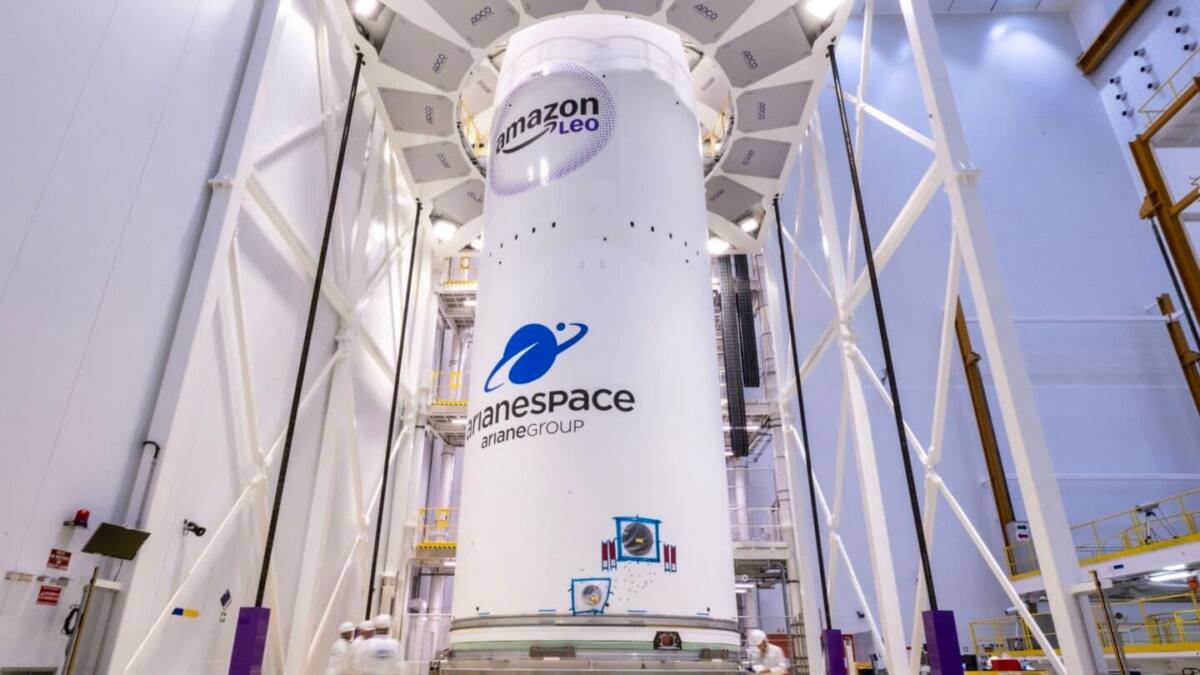
Amazon’s Kuiper rollout is now waiting on rockets. The company has built a satellite factory that is moving faster than the launch market can keep up, with hundreds of finished Kuiper satellites sitting in Florida ready to fly while Amazon waits for enough rocket capacity to expand its planned low-Earth-orbit internet network.
Amazon says it already has 331 satellites in space and is aiming for 3,236 in total. The bottleneck is not production anymore; it is launch availability, with Ariane 6, Vulcan and New Glenn all playing parts in a deployment schedule that now looks more fragile than ambitious.
Ariane 6 is doing the heavy lifting
Amazon’s next batch is slated to lift off from French Guiana on an Ariane 64 rocket built by Arianespace, carrying several dozen Kuiper satellites. The launch is scheduled for 7:53 a.m. Eastern time in the US, or 11:53 UTC, and for now Arianespace is the only partner delivering with any real consistency.
That matters because most of the current constellation was delivered by United Launch Alliance’s Atlas V, a rocket nearing retirement, with only one more Amazon launch left on the manifest. In other words, one of the most aggressive satellite internet deployments ever planned is leaning on the most dependable launcher in the room, while the rest are still getting up to speed.
Blue Origin and ULA still have work to do
Amazon has reserved 18 Ariane 6 flights, 12 New Glenn launches with an option for 15 more, and 38 Vulcan missions. That is a serious stack of launch commitments, but reservations are not the same as cadence, and right now cadence is the whole game.
Blue Origin’s New Glenn was hit by a launchpad accident during a static fire test in Florida at the end of May, damaging ground infrastructure and pushing recovery into a timeline that could stretch from 12 to 18 months. Vulcan has its own uncertainty, with possible engine issues around the BE-4 that also powers its first stage. For Amazon, that means the backup plan is looking a lot like the main plan.
Amazon says Kuiper is still on schedule
Despite the launch pinch, Amazon says it is still on track to begin commercial service for Kuiper this year. Steve Metayer, the company’s vice president for manufacturing operations on the project, says satellites are now being assembled at a pace of ”several per day,” which is exactly the kind of problem you want to have right up until you realize there are not enough rockets to carry them.
- Satellites already in orbit: 331
- Total planned constellation: 3,236
- Ariane 6 launches booked: 18
- New Glenn launches booked: 12, with 15 more optional
- Vulcan launches booked: 38
The broader pattern is familiar: satellite operators can scale manufacturing quickly, but launch infrastructure still runs on a far more unpredictable timetable. SpaceX has shown what a mature launch cadence can do; Amazon is now discovering how hard it is to buy that kind of reliability from anyone else.
The next few months will show whether Arianespace can keep Kuiper moving while Blue Origin and ULA recover. If not, Amazon’s big internet constellation may end up being remembered less for its satellites than for how long it had to wait on the ground.