

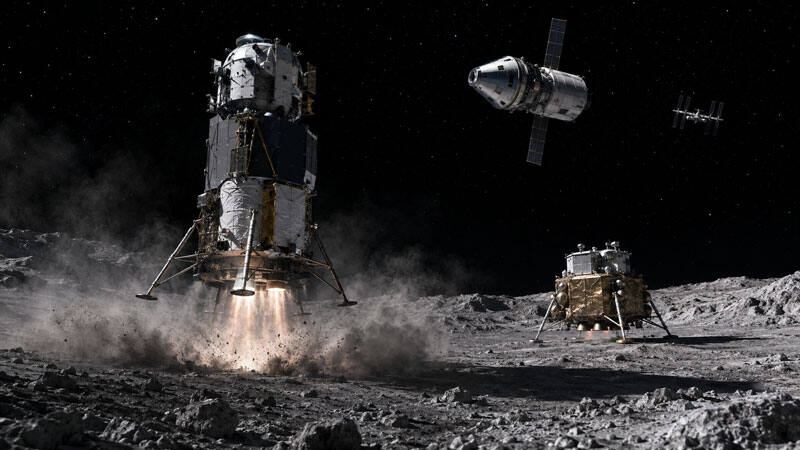
China’s Lanyue lunar lander is being pitched as a tougher ride for future taikonauts than the Apollo-era hardware that carried astronauts to the Moon half a century ago. The reason is blunt: where Apollo’s lander had just one engine for lift-off from the lunar surface, Lanyue is designed with multiple layers of backup, and that extra hardware could be the difference between a dramatic departure and a very bad day.
That confidence comes from a design that squeezes more resilience out of the same mass budget. Chinese developers say Lanyue uses a shared propellant tank divided by a partition, and part of the craft doubles as structure for the descent module. The saved mass makes room for four throttleable main engines and six orbit-manoeuvring engines, a setup that gives the lander several ways to survive engine trouble.
How Lanyue builds in engine backup
The headline feature is redundancy. According to the engineers, a complete failure of one main engine would not be fatal, because the lander could still lift off from the Moon. If one more engine failed, the six smaller manoeuvring engines could still help it leave the surface, which is a pretty strong answer to the old lunar nightmare of being stranded forever.
That is a more modern approach than the Apollo lander, and it reflects how much lunar engineering has changed. Spacecraft designers have become far less tolerant of single points of failure, especially after decades of mission losses across the industry taught everyone that ”works perfectly in the lab” is not the same as ”works on the Moon.”
Artemis landers are not simple either
Still, comparing Lanyue with NASA’s future Artemis landers is awkward, because the final American configurations are not settled. SpaceX’s Starship lander is expected to use at least six Raptor 3 engines, plus two or three braking engines placed higher on the vehicle to avoid kicking up dust at touchdown. Blue Origin’s Blue Moon Mark 2 is planned with at least three BE-7 engines, which also gives it a healthy safety margin on paper.
The catch is that Artemis is relying on two very different landers with very different risks. Starship is the bigger gamble: a 50-meter spacecraft attempting a Moon landing is an audacious idea, and audacious is just a polite word for ”please do not fail.” Blue Moon Mark 2 looks more conventional, but Blue Origin has its own challenges, and a hardware concept is only as real as the vehicle that actually reaches the pad.
China’s advantage is paper-deep for now
So yes, Lanyue sounds more dependable than the Apollo lander and potentially more conservative than the flashier Artemis options. But it is still a design claim, not a flight record. The real test will come when these machines have to do the one thing PowerPoint never prepares them for: land, survive, and leave again.