

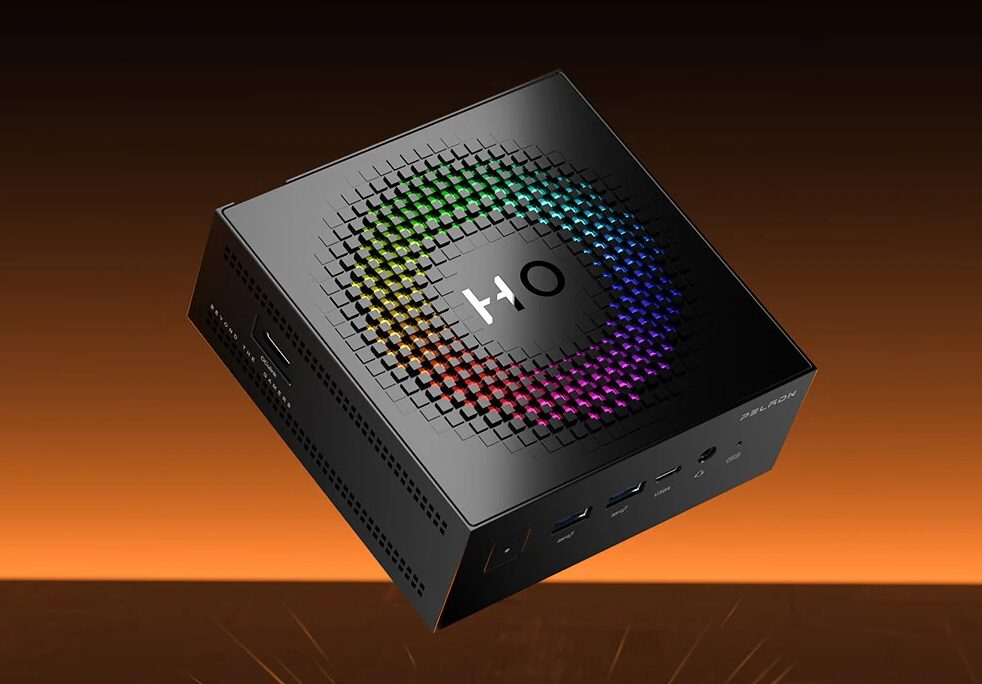
Peladn is giving its HO5 mini PC a serious internal upgrade, swapping in AMD’s Ryzen AI 9 HX 470 and pairing it with an OCuLink port for external graphics support. The new configuration is set to go on sale globally in late June 2026 for $1,299, or 7,599 yuan in China, and it arrives with 32GB of memory and a 1TB SSD already included.
That pricing puts it squarely in the premium mini PC bracket, where the pitch is no longer just ”small desktop” but ”small desktop that can moonlight as a workstation.” Peladn is clearly chasing the same buyers other compact PC makers have started targeting: people who want strong integrated performance now, plus a cleaner upgrade path later if they bolt on a discrete GPU dock.
Ryzen AI 9 HX 470 and 86 TOPS in one box
The Ryzen AI 9 HX 470 is a 12-core, 24-thread chip built on Zen 5 and capable of boosting to 5.2GHz. Its integrated NPU delivers 55 TOPS on its own, clearing Microsoft’s 40 TOPS threshold for local Copilot+ features, while the full CPU-GPU-NPU package reaches up to 86 TOPS of total compute performance.
For graphics, Peladn sticks with AMD’s Radeon 890M, which is fine for esports and older AAA games at sensible settings. The OCuLink 4i port is the smarter move here: compared with USB4, it gives external GPUs a more direct path and avoids some of the bandwidth pain that holds back docked gaming rigs. Mini PC makers have been leaning harder into this kind of expansion, because integrated graphics alone still hit a wall fast.
- Processor: AMD Ryzen AI 9 HX 470
- Cores/threads: 12-core, 24-thread
- Boost clock: up to 5.2GHz
- NPU performance: 55 TOPS
- Total compute: up to 86 TOPS
Ports, memory, and storage in the HO5 chassis
The HO5 uses a 130 x 130 x 55 mm chassis with a vapor chamber and turbo fan for cooling. Memory is fixed at 32GB of LPDDR5X-6400, so there is no RAM upgrade path, but storage is more flexible thanks to two M.2 2280 PCIe 4.0 x4 slots, one of which is already filled by the 1TB NVMe drive.
Connectivity is better than you might expect from a box this small. Up front, there is a 40Gbps USB-C port, two 10Gbps USB-A ports, and a 3.5mm combo audio jack. Around the back, Peladn includes two 480Mbps USB-A ports, dual 2.5GbE RJ45 Ethernet jacks, HDMI 2.1 FRL, and DisplayPort 1.2, with support for up to three displays at once. Wi-Fi 7 and Bluetooth 5.4 round out the wireless side.
Why Peladn is leaning on OCuLink
The top-panel RGB lighting is the loudest part of the design, but the real message is more practical: Peladn wants the HO5 to serve as a compact all-rounder, not just another tiny office PC. That is a sensible bet, because the mini PC market has been drifting toward higher-end chips and external GPU support as buyers try to squeeze more life out of small systems without jumping straight to a full tower.
The HO5 will be sold through Peladn’s global channels later this month. If the company can keep the price competitive against fresh rivals from Minisforum and ASUS, the OCuLink port may end up being the feature that matters most: not flashy, just useful, which is usually how the smarter hardware wins.