

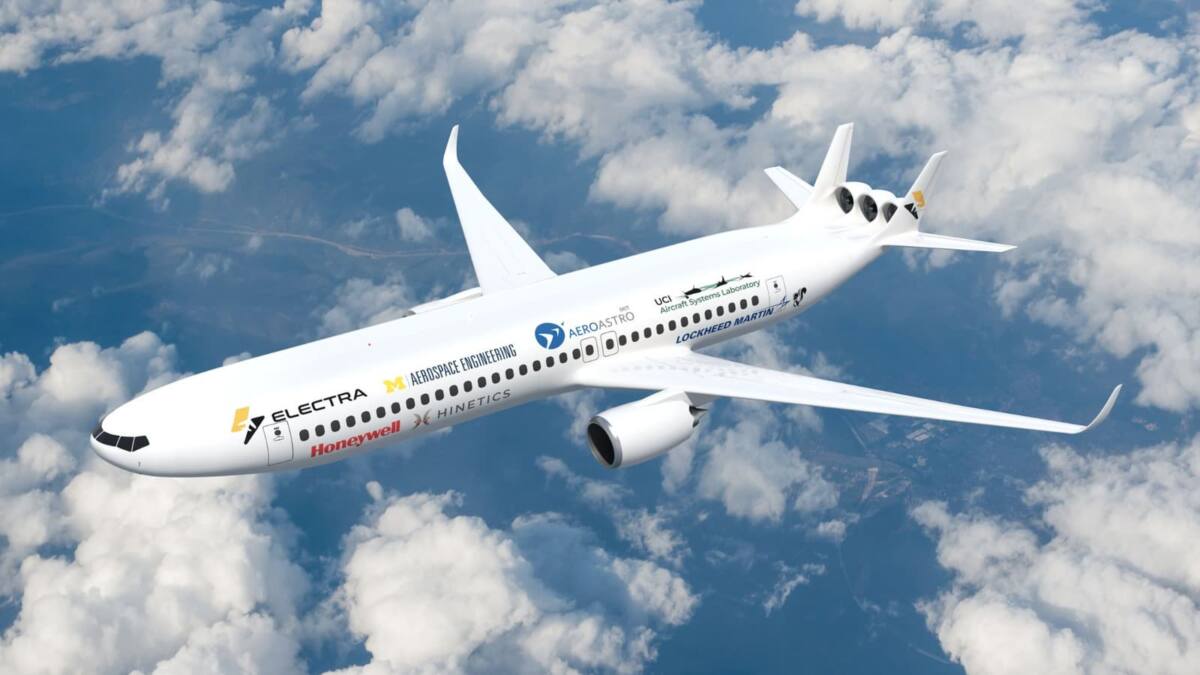
A startup best known for hybrid-electric aircraft has unveiled a twin-fuselage passenger-jet concept that looks like it was designed by someone tired of conventional airplanes. Electra’s new design pairs a ”double bubble” fuselage with a flow-management system called Boundary Layer Ingestion, and the pitch is straightforward: more cabin space, less drag, and a path to cleaner aviation without forcing airports to rebuild from scratch.
The project sits inside NASA’s Advanced Aircraft Concepts for Environmental Sustainability 2050 program, which is chasing a sharp cut in aviation’s environmental footprint by mid-century. That’s the real tell here. The industry is no longer only chasing quieter motors or better wing shapes; it is trying to squeeze efficiency out of the whole aircraft body, because the easy gains are mostly gone.
How the double-bubble fuselage works
Electra’s fuselage uses a wide-body-style ”double bubble” shape that is meant to do two things at once: improve aerodynamics and create a roomier cabin. In practice, the aircraft would still be comparable in size to narrow-body jets, but inside it would have a wider passenger area with two aisles. Airlines will like the boarding math; passengers will probably just enjoy not playing elbow chess for once.
That cabin layout is not just about comfort. Two aisles can speed up boarding and deplaning, which is one of those unglamorous airline headaches that quietly cost time and money on every turn. If Electra’s geometry can deliver that without a weight penalty, it becomes more interesting than a pure design exercise.
Boundary Layer Ingestion and extra efficiency
The second idea is Boundary Layer Ingestion, or BLI. Instead of relying only on two under-wing turbofan engines, the concept uses them to power additional electric fans at the rear of the aircraft, where they capture slower-moving air along the fuselage and accelerate it again. That reduces drag, at least in theory, and Electra says the approach could add up to 17% more fuel efficiency on top of the industry improvements expected by 2050.
- Two turbofan engines under the wing provide thrust and electrical power.
- Extra electric fans in the tail ingest slower boundary-layer air.
- The goal is lower drag and better fuel burn without major airport changes.
That last point matters because aviation is full of concepts that only work if the entire system gets rebuilt around them. Electra is arguing the opposite: use standard airport infrastructure, burn conventional jet fuel or sustainable aviation fuel, and let the airframe do more of the efficiency work. It is a more pragmatic sales pitch than the usual hydrogen opera.
The partner list is the real signal
Electra did not release the concept into a vacuum. American Airlines, Honeywell Aerospace, Lockheed Martin’s Skunk Works, Hinetics, MIT, the University of Michigan, and the University of California, Irvine are all involved in the effort. That mix of airline, aerospace industrial muscle, and research institutions suggests the idea is being treated as more than a render for the annual futurism slide deck.
Alongside the concept, Electra published 11 technical documents with calculations and models, plus a design software tool built on NASA’s open Aviary platform for electrified aircraft. For a sector where many ”future of flight” announcements are all mood board and no math, that is a welcome change. The obvious question now is whether this configuration can survive the usual airline gauntlet of weight, maintenance, certification, and economics – the four horsemen of aviation reality.