

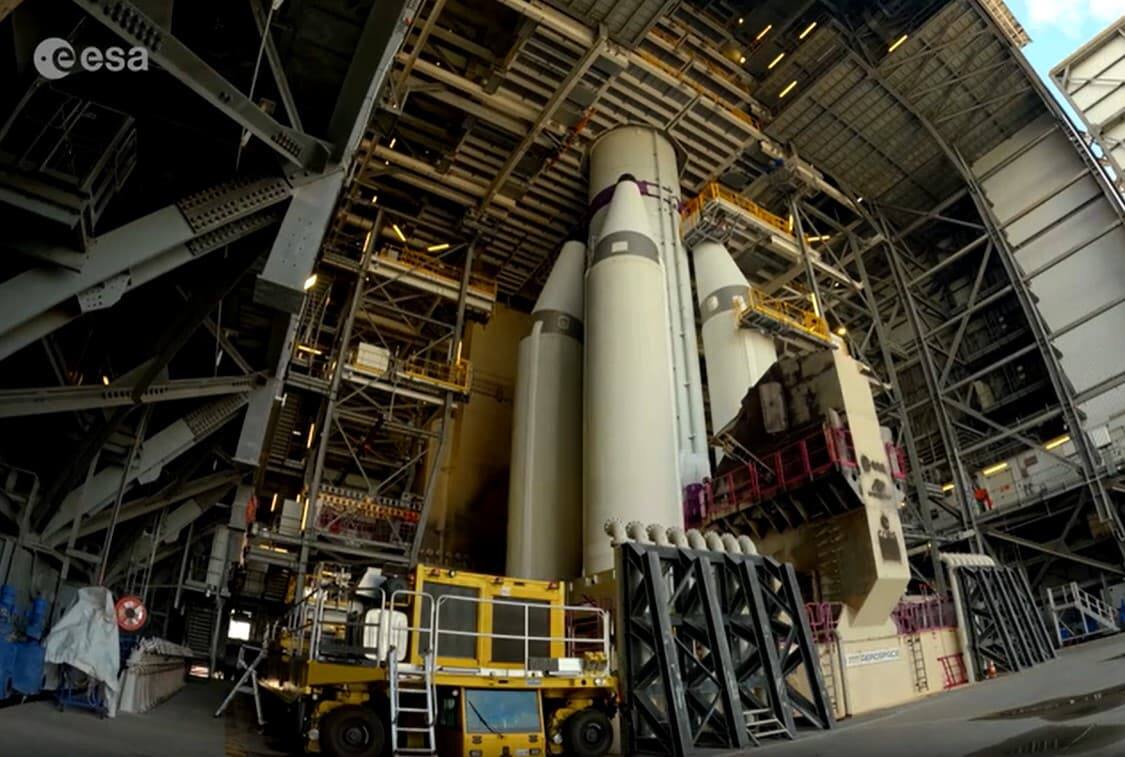
Europe’s Ariane 6 is about to get a quieter but important upgrade: the rocket’s next launch campaign will introduce the P160C solid-fuel booster, a new side accelerator that is said to deliver about 10% more performance than the current P120C. The first flight to use it will be VA269, a mission run by Arianespace under contract for Amazon.
This is not a flashy redesign so much as a practical power boost. The new motor carries 14 tonnes more propellant than the P120C, which is the kind of change rocket engineers love and marketing teams usually summarize with a neat percentage. In launch services, even single-digit gains matter because they can mean heavier payloads, more flexible orbit options, or simply more breathing room on a mission profile.
P160C will fly first on VA269
The eighth launch of Ariane 6 will be the debut flight for P160C, according to the developers. Once the booster arrives at the European spaceport in French Guiana, it will be fueled and integrated with Ariane 6 as a side booster. That puts the upgrade straight into operational service instead of letting it linger as a test article on a slide deck.
For ArianeGroup and its partners, the move also shows how Europe keeps iterating on a launch system built across national borders. The motor is developed by Europropulsion under contract with ArianeGroup and Italy’s Avio, with the casing made in Italy, the nozzle in France, and the igniter in Norway. Space hardware tends to be a team sport; this one is especially European about it.
What changes from P120C to P160C
- About 10% more performance when placing payloads into orbit
- 14 tonnes more propellant than the P120C
- Used as a side booster on Ariane 6
- First flight planned on mission VA269
Ariane 6 itself remains one of Europe’s biggest shared space projects, with ESA coordinating work with industrial partners from 13 countries under ArianeGroup’s lead. CNES manages the spaceport in French Guiana, which is where the new booster will be assembled into the launch stack. That kind of setup takes time, money, and patience, but it also explains why upgrades like P160C are rolled into service carefully rather than slapped on overnight.
Ariane 6 gets a useful payload bump
Amazon is getting the first operational beneficiary here, but the bigger story is that Ariane 6 keeps edging toward a more capable configuration just as Europe is trying to stay competitive in commercial launch. If P160C performs as expected, the next question is how quickly that extra headroom gets turned into real mission flexibility – and whether customers notice the difference anywhere except on the procurement spreadsheet.