

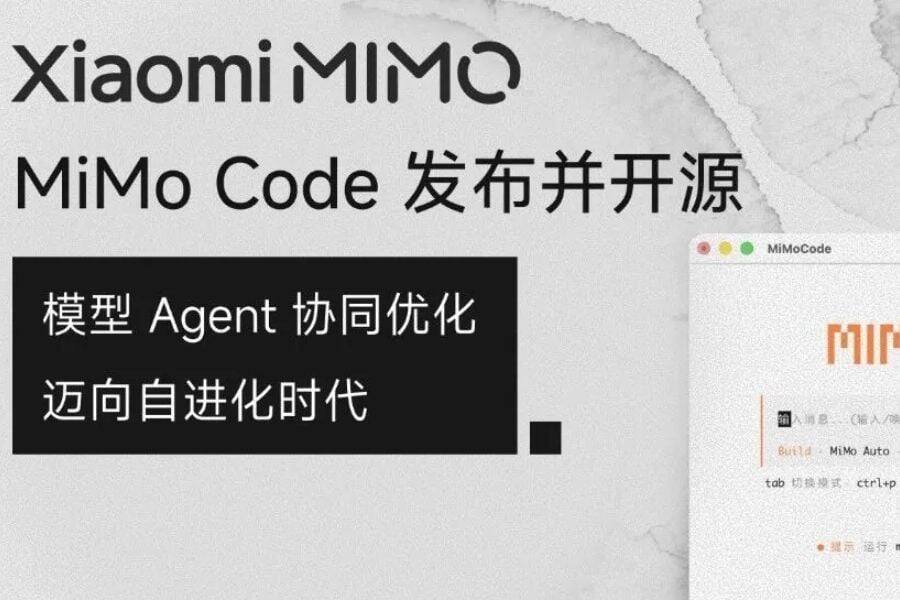
Xiaomi has open-sourced MiMo Code V0.1.0, a terminal-based AI coding assistant built to handle long software projects without constantly losing the thread. The pitch is straightforward: instead of a chatty tool that forgets its own plan after a few back-and-forths, Xiaomi wants a coding agent that can keep state, manage context, and keep shipping code.
The new tool sits on top of the open-source OpenCode project and is released under the MIT license, so developers can use it, modify it, and fold it into their own workflows. It also ships with free access to MiMo-V2.5, Xiaomi’s latest multimodal model, though users can swap in services such as DeepSeek, Kimi, or GLM if they prefer a different backend.
Persistent memory is the main selling point
Most AI coding assistants hit the same wall: the context window fills up, the tool starts forgetting earlier decisions, and the session turns into a cleanup job for the human. Xiaomi says MiMo Code avoids that trap with a background subagent that continuously stores and manages context while the main agent keeps working.
When the active conversation gets close to its limit, that subagent condenses the session into a structured summary so the agent can continue without stumbling over its own memory. The company also built in a ”/dream” routine that runs every seven days, sending a maintenance agent through old sessions and memory files to remove duplicates, verify file paths, and compress everything into an updated long-term store.
Compose mode tries to do the whole job
MiMo Code is also wired for a dedicated Harness system designed around MiMo models rather than a generic API wrapper. That matters because model-specific tooling tends to do a better job of extracting the behavior a vendor claims is special, instead of treating the model like interchangeable plumbing.
The most ambitious piece is Compose mode, triggered with the Tab key. Instead of handing the assistant one tiny task at a time, you can give it a rough goal and let it move through planning, design, coding, testing, and review in one sweep. Xiaomi says that can produce an ”industrial-grade finished product,” which is a big promise for any terminal tool, let alone one still at version V0.1.0.
- SWE-Bench Pro: 62%
- Terminal Bench 2: 73%
- Claimed edge over Claude Code: around five percentage points
Voice input and fast setup round out the package
MiMo Code also includes voice input powered by MiMo-V2.5-ASR, letting users dictate commands, correct typos, or trigger actions such as ”send” and ”execute” without touching the keyboard. That is a small quality-of-life addition, but one that fits the broader push toward agents that feel less like autocomplete and more like a real collaborator.
Setup is deliberately simple. On macOS and Linux, installation takes a single terminal command, while Windows users can install it through npm. Launching the assistant is as easy as typing ”mimo”, and Xiaomi says the free MiMo-V2.5 channel does not require an account or registration.
Xiaomi is betting on coding agents, not just models
This is the more interesting part of Xiaomi’s move: it is not just launching another model, but trying to own the workflow around it. Open-source coding agents are getting crowded fast, and the competition is no longer just about benchmark bragging rights – it is about memory, tooling, and how much friction developers are willing to tolerate before they go back to the terminal and do it themselves.
If MiMo Code delivers on its memory tricks and compose-style automation, it could make Xiaomi’s open-source stack more attractive to developers who want a serious local-first assistant. The open question is whether the persistent-memory pitch survives real-world, messy projects, where long sessions, bad prompts, and half-finished refactors are usually what expose the cracks.