

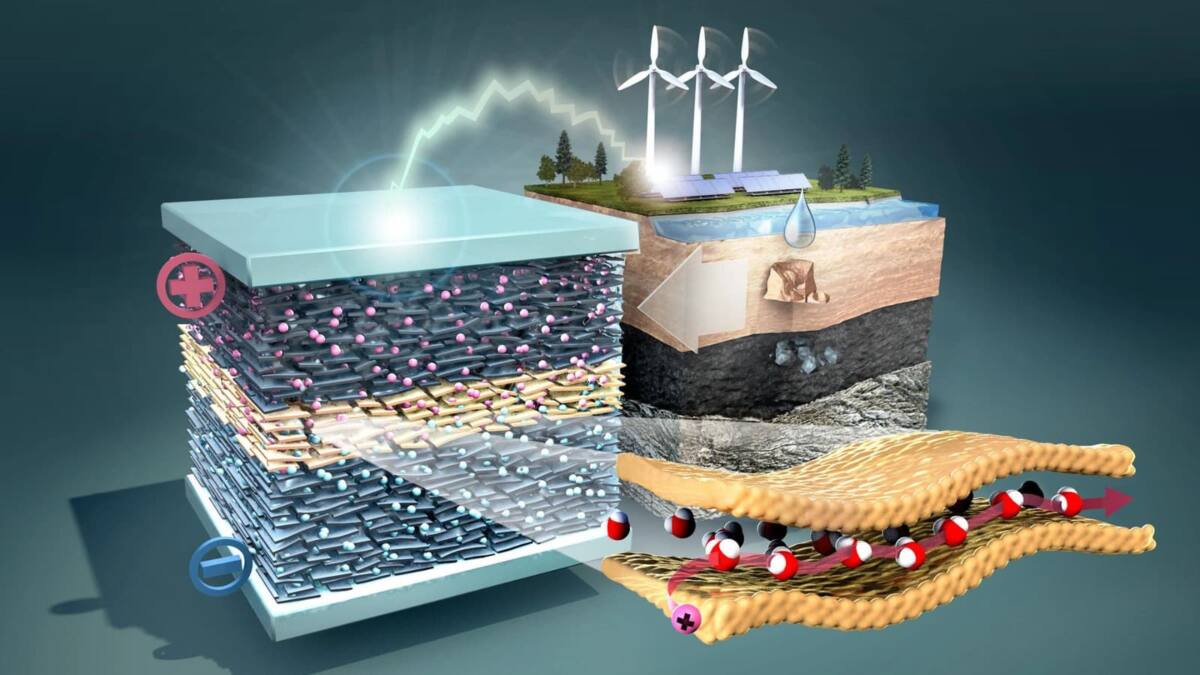
A research team led by Hamburg University of Technology has built a supercapacitor called Blue Capacitor that uses plain water as its electrolyte, paired with clay and carbon, and it has already survived more than 60,000 charge-discharge cycles. The device is a neat reminder that energy storage does not always need expensive chemistry to be interesting – sometimes it needs nanometer-wide clay channels and a very good idea.
The pitch is simple enough to sound slightly suspicious: take natural clay, mix it with graphene, form a membrane packed with millions of channels about one nanometer wide, then fill the structure with purified water. Inside that cramped space, water molecules behave differently, letting the system store and move charge in a way that ordinary bulk water cannot.
How the Blue Capacitor is built
The device is made from just three common materials: water, clay, and carbon. The clay-graphene membrane creates the nanoscale pathways that change the electrolyte’s behavior, which is the whole trick here. In other words, the breakthrough is not some exotic new liquid, but a clever way of forcing familiar water into an unfamiliar environment.
That matters because conventional electrolytes often rely on acids, salts, or organic solvents. Those materials can be toxic, flammable, or annoying to dispose of, which is not exactly ideal if you want energy storage to scale beyond the lab without becoming a hazard in a box.
Performance that looks surprisingly solid
In testing, the prototype handled more than 60,000 cycles without noticeable degradation. It also remained stable at up to 1.6 V, which is unusually high for a water-based system, since water normally starts splitting into hydrogen and oxygen at lower voltages.
- Electrolyte: purified water
- Materials: water, clay, and carbon
- Channel width: about one nanometer
- Cycle life: more than 60,000 charge-discharge cycles
- Operating voltage: up to 1.6 V
Where a water-based supercapacitor could fit
The researchers say the technology is still early, but the use cases are obvious: buffering power for solar and wind systems, helping stabilize grids, and powering electronics that need fast charging and long service life. That is a crowded field, of course, with lithium-ion batteries and commercial supercapacitors already entrenched, but a cleaner and cheaper electrolyte story is the sort of thing investors and utilities tend to notice quickly.
The real question is whether the laboratory results survive the transition to larger formats. If they do, the Blue Capacitor could become less of a science headline and more of a practical alternative in places where durability, safety, and simple materials matter more than chasing the absolute highest energy density.