

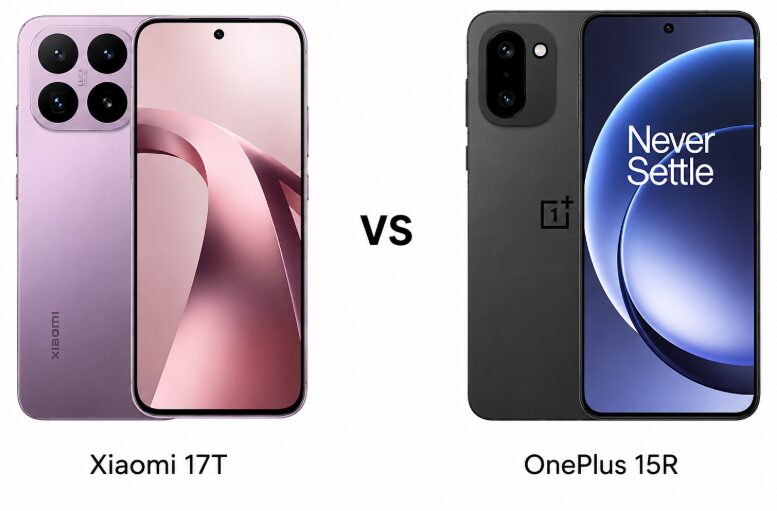
The Xiaomi 17T vs OnePlus 15R debate comes down to value, and the answer is already pretty clear: OnePlus looks stronger for most buyers, while Xiaomi leans hard into cameras. If you want the cleaner spec sheet, OnePlus has the easier pitch. If you care about zoom shots and a more imaging-first package, Xiaomi refuses to sit quietly in the corner.
Design and display differences
On paper, the OnePlus 15R looks and feels more premium. It uses an aluminum frame, carries IP68/IP69K certification, and adds an ultrasonic fingerprint scanner, which is the kind of detail that sounds small until you use it every day. Xiaomi responds with Gorilla Glass 7i, a glass-fiber reinforced plastic frame and back, plus IP68 protection, which should still be plenty for normal wear and tear.
The display story follows the same pattern. Xiaomi gives the 17T a 120Hz AMOLED panel with Dolby Vision, HDR10+, and a 3500-nit peak brightness rating. OnePlus counters with a larger AMOLED screen, 165Hz refresh rate, 1 billion colors, and HDR Vivid support. That extra smoothness is easy to like on paper, and gaming fans will probably notice it first.
In simple terms: Xiaomi is the easier phone to live with; OnePlus is the one that flashes more premium hardware at you.
Snapdragon 8 Gen 5 vs Dimensity 8500 Ultra
Performance is where OnePlus starts pulling away. The 15R runs on Qualcomm’s Snapdragon 8 Gen 5, built on a 3nm process and paired with the Adreno 829 GPU. That makes it the more obvious pick for gaming, sustained heavy workloads, and buyers who want headroom for the next few software updates without sweating the result.
Xiaomi’s Dimensity 8500 Ultra is no slouch, though. It is paired with UFS 4.1 storage and Android 16-based HyperOS 3, so everyday multitasking should still feel quick and polished. The difference is that OnePlus is selling extra muscle, while Xiaomi is selling efficiency and balance. That split has become familiar in the premium-midrange segment: one brand chases raw specs, the other tries to look smart without overcooking the price.
- Xiaomi 17T: MediaTek Dimensity 8500 Ultra, UFS 4.1, HyperOS 3
- OnePlus 15R: Snapdragon 8 Gen 5, Adreno 829 GPU, 3nm process
Battery and charging are a OnePlus flex
Battery life should be a strong suit for both phones, but OnePlus clearly goes bigger. The 15R has a 7400mAh battery and 80W charging, while Xiaomi packs in 6500mAh with 67W charging and reverse wired charging. That extra capacity is not a cute spec bump; it is the sort of thing heavy users feel by dinner time.
For people who live on their phones, the OnePlus setup is easier to sell. Xiaomi still offers a respectable battery setup, but the 15R has the more aggressive endurance-and-speed combination, which is exactly what helps a phone look like a better buy even when the price gap is not huge.
The Xiaomi 17T camera setup
This is where the Xiaomi 17T stops playing defense. Its Leica-branded triple camera setup includes a 50MP main sensor, a 50MP periscope telephoto camera with 5x optical zoom, and a 12MP ultrawide lens. That periscope lens is the standout: it gives Xiaomi a real advantage for portraits, distant subjects, and anyone who still likes taking photos that are not just wide-angle copies of the same scene.
The OnePlus 15R keeps things much simpler with a 50MP main camera and an 8MP ultrawide. It should be fine for standard shots, and the 32MP selfie camera with autofocus is a nice touch, but the missing telephoto lens is hard to ignore. In a market full of ”good enough” cameras, Xiaomi has bothered to add a feature that actually changes how you shoot.
Both phones can record 4K video at up to 120fps on the rear setup, so videographers are not being shortchanged. Still, if your camera checklist includes zoom, the Xiaomi 17T is the one that makes the stronger case.
Price and value split
- Xiaomi 17T: around $700 (approximately ₹60,000)
- OnePlus 15R: around $650 (approximately ₹55,000)
The price difference is small enough to keep things interesting. That is not a canyon, but it is enough to make the OnePlus look unusually stacked: faster chip, larger battery, quicker charging, aluminum frame, and a 165Hz display for less money.
Xiaomi’s higher price is easier to justify if you want the Leica-tuned camera system and especially the 5x periscope zoom. The trade-off is simple, and a little old-fashioned in the best way: OnePlus wins on hardware per dollar, while Xiaomi wins on camera ambition.
- Choose Xiaomi 17T if camera flexibility and zoom matter most
- Choose OnePlus 15R if gaming, battery life, charging speed, and price matter more
The real question is whether buyers will pay extra for a better camera system when the OnePlus 15R looks stronger almost everywhere else. My bet: most will not, which is exactly why Xiaomi is leaning so hard on imaging. That leaves the 17T with a clear niche, and the 15R with the broader win.