

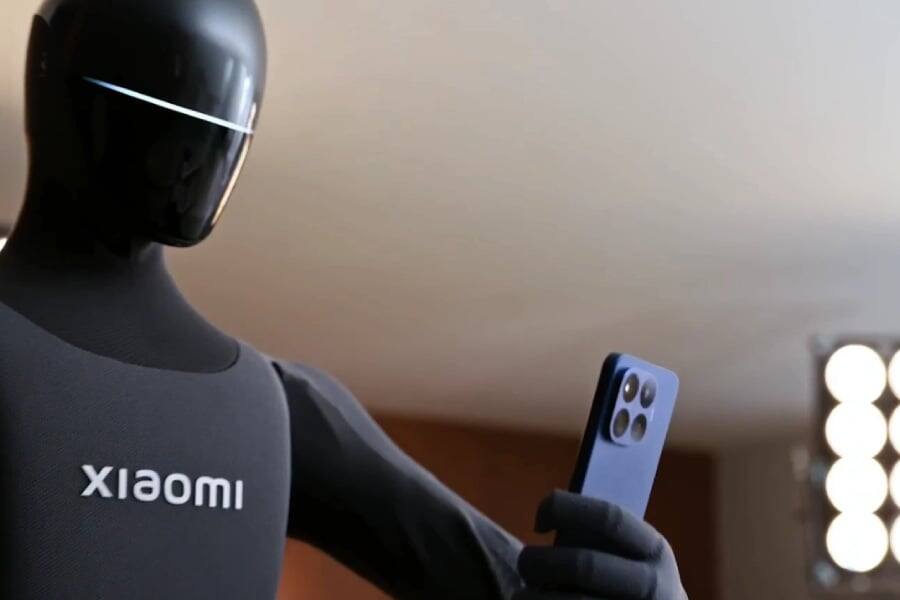
Xiaomi turned a phone launch into a robotics demo in China, putting its next-generation humanoid robot on stage to pick up the Xiaomi 17T Pro, work the volume buttons, and snap a picture. The stunt was brief, but it said a lot: Xiaomi wants its robots to look less like lab curiosities and more like machines that can handle everyday objects with human-style dexterity.
The Xiaomi 17T starts at 2,999 yuan (~$445), while the Xiaomi 17T Pro begins at 3,999 yuan (~$590). As with the global models, there is not much separating these China versions on specs, which leaves the robot cameo as the most memorable thing from the event. That is a smart bit of stagecraft, because phone launches are starting to blur unless a brand gives the audience something weird, useful, or both.
What Xiaomi’s robot did on stage
The demo was simple enough to read in a single glance. The robot used its bionic hand to lift the phone, adjusted zoom with the side buttons, and took a photo. Xiaomi even showed the resulting shot, underlining that this was not just a prop moving for applause.
There is a reason manufacturers keep returning to these polished demos: phones are familiar, and so is the idea of a robot interacting with one. The hard part is not making a robot wave at a crowd. It is making one reliably manipulate small, awkward devices without fumbling, crushing, or freezing up.
Inside Xiaomi’s robotics push
Xiaomi has been telegraphing this direction for a while. The company has talked about deploying CyberOne in its own factories, and Lei Jun has previously said he wants humanoid robots working at Xiaomi factories at scale within five years. That puts the company in the same broad race as other electronics giants chasing industrial robotics rather than consumer gimmicks.
Earlier this year, Xiaomi said its robots had completed three-hour continuous shifts at a self-tapping nut installation station in a car factory, with a 90.2% success rate for simultaneous bilateral installation while meeting a 76-second cycle time requirement. That kind of number matters more than stage theatrics, because factories do not care how elegant a demo looks if the machine cannot keep pace with the line.
The bionic hand got a serious upgrade
Xiaomi also says it has redesigned the robot’s bionic hand. The new version is 60% smaller in volume and now matches the size of a human worker’s hand, while offering 64% more degrees of freedom. It also includes a full-palm tactile sensor with 8,200 square millimetres of coverage, a gripping cycle life of over 150,000 operations, and a bionic sweat gland system for heat management during extended use.
- 60% smaller than before
- 64% more degrees of freedom
- 8,200 square millimetres of tactile sensing
- Over 150,000 gripping operations
That mix of tactile sensing, articulation, and thermal management is the real story here. Plenty of robotics teams can build a hand that looks advanced in a press photo; fewer can make one survive repetitive work without losing precision or cooking itself.
Xiaomi’s industrial robotics ambitions
Lei Jun recently said Xiaomi’s robotics team took first place in two international competitions, and he framed the company’s goal very plainly: robots should do practical work in real environments, not just controlled ones. That is the right ambition, and also the difficult one, because the jump from a carefully staged demo to a messy factory floor is where a lot of robotics hype goes to die.
Still, Xiaomi’s approach is coherent. The company is pairing visible consumer-product theatrics with industrial benchmarks, which is how you build credibility in robotics without pretending the problem is solved. The next question is whether these hands keep performing when the lights are off, the line is moving, and nobody is standing by with a camera.