

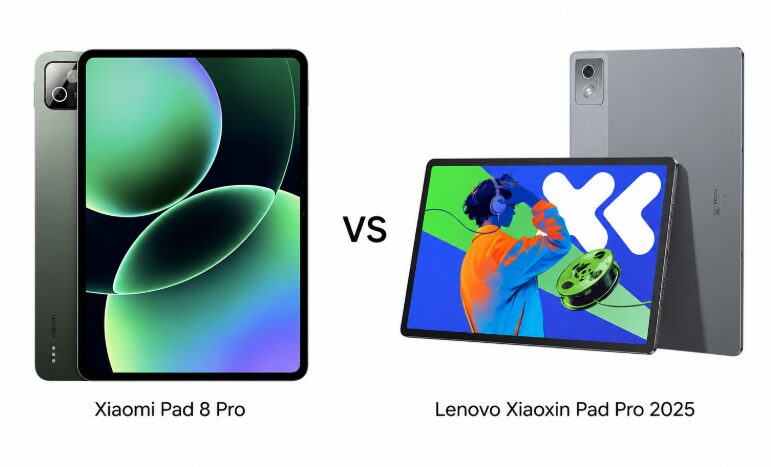
The Xiaomi Pad 8 Pro vs Lenovo Xiaoxin Pad Pro 12.7 2025 comparison comes down to priorities. Xiaomi is the sharper pick for power users, with a Snapdragon 8 Elite chip, faster storage, and a slimmer metal body, while the Lenovo Xiaoxin Pad Pro 12.7 2025 leans harder into size, endurance, and the sort of productivity features that make sense on a desk rather than in a bag.
That divide is familiar in the Android tablet world: one camp chases laptop-adjacent performance, the other sells itself on a bigger screen and a lower bill. Lenovo’s approach is often the safer one for students and media hogs; Xiaomi is clearly aiming at buyers who want the closest thing to an Android flagship slate without drifting into Samsung money.
Design and display choices
Xiaomi keeps things compact at 5.8mm thick and around 485g, and the aluminum unibody gives it the more premium first impression. It also supports a magnetic stylus and feels like the cleaner, more portable option. Lenovo counters with a larger chassis that makes room for a 12.7-inch panel, a bigger battery, a side fingerprint scanner, and POGO pin support.
On paper, both screens are strong. Xiaomi uses an 11.2-inch 3.2K IPS panel with Dolby Vision, HDR Vivid, 800 nits peak brightness, and a 144Hz refresh rate. Lenovo answers with a 12.7-inch 2.9K LCD, also at 144Hz, with HDR10+ and Dolby Vision, which gives it the edge for reading, split-screen work, and binge-watching in bed like a responsible adult.
Performance gap favors Xiaomi
This is where the comparison stops being polite. The Snapdragon 8 Elite inside the Xiaomi Pad 8 Pro is in a different class from Lenovo’s Dimensity 8300, and that matters for gaming, video editing, and heavy multitasking. Xiaomi also pairs it with up to 16GB RAM and UFS 4.1 storage, which should help it stay quick for longer.
Lenovo is still plenty capable for everyday use, office work, and media consumption, and its larger display does make split-screen work less cramped. But raw speed belongs to Xiaomi, and Android tablets rarely get enough software polish to waste performance headroom. Xiaomi’s Android 16-based HyperOS 3 should help it feel fresher too.
Battery, accessories, and cameras
Battery strategy follows the same split. Xiaomi includes a 9200mAh cell with 67W fast charging and reverse wired charging, while Lenovo goes bigger with a 10200mAh battery that should last longer, especially for streaming and productivity sessions. Lenovo’s slower charging is the tax you pay for endurance.
Accessories and imaging tilt the trade-off again. Xiaomi’s 50MP rear camera and 32MP ultrawide front camera are better for documents and video calls, and it can record 4K at up to 60fps. Lenovo keeps things simpler with 13MP rear and 8MP front cameras, but it adds a four-speaker JBL system with Dolby Atmos, which may matter more than tablet cameras ever do.
- Xiaomi Pad 8 Pro: Snapdragon 8 Elite, up to 16GB RAM, UFS 4.1, 9200mAh battery, 67W charging, 50MP rear camera
- Lenovo Xiaoxin Pad Pro 12.7 2025: Dimensity 8300, 10200mAh battery, microSD expansion, JBL quad speakers, 12.7-inch display
Which tablet is the smarter buy?
The pricing split makes the choice easier. Xiaomi is expected to cost around $500, or approximately ₹47,000, while Lenovo is aimed at the lower bracket and offers more screen, more battery, and more flexibility for less money. That is a very Lenovo move: practical, broad-appeal, and unlikely to make spec-sheet enthusiasts faint.
If you want the stronger long-term machine, Xiaomi is the better bet. If you care more about display size, battery life, expandable storage, and value, Lenovo looks smarter. The only real open question is how wide the real-world price gap becomes once these tablets leave China, because that will decide whether Xiaomi’s premium is justified or just aggressively optimistic.