

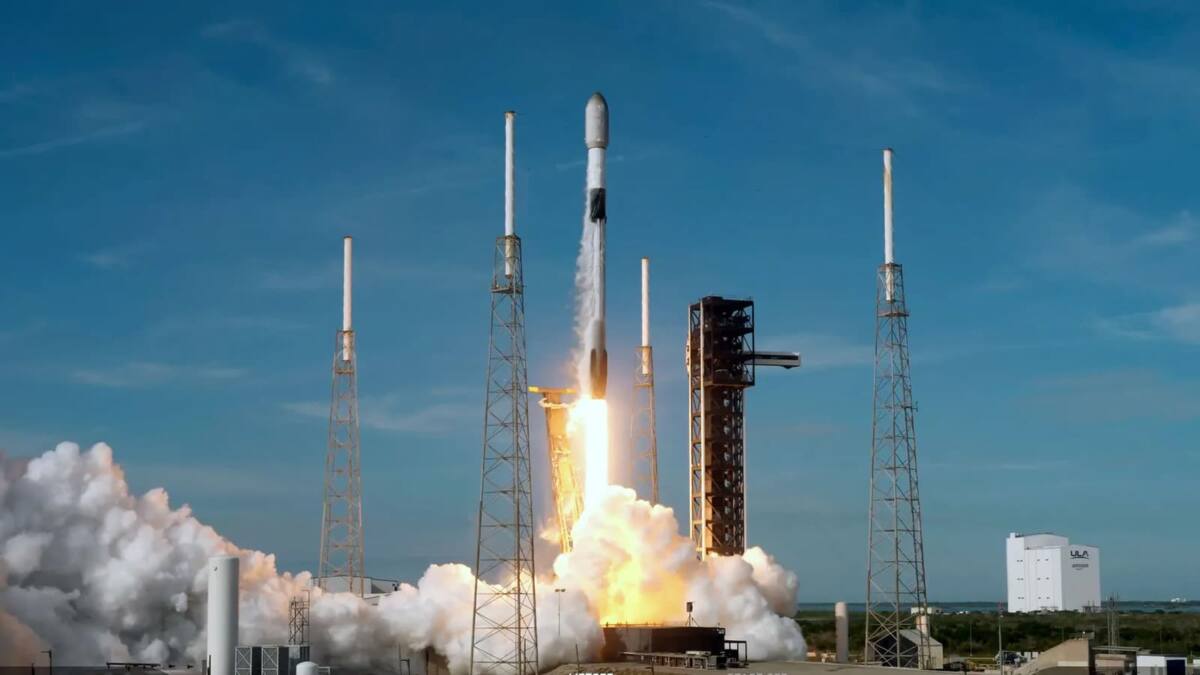
SpaceX launched 29 Starlink satellites on 29 May aboard a Falcon 9 rocket from Cape Canaveral, even as Blue Origin was dealing with the wreckage of an explosion at a nearby pad just 12 hours earlier. The mission showed SpaceX’s launch cadence is still exceptionally high, and Falcon 9 reuse has become a routine part of the company’s business.
The launch took place at 15:57 Moscow time from SLC-40 at the U.S. Space Force base on Cape Canaveral. About an hour later, SpaceX confirmed that all 29 satellites from the Group 10-53 batch had been deployed successfully. There was no drama in the ascent, which is probably the most impressive part. In spaceflight, routine is expensive to build and easy to lose.
Booster 1085 flew for the 16th time
The first stage on this mission, Booster 1085, logged its 16th flight and then landed on the autonomous droneship ”A Shortfall of Gravitas” in the Atlantic. SpaceX will tow it back for servicing before another launch, a cadence that would have looked wildly optimistic a decade ago.
- Falcon 9 launches in 2026: 61
- Falcon 9 launches since debut in 2010: 644
- Starlink satellites now in orbit: more than 10,400
- Satellites deployed on this mission: 29
Blue Origin’s failure was next door
The timing was awkward for Blue Origin. On the evening of 28 May, its New Glenn rocket exploded during static-fire testing at LC-36, sending up a fireball visible from more than 160 kilometers away. Fresh photos reportedly show serious damage to the pad, but the incident did not stop SpaceX from flying the next day, which only sharpened the contrast between a launch system that keeps moving and one that is still very much in its proving phase.
Booster 1085 has become one of the more traveled pieces of hardware in the fleet, with previous flights including Crew 9, Fram 2 and Blue Ghost Mission 1, plus eight other Starlink launches. SpaceX does not just launch a lot; it reuses the same hardware often enough that each flight further normalizes a business model competitors are still trying to match.
Starlink satellite count passes 10,400
According to astrophysicist Jonathan McDowell, today’s deployment pushed the number of active Starlink satellites in orbit beyond 10,400. That scale is now the real story behind these launches: every added batch is small on its own, but together they deepen SpaceX’s lead in broadband constellations and make the network harder to ignore, whether regulators, rivals or astronomers like it or not.
The next question is less about whether Falcon 9 can keep flying and more about how long the rest of the launch market can tolerate this pace. If SpaceX keeps stacking up reusable missions while competitors are dealing with test failures and pad repairs, the gap is only going to feel more unfair.