

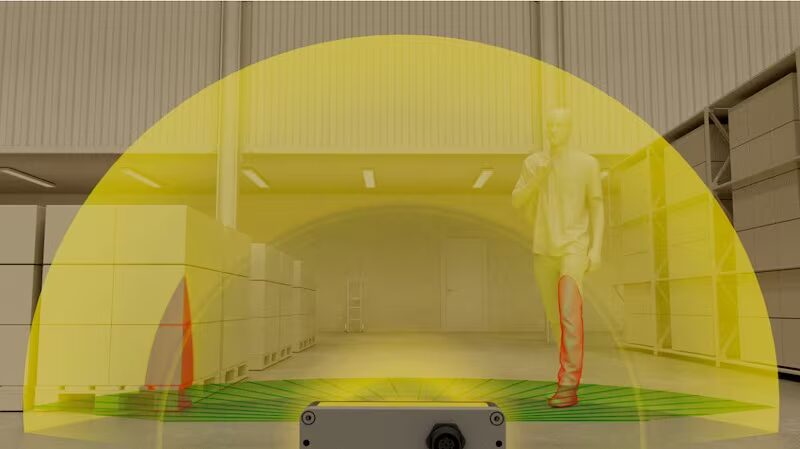
Sonair has unveiled the ADAR One, the first certified 3D ultrasonic safety sensor for industrial robots. Unlike standard 2D lidar and laser scanners that scan a single plane, this sensor monitors the entire space in front of a machine. For autonomous mobile robots (AMRs), this means detecting people or obstacles not just at a fixed height but also above and below the usual scanning line.
ADAR One uses ultrasound instead of light, with ADAR standing for acoustic detection and ranging. It covers a 180 × 180-degree field and is designed to be embedded directly into the robot’s body. This compact integration is crucial for both small mobile platforms and humanoid robots, where extra protruding modules create engineering challenges.
Certification is a major selling point. The ADAR One is officially certified under IEC 61496 as a protective sensor for humans, complies with safety standards IEC 61508 and ISO 13849, and has achieved SIL 2 and PL d safety integrity levels. The testing was done by exida, a respected international authority in functional safety certification.
Sonair also highlights that ADAR One is the first certified embedded safety device built using the Rust programming language. Rust has been gaining traction in industrial automation for its strict memory safety and lower risk of bugs. Certified products using Rust are still extremely rare in this field.
According to Sonair, the sensor is already in production and has been tested by over 80 robotics companies in the past year. One early commercial partner is beRobox, which develops automated palletizing and unloading systems. Warehouses and intralogistics remain some of the fastest-growing sectors for robot adoption. Interact Analysis predicts the global population of autonomous mobile robots will reach millions by 2030, all requiring reliable safety systems that function around humans-not just in sterile environments.
Until now, 2D safety solutions from companies like SICK, OMRON, and Hokuyo have dominated the industry. For 3D spatial detection, manufacturers had to combine multiple sensors or cameras, complicating design and certification. If Sonair proves that ultrasonic 3D sensing is reliable in harsh factory and warehouse conditions, AMR and automated guided vehicle (AGV) makers could simplify their systems and clear safety certifications without complex workarounds.
This launch marks a notable shift toward more compact, intrinsically safe robot sensing. The big question now is whether ADAR One’s ultrasonic approach can stand up to the demanding, noisy environments inside industrial facilities-and how quickly other companies will follow Sonair’s lead in applying Rust for certified safety devices.