

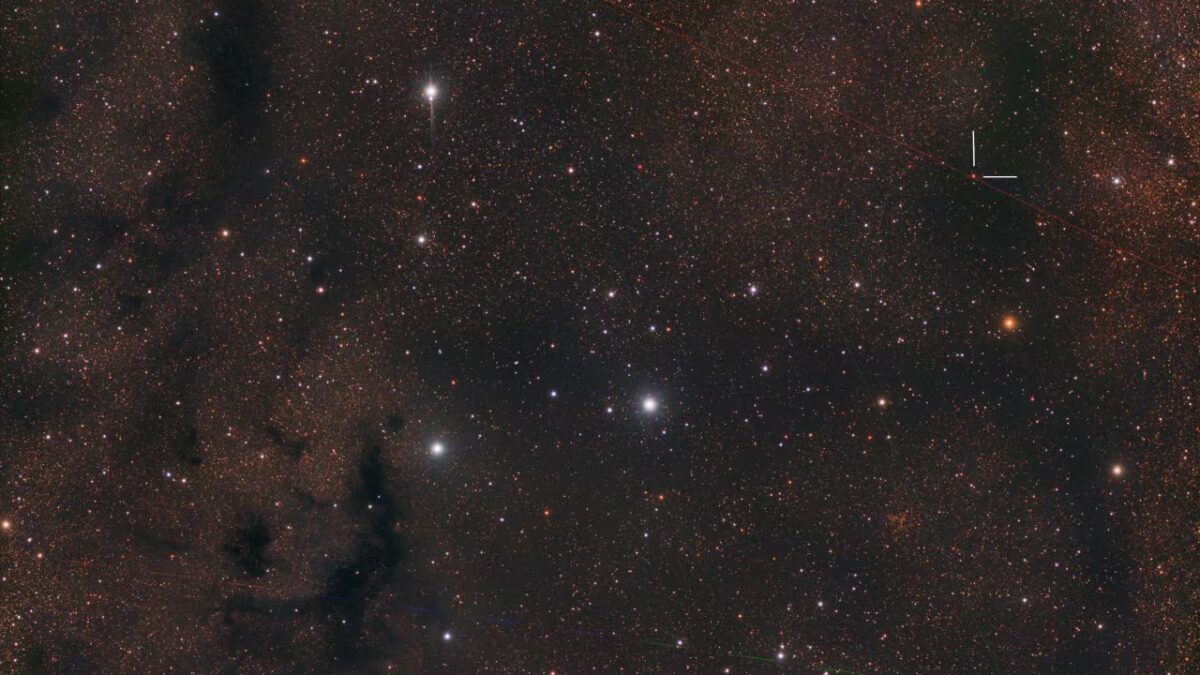
A sudden flare-up in the constellation Aquila has revealed a classic nova, temporarily labeled AT 2026rdg, which brightened by a factor of 2.5 in just 13 hours. The event was first spotted overnight between July 1 and 2 by the Astrovers astrophotography farm in Arkhyz, Russia, then confirmed through spectral analysis from observatories in Italy and South Africa. Rather than a supernova or stellar death, this outburst is a thermonuclear explosion on the surface of a white dwarf locked in a tight binary star system.
At discovery, the nova’s brightness measured around magnitude +11.8. Data show it gained roughly one magnitude in brightness over the preceding 13 hours, meaning it grew about 2.5 times brighter. Earlier observations by Chinese amateur astronomers analyzing open data from the Zwicky Transient Facility (ZTF)-a global automated sky survey specializing in transient events-also caught the same brightening.
Spectral readings reveal material ejections shooting out at approximately 680 km/s. This matches the typical pattern for a classical nova: the white dwarf siphons hydrogen-rich material from its companion star, builds up a critical layer, and then ignites a thermonuclear blast, causing a sharp rise in luminosity. Within our Milky Way galaxy, these nova events occur roughly five to 10 times per year, though astronomers believe the actual number is higher because many go unnoticed due to interstellar dust and unfavorable viewing angles.
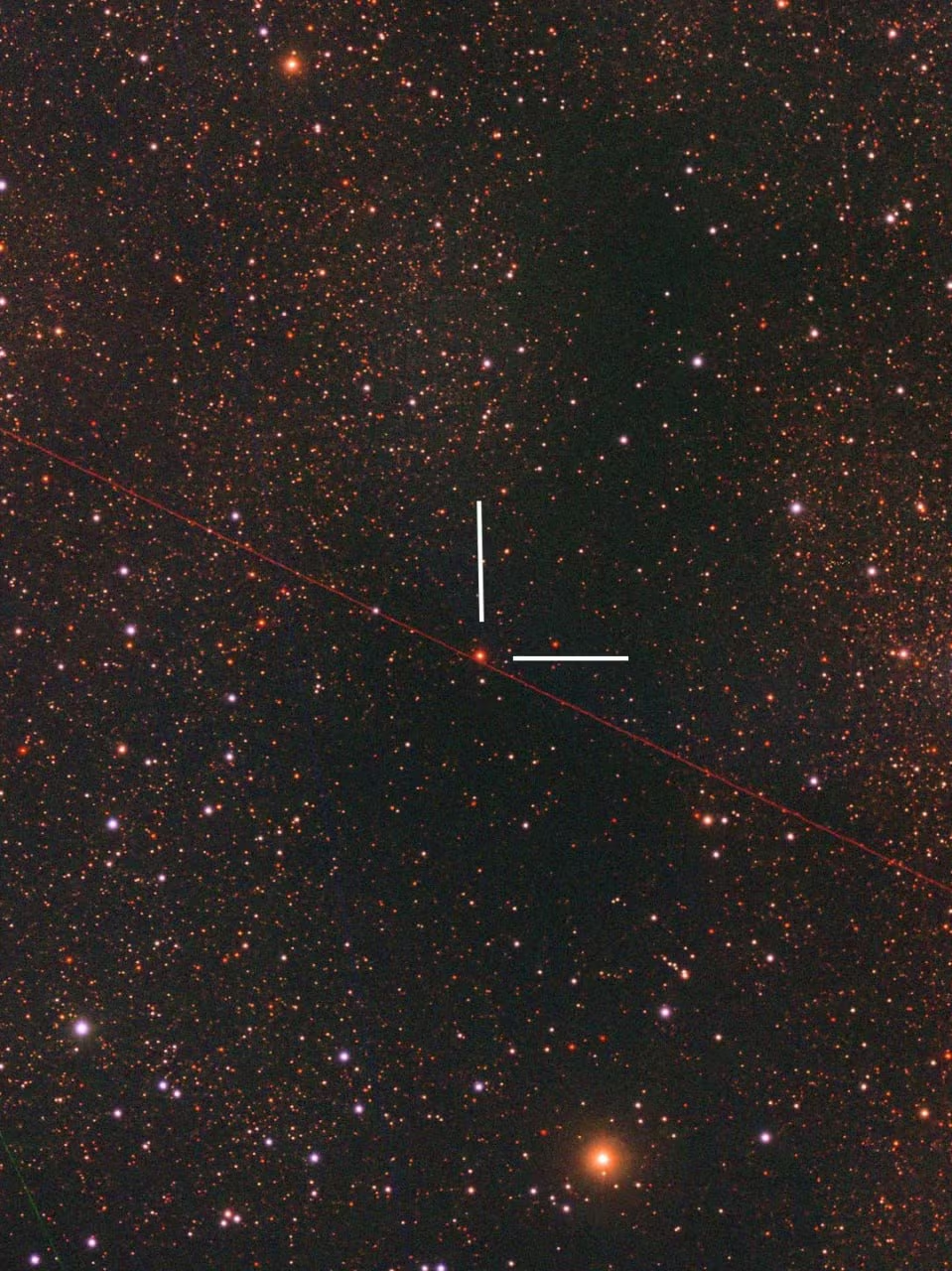
One intriguing aspect of AT 2026rdg is the significant reddening detected by astronomers. The most plausible cause is a dense cloud of interstellar dust along our line of sight. Deep-field images confirm that the nova aligns with dark dust filaments, which absorb more blue light, making the nova appear visually redder.
Currently, observers estimate the nova is near its peak brightness, hovering around magnitude +11. This brightness is typical for professional sky surveys but also accessible to amateur astronomers equipped with small telescopes and modern digital cameras, especially outside of white-night seasons. Such grassroots monitoring is key for building detailed light curves to track how rapidly the nova’s glow dims.
In the coming days, AT 2026rdg will receive an official designation. Ongoing spectral and photometric data will refine its characteristics. The rate at which its brightness declines will be crucial to classify it within specific nova subtypes and to compare it with other recent Galactic eruptions caught by surveys like ZTF and ASAS-SN.
Role of the Zwicky Transient Facility in nova discoveries
Compared to similar transient detections by Apple, Google, or Samsung-powered telescopes and sky surveys, ZTF and ASAS-SN stand out for their rapid, automated detection of explosive stellar events. This new nova adds to the growing catalog of such transients, highlighting how advancements in global survey networks empower both professional and amateur astronomers worldwide.
Insights from tracking nova AT 2026rdg’s brightness changes
Looking ahead, the speed of AT 2026rdg’s fade will offer insights into the white dwarf’s properties and the mass transfer dynamics in its binary system. Tracking this nova could also improve understanding of how often these explosions really happen in the Milky Way galaxy-information vital for models of stellar evolution and Galactic chemical enrichment.