

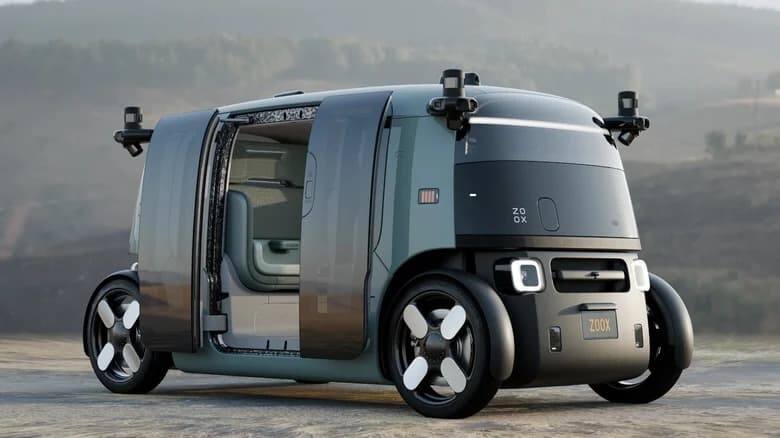
Amazon’s Zoox has turned its purpose-built robotaxi from a showpiece into a manufacturing plan. The company has unveiled an updated production version of its autonomous vehicle, with revised lighting, better passenger communication, a refreshed cabin, and a target of up to 100 cars a week at its Hayward, California plant.
The headline change is not a flashier body or a radical redesign. Zoox has kept the same boxy, bidirectional shape first shown in 2020, because the point is not to mimic a normal car. It is to make a vehicle that can be built repeatedly, operate in dense city traffic, and make itself understandable to people outside and inside the cabin.
Zoox robotaxi gets new lighting and two-way communication
Zoox has moved and upgraded its bidirectional reflectors so they can change color, helping riders and pedestrians tell which end is facing forward. That sounds minor until you remember the vehicle has no obvious nose or grille, which is exactly the sort of detail that trips up autonomous vehicles in the real world. The company has also added two-way audio through door-mounted speakers and microphones, allowing passengers to speak directly with road users, emergency services, and Zoox support staff.
That is a sensible move, and one the industry has been drifting toward for years. Cruise, Waymo, and others have all had to deal with the same problem: self-driving cars are easy to demo and harder to explain when something odd happens at a curb, a junction, or a police stop.
Zoox robotaxi cabin updates for longer rides
Inside, Zoox has lightened the color palette with aloe-green seats and a stone-gray floor. The seats now have softer support, improved ergonomics, and redesigned headrests, while the screen is brighter and higher-contrast. Cupholders have also been enlarged, a small but telling admission that urban robotaxi rides are expected to be more than quick hops across a parking lot.
The layout itself has not changed: four passengers still sit facing each other in a wagon-style arrangement. Zoox has never pretended this is a converted passenger car, and that is probably the smartest thing about it. Purpose-built autonomy may be more expensive to get right, but it avoids the compromises that keep retrofitted vehicles looking like half-finished ideas.
Zoox robotaxi production plan in Hayward
The company is already past the laboratory stage. Zoox launched its robotaxi service on the Las Vegas Strip in September 2025 after a long testing period, and the updated vehicles will be added to the operating fleet as they come off the line. The new production site in Hayward is supposed to support output of up to 100 vehicles per week, with broader expansion tied to regulatory approvals and local operating conditions.
That is where the real contest sits now. In autonomous transport, the hardest part is no longer just getting the car to drive itself; it is building enough of them, reliably enough, to matter commercially. Zoox is betting that industrial scale, not another flashy prototype, is what will finally make robotaxis feel less like a promise and more like a service.
The open question is whether regulators will let that pace translate into actual fleet growth, or whether Zoox will spend most of 2026 doing what the sector knows best: proving that the future can be manufactured, one approval at a time.