

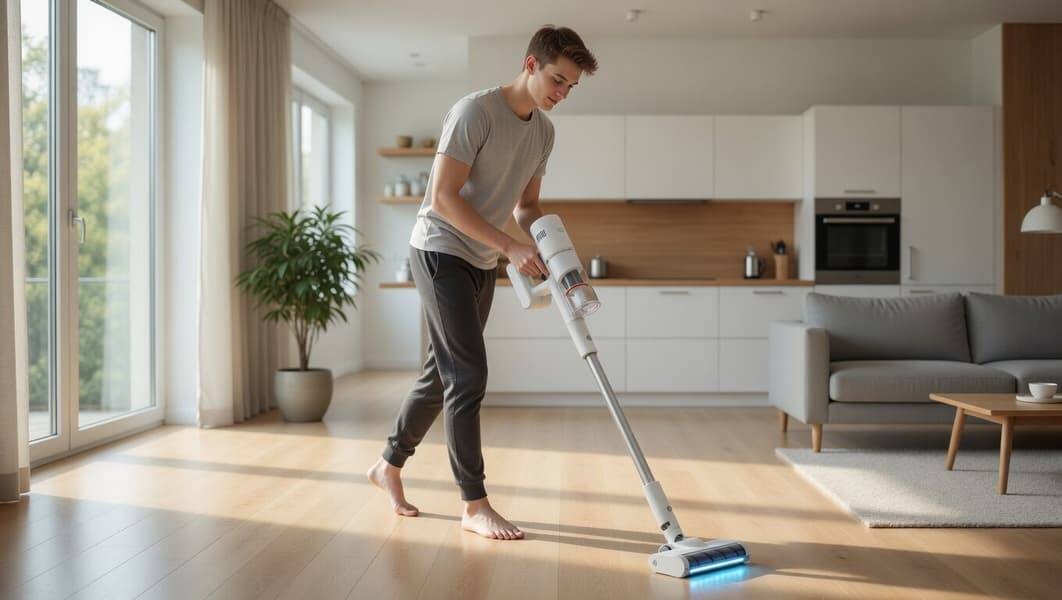
Xiaomi has put a new twist on budget cordless cleaning in China with the Mijia Wireless Vacuum Cleaner 4, a $130 model that pairs strong suction with smart dirt sensing, auto power control, and a battery rated for up to 90 minutes. It is the kind of spec sheet that tries hard not to look cheap, which is exactly the point: Xiaomi keeps pushing smart-home hardware downmarket before rivals can make the category boring again.
230 AW suction and a 120,000 rpm motor
The headline numbers are straightforward enough. Xiaomi says the vacuum uses a brushless motor spinning at up to 120,000 rpm and delivers 230 AW of suction, aimed at pet hair, fine dust, and everyday debris. That puts it squarely in the ”serious enough for real messes” camp rather than the usual decorative cordless fluff.
- Motor speed: up to 120,000 rpm
- Suction power: 230 AW
- Battery: 2600 mAh
- Runtime: up to 90 minutes in economy mode
Blue light and infrared sensors hunt dust automatically
The more interesting part is the cleaning assist system. Xiaomi built a blue light strip into the main brush with a 180-degree spread, designed to reveal dust up to 30 cm ahead of the vacuum, especially in dark corners and awkward spots. An infrared sensor then measures dirt in real time and adjusts suction on the fly, which is a smarter approach than forcing users to guess which mode they need and hope for the best.
The vacuum also includes anti-hair-wrapping protection, a five-stage filtration system, and an H13 HEPA filter rated for up to 99.99% efficiency for particles as small as 0.3 microns. That filtration setup is the sort of feature that has quietly become a battleground in cordless cleaners, as buyers increasingly expect better dust control without moving into premium pricing territory.
Xiaomi Mijia Vacuum Cleaner 4 price in China
The Mijia Wireless Vacuum Cleaner 4 goes on sale in China for 898 yuan, or $130. At that price, Xiaomi is leaning into the same formula that has helped it win in phones, routers, and home gadgets: undercut the obvious premium names, then stack on enough features to make the value argument hard to ignore. The real question is whether the company keeps this model China-only or uses it to sharpen pressure on competing budget cordless vacuums elsewhere.