

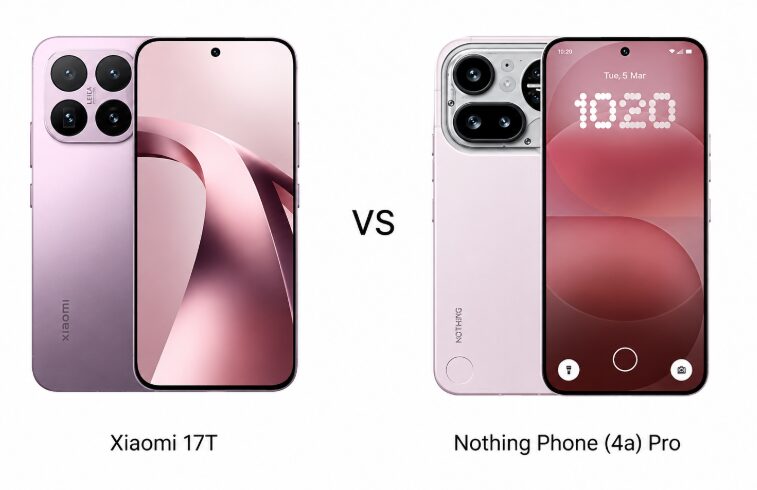
Xiaomi and Nothing are chasing two very different buyers with the Xiaomi 17T vs Nothing Phone (4a) Pro comparison. One leans hard into raw hardware, battery life, and camera reach; the other sells personality, a lighter bill, and a phone that looks like it escaped from a future nightclub.
That split is becoming familiar across the upper-midrange. Brands are no longer pretending a clean design and a fast refresh rate are enough to win a spec sheet fight; they are choosing between ”premium enough” and ”better everywhere that counts”.
Design and display: durability versus flair
The Xiaomi 17T goes for a safer flagship look with Gorilla Glass 7i protection and IP68 water resistance, while the Nothing Phone (4a) Pro uses an aircraft-grade aluminum unibody and the Glyph lighting system with 137 programmable LEDs. Xiaomi is the more practical choice if you care about water resistance and everyday abuse; Nothing is the one that will make strangers ask what phone you are using.
On the front, both use AMOLED panels with HDR support, but they aim at different priorities. Xiaomi adds Dolby Vision and a 1268p resolution, while Nothing counters with a larger 144Hz display, higher peak brightness, and slimmer bezels for a more immersive feel.
Dimensity 8500 Ultra vs Snapdragon 7 Gen 4
This is where the Xiaomi 17T pulls away. Its MediaTek Dimensity 8500 Ultra, paired with UFS 4.1 storage and 12GB RAM as standard, should deliver faster app launches, smoother multitasking, and more headroom over time than the Snapdragon 7 Gen 4 in the Nothing Phone (4a) Pro.
Nothing still looks well-specced for everyday use, streaming, social apps, and casual gaming. But Xiaomi is clearly the stronger pick for buyers who keep phones for years and hate the slow-burn disappointment of a midrange chip hitting its limits too early.
- Xiaomi 17T: MediaTek Dimensity 8500 Ultra, UFS 4.1, 12GB RAM
- Nothing Phone (4a) Pro: Snapdragon 7 Gen 4
- Xiaomi 17T battery: 6500mAh globally, 67W charging, reverse wired charging
- Nothing Phone (4a) Pro battery: 5400mAh in India, 50W charging
Camera hardware tilts heavily toward Xiaomi
Both phones use a triple-camera setup with wide, periscope telephoto, and ultrawide lenses, but Xiaomi simply brings more to the table. The 17T adds Leica-tuned imaging, 5x optical zoom, and a higher-quality ultrawide sensor, which gives it more flexibility for portraits, landscapes, and distant subjects.
The Nothing Phone (4a) Pro is not a slouch: its 50MP main camera should still produce solid results with good dynamic range. But its 3.5x telephoto and lower-resolution ultrawide camera make it feel more restrained, and the 32MP selfie camera tops out at 1080p video, while Xiaomi offers 4K selfie recording with HDR10+ support.
₹60,000 vs ₹40,000: the real trade-off
The pricing tells you everything. The Xiaomi 17T is around ₹60,000 ($700), while the Nothing Phone (4a) Pro sits around ₹40,000 ($500), leaving roughly ₹20,000 between them.
That gap is not small, and it changes the argument. Xiaomi is asking for more money because it offers more battery, better water resistance, faster storage, stronger performance, and a more capable camera system; Nothing is betting that design, smooth software, and a lower entry price will matter more than brute-force specs.
For most buyers, the smarter move depends on what will annoy them first: limited hardware or a higher bill. If Nothing keeps its usual software polish and Xiaomi’s camera tuning lands well in real use, this could be one of those comparisons where the better phone and the better buy are not the same device at all.