

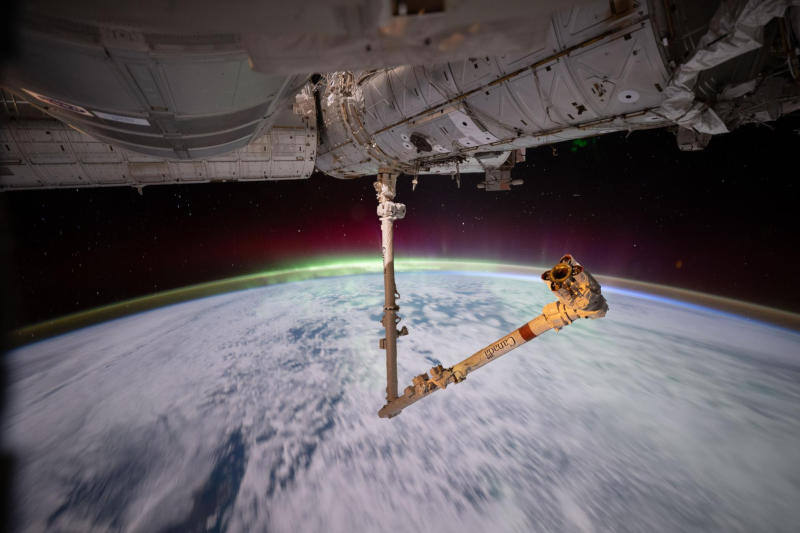
NASA is taking Canadarm2 offline for a few weeks after the International Space Station’s robotic arm started misbehaving during routine work on 27 May. The fix is old-school by space standards: astronauts will have to go outside on 30 June and swap out a jammed wrist component, even though the arm is currently in a stable position and the replacement part is already on the station.
That is a reminder that even the most famous space robots still need human hands when a motor starts drawing too much current and the arm stops moving the way it should. Canadarm2 has been doing this job for 25 years as of April, which is impressive, but also a polite way of saying the hardware has been working overtime for a decade beyond its design life.
Why NASA needs a Canadarm2 spacewalk repair
NASA said consultations with the Canadian Space Agency and MDA Space pointed to an EVA repair rather than a software tweak or a ground-side reset. That is a sensible call: Canadarm2 is modular by design, and its segments are meant to be replaced in space, which is exactly why CSA had already arranged for spare parts to be delivered. The same basic playbook was used in 2017, when the arm was repaired in orbit after a similar issue.
- Issue spotted: increased current in the wrist motor
- Repair method: astronaut spacewalk
- Repair date: 30 June
- Backup part: already on the ISS
A 25-year-old Canadarm2 that still does real work
Canadarm2 is still central to cargo handling and station maintenance, and its last capture was in April, when Northrop Grumman’s Cygnus XL arrived at the station. That kind of workload helps explain why NASA and its partners are still investing in repairs instead of treating the arm as museum hardware. The alternative would be awkward for an ISS that still depends on robotic muscle for too many jobs to count.
The arm first began operating in 2001, long before commercial cargo spacecraft became routine, and it has since logged milestone after milestone, including its 50th capture in 2024. Dextre, the station’s other Canadian manipulator, shares the load, with both systems sometimes run from Earth for up to 100 days a year by engineers rather than astronauts.
Canada’s robotic space line keeps stretching
Canadarm2 sits in a longer Canadian lineage that started with the original Canadarm in 1981 and now continues with Canadarm3 for Artemis. That continuity matters: Canada has managed to turn niche robotic expertise into a durable role in human spaceflight, while the ISS keeps proving that modular engineering is the difference between a temporary outage and a mission headache.
NASA says a press conference is coming to outline the spacewalk and identify the astronauts who will do the job. The only real question now is whether this repair stays routine – or becomes another reminder that a machine can be both iconic and one jammed joint away from a week of scrambling.