

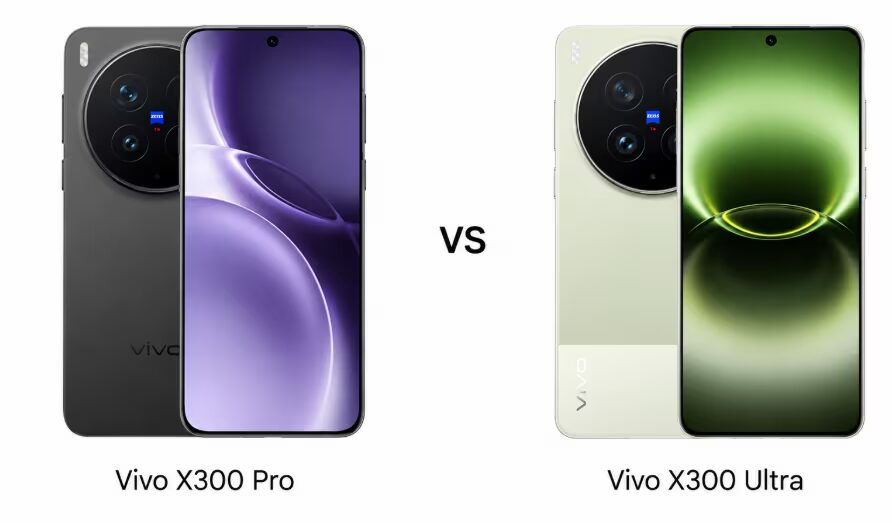
Vivo’s latest flagships, the X300 Pro and X300 Ultra, sit close in class but are priced $500 apart. The X300 Pro starts at around $1,000, while the Ultra model jumps to about $1,500. While both look similar on the outside, that extra half grand isn’t just for a faster processor or a slightly better screen. The Ultra’s main selling point lies in its enhanced camera setup, targeting photographers and enthusiasts who prioritize mobile imaging above all else.
Both phones share premium materials like glass and aluminum and offer IP68/IP69 water and dust resistance, under-display ultrasonic fingerprint sensors, and LTPO AMOLED panels. The Ultra is a touch larger, sporting a 6.82-inch 1440p display with a 144 Hz refresh rate versus the Pro’s 6.78-inch screen capped at 120 Hz and a peak brightness of 4500 nits. For everyday use, the Pro’s display is more than sufficient, but the Ultra caters to gamers, video lovers, and those who want the absolute maximum smoothness and detail.
Vivo X300 Pro vs Ultra performance and battery specifications
Performance-wise, the phones differ more than you might expect. The X300 Pro runs on a MediaTek Dimensity 9500 chip, while the Ultra leverages Qualcomm’s Snapdragon 8 Gen 2 Elite (Gen 5) paired with the Adreno 840 GPU. The Ultra also adds DisplayPort support over USB-C and broader Bluetooth codec compatibility, enhancing external device connections. Battery sizes are close-6510 mAh on the Pro and 6600 mAh on the Ultra-with the Ultra charging faster at 100W wired (versus 90W on the Pro). Wireless charging matches at 40W.
Vivo X300 Ultra camera upgrades compared to X300 Pro
Where the Ultra truly differentiates itself is its camera system. The X300 Pro already offers a solid trio: a 50 MP main sensor, a 200 MP periscope telephoto zoom delivering 3.7x optical zoom, and a 50 MP ultrawide lens. The Ultra upgrades these with a 200 MP primary sensor featuring gimbal stabilization, a 200 MP telephoto unit, a larger 50 MP ultrawide with optical stabilization, plus support for additional external zoom lenses at 200 mm and 400 mm focal lengths. For most users, that’s overkill, but for dedicated mobile photographers, these upgrades can justify the steep price premium.
Price comparison and market positioning of Vivo X300 Pro and Ultra
This tiered approach is familiar in the Android ecosystem. Samsung’s Galaxy S25 Ultra carries a noticeable premium over its base models, and Xiaomi’s 15 Ultra and Oppo’s Find X8 Ultra also prioritize photography enhancements over outright daily speed gains. According to Counterpoint Research, the ultra-premium smartphone segment priced above $1,000 remains the fastest-growing, and cameras are often the key motivating factor driving buyers to upgrade within that segment.
Stripped of marketing flair, the X300 Pro emerges as the more sensible buy for most. It packs nearly all flagship specs, a strong battery, and an impressive telephoto lens, all for significantly less cash. The X300 Ultra makes sense only if you genuinely appreciate the upgraded display, chipset, and especially the advanced camera array. For that niche, the extra $500 seems reasonable. For everyone else, better to keep those dollars in your pocket.
- Vivo X300 Pro price: Around $1,000
- Vivo X300 Ultra price: Around $1,500