

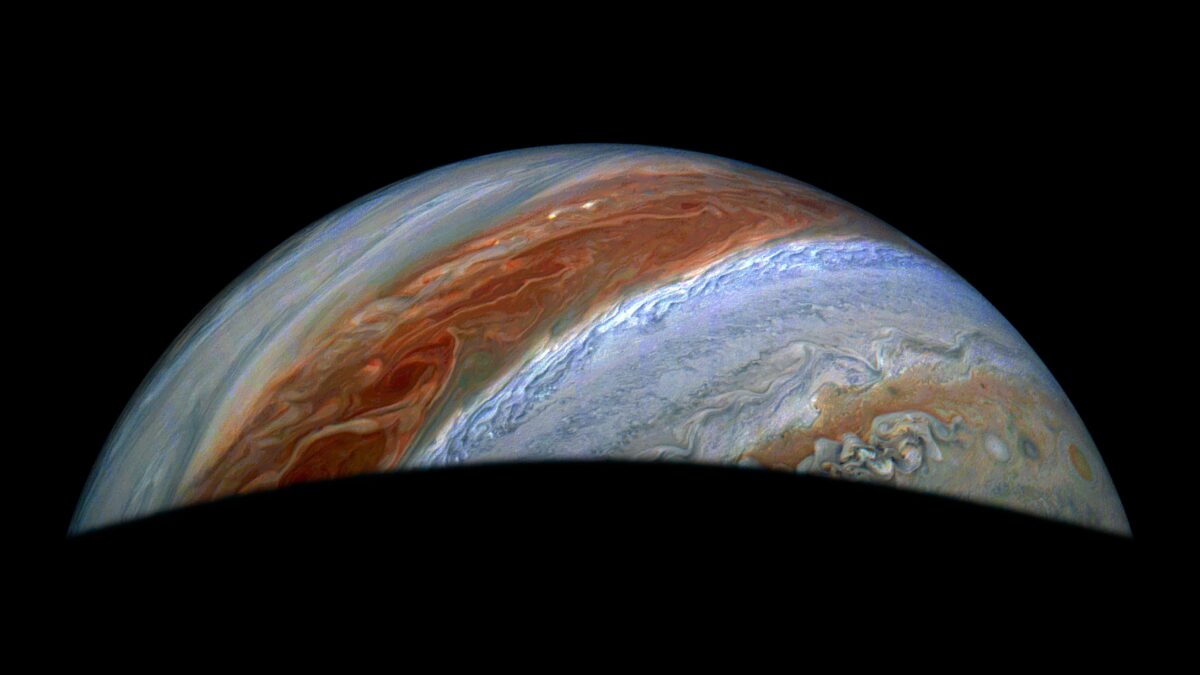
Ten years ago, NASA’s Juno spacecraft entered orbit around Jupiter-and it’s still going strong. Celebrating a rare milestone for deep-space missions, Juno has delivered a decade of eye-opening data not just about Jupiter itself but also its diverse moons, from the icy Europa to the volcanic Io. This trove of information has painted a complex portrait of the Jovian system: a world of both frozen oceans and fiery storms.
Juno’s updated view of Jupiter’s size and shape
Juno’s detailed measurements have refined our understanding of Jupiter’s dimensions, factoring in its intense zonal winds. The planet’s polar radius is now measured at 66,842 kilometers, its equatorial radius at 71,488 kilometers, with an average radius of 69,886 kilometers. This means Jupiter is slightly smaller and more oblate (flattened at the poles) than previously thought, tweaking the textbook image of the solar system’s largest planet.
Jupiter’s storms and lightning revealed by Juno
Juno has also probed deep into Jupiter’s tumultuous atmosphere, providing new insights into its iconic storms. The spacecraft has revised estimates of the Great Red Spot’s depth, which now ranges from 200 to 500 kilometers-significantly deeper than earlier estimates of around 240 kilometers. It has detected direct lightning flashes and radio bursts from hidden thunderstorms within Jupiter’s superstorms. Some lightning events pack energy comparable to Earth’s lightning bolts, while others are up to a million times more powerful.
These observations have supported a fascinating theory: the most intense Jovian storms produce a kind of hail made of water and ammonia. This ”hail” heats the upper atmosphere and redistributes ammonia, a dynamic that seems to extend beyond Jupiter to Saturn, Uranus, and Neptune as well. Understanding these processes provides a template for interpreting the atmospheres of distant gas giant exoplanets, now known in the thousands.
Particle acceleration in Jupiter’s magnetosphere
Beyond the clouds, Juno has shed light on particle physics in Jupiter’s magnetosphere. It revealed that electrons near Jupiter’s bow shock-the boundary where the solar wind meets the planet’s magnetic field-can accelerate to extremely high energies. This natural laboratory helps astrophysicists refine models of cosmic ray acceleration, with implications for understanding phenomena ranging from supernova remnants to distant active galactic nuclei.
Juno’s longevity amid NASA budget challenges
For a spacecraft operating in Jupiter’s harsh radiation environment, Juno’s resilience is impressive. It has survived multiple safe-mode events and camera damage from intense radiation near the planet. However, the mission now faces a new threat from Earth: proposed NASA budget cuts for 2027 could severely reduce funding for ongoing planetary missions. If enacted, Juno’s mission may end prematurely-just as other ambitious Jupiter explorers like ESA’s JUICE (slated for 2031) and NASA’s Europa Clipper prepare to arrive.
Compared to giant-planet missions by other space agencies, Juno remains uniquely focused on Jupiter’s deep interior and atmospheric dynamics, while JUICE will prioritize icy moons like Ganymede. Together, these explorations promise to deepen our understanding of gas giant systems in the solar system and beyond.
Marking Juno’s decade in orbit, the mission underscores how long-term commitment to a single destination can transform our grasp of giant planets-and set the stage for future interplanetary science. The biggest question now is whether Juno will extend its run and continue to complement the upcoming wave of exploration, or if budget pressures will cut short its groundbreaking work.