

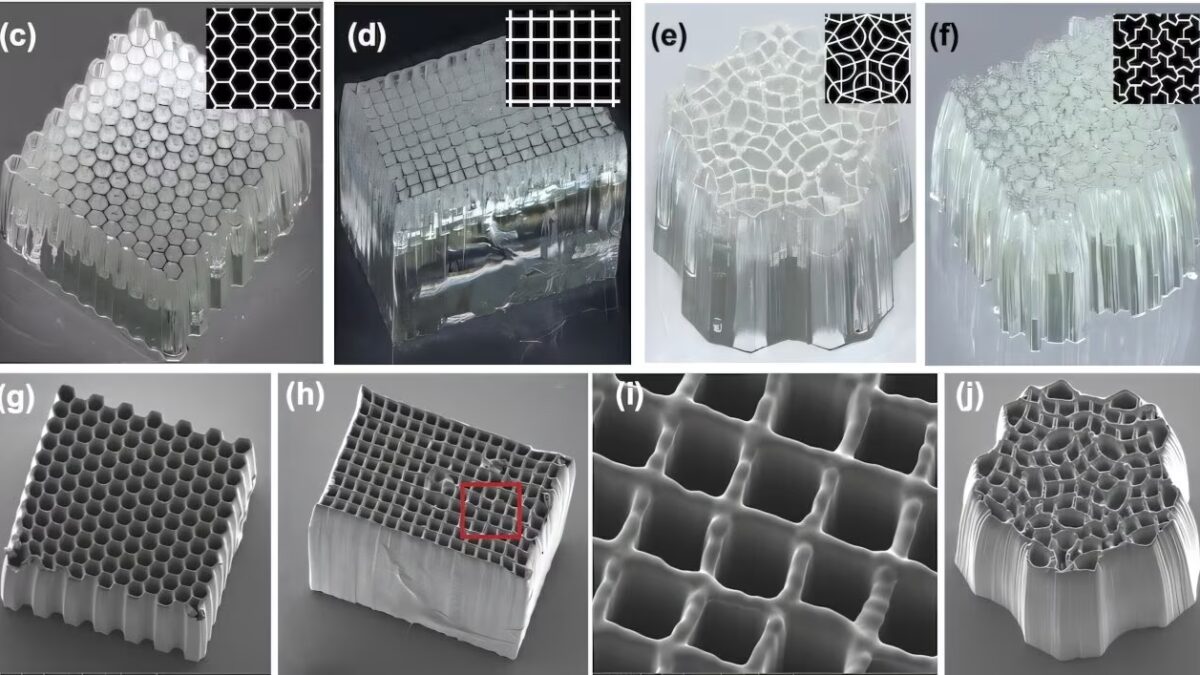
Scientists at the University of Utah have unveiled a 3D printing method for micro parts that eliminates one of additive manufacturing’s biggest headaches: weak layer adhesion. Instead of building objects layer by layer, their technique cures the entire desired shape inside a polymer using a holographic light pattern-all hardened in about 20 seconds.
The project, led by Rajesh Menon and Dajun Lin, draws inspiration from photolithography processes used in chip manufacturing. Their material of choice is SU-8, a well-known photoresist favored in microelectromechanical systems (MEMS) fabrication. A laser triggers cross-linking of long polymer chains where illuminated, then unexposed material is washed away, leaving behind the finished microstructure.
How the Utah 3D printer creates micro parts with holographic light
What stands out is the nanostructured lens-mask that sculpts the laser beam into a precise 3D pattern while compensating for light scattering inside the partially opaque polymer. This enables creation of structures with aspect ratios up to 120:1, including arrays of microtubes as thin as 6 micrometers in diameter.
Process specifics and current limitations of the micro-scale 3D printing
For now, the process is closer to ”elongated” 3D printing rather than truly freeform volumetric fabrication. The pattern is tightly defined in two dimensions and then built along a third axis. Tested samples endured compression and could transport fluids through capillary action without external pressure.
Comparison with existing micro 3D printing techniques and speed advantages
This development is important because micro-scale 3D printing often forces a tradeoff between speed and precision. Techniques like two-photon polymerization-used by companies such as the Austrian firm Nanoscribe-deliver superb resolution but print point-by-point, turning complex parts into hours-long projects. Top research groups from MIT to Caltech are chasing volumetric curing methods that solidify entire regions simultaneously to cut printing times drastically.
Potential applications of fast, seamless 3D printed micro parts
If Menon’s team manages to fully control shapes in all three dimensions, their approach could unlock practical uses in microfluidics, medical implants, and micro-optics-fields that demand tiny components free of mechanically weak seams. In these cases, shaving printing time from hours to 20 seconds is more than convenient; it’s transformative. The global additive manufacturing industry, after all, is already a multibillion-dollar industry.