

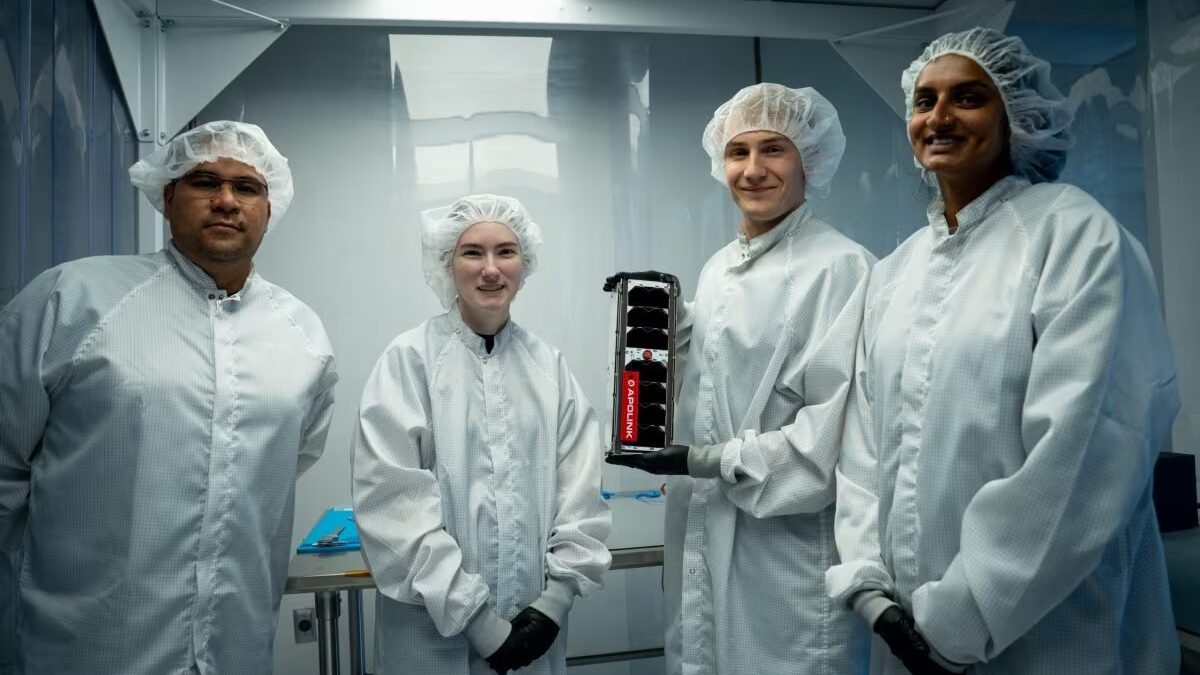
US startup Apolink has established contact with its first satellite, the IPoS-TDsM CubeSat, launched aboard a SpaceX Falcon 9 rocket on July 7. This milestone kicks off the mission’s real work: testing data transmission between satellites in low Earth orbit and downlinking that data to ground stations. If successful, operators won’t have to wait for satellites to pass over ground stations to send commands or retrieve information.
The IPoS-TDsM satellite communicates using the Interoperability Protocol over Satellite, a novel standard supported by an experimental license from the US Federal Communications Commission (FCC). Apolink’s 3U CubeSat-measuring roughly 10 × 10 × 34 cm-relays signals it receives from partner satellites to authorized ground stations, acting as a space-based data forwarding node.
CEO Onkar Batra explained that Apolink’s system operates within about 150 km line of sight between satellites. Initial testing windows started in July and will continue through November 2024. Singapore’s NuSpace, which launched its NuLink-1 and NuLink-2 satellites in May 2024, is partnering with Apolink for these data exchange trials.
Unlike major satellite constellations such as Starlink, which rely primarily on laser-based inter-satellite links that are costly and complex for small satellites, Apolink is exploring a lighter, radio-frequency-based ”store-and-forward” relay approach. This method is tailored for the rapidly growing smallsat segment-a sector that saw over 2,800 small satellites launched in 2023 alone, according to analytics firm BryceTech-and aims to solve communication gaps outside ground station coverage.
Apolink’s plans for a 32-satellite relay network
If current tests succeed, Apolink plans to deploy a network of 32 orbital relay satellites and is actively seeking new partners. A key milestone is set for 2027, when the company intends to launch a new satellite developed in collaboration with Canadian startup Galaxia. This launch will help clarify whether Apolink can carve out a niche between high-cost inter-satellite laser constellations and simpler communication solutions for smaller operators.