

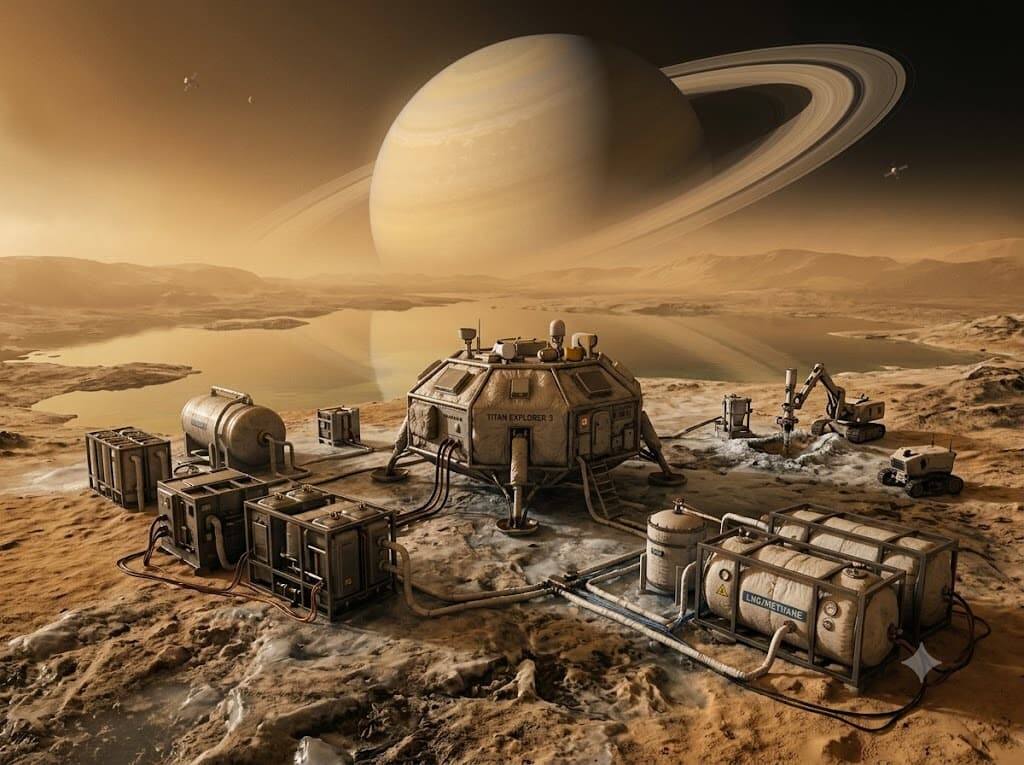
Titan may be Saturn’s moon, but NASA researchers are treating it like a possible pit stop for the rest of the Solar System. A team at NASA Goddard Space Flight Center says its dense atmosphere and lakes of liquid hydrocarbons could one day support fuel and material production on site, turning the biggest moon of Saturn into a candidate refueling base for missions headed farther out.
That is a long way from an actual depot, of course. The idea sits inside in situ resource utilization, or ISRU, the very practical-sounding notion that you should make things where you are instead of hauling everything from Earth. NASA has been talking up ISRU for years around the Moon and Mars; Titan is different because it seems to have the raw chemistry to do more than just support a habitat. It could, in theory, supply the feedstock too.
Why Titan stands out from the Moon and Mars
Conor Nixon, an astronomer at NASA Goddard Space Flight Center, led the work. The team’s pitch is simple: Titan has a stable atmosphere, liquid methane and ethane on its surface, and more complex organic compounds that could be turned into propellant, plastics, synthetic materials, and chemical reagents. That’s a much richer pantry than the barren rock engineers usually have to work with on the Moon and Mars.
The comparison with the Moon and Mars matters because both are already central to NASA’s long-term exploration plans, yet neither offers Titan’s carbon-rich chemistry. Titan’s atmosphere is about 50% larger than Earth’s by volume, and it is the only known moon with a persistent atmosphere. For planners thinking beyond a single landing, that gives Titan a peculiar advantage: the moon is hostile, but not chemically stingy.
A freezing place with useful chemistry
The catch is the sort of catch that tends to ruin a weekend trip: Titan is brutally cold. Its average temperature is about −290 °F (about −179 °C), surface gravity is roughly one-seventh of Earth’s, and free oxygen is basically absent, meaning any breathing gas would have to be manufactured separately, for example by electrolysis. So yes, the moon may contain useful chemistry, but it is not exactly rolling out the welcome mat.
Even so, researchers argue that Titan could serve as a logistics node for missions deeper into the outer Solar System, especially journeys beyond Jupiter and Saturn. That idea is getting extra attention because it aligns with a broader shift in spaceflight: the farther humans go, the less realistic it becomes to depend on Earth for every kilogram of fuel, plastic, and spare parts.
Dragonfly will test Titan’s appeal
The near-term reality is still more probe than port. NASA’s Dragonfly mission is already in preparation and is expected to study Titan’s surface in the coming decades, offering a chance to turn these theoretical arguments into hard data. If Dragonfly finds the chemistry researchers hope it will, Titan’s reputation could shift from exotic curiosity to strategic outpost.
For now, the moon’s role as a deep-space fueling station remains speculative. But if off-Earth industry ever becomes more than a buzzword, Titan is exactly the kind of place that could end up mattering first: cold, inconvenient, and full of useful hydrocarbons.