

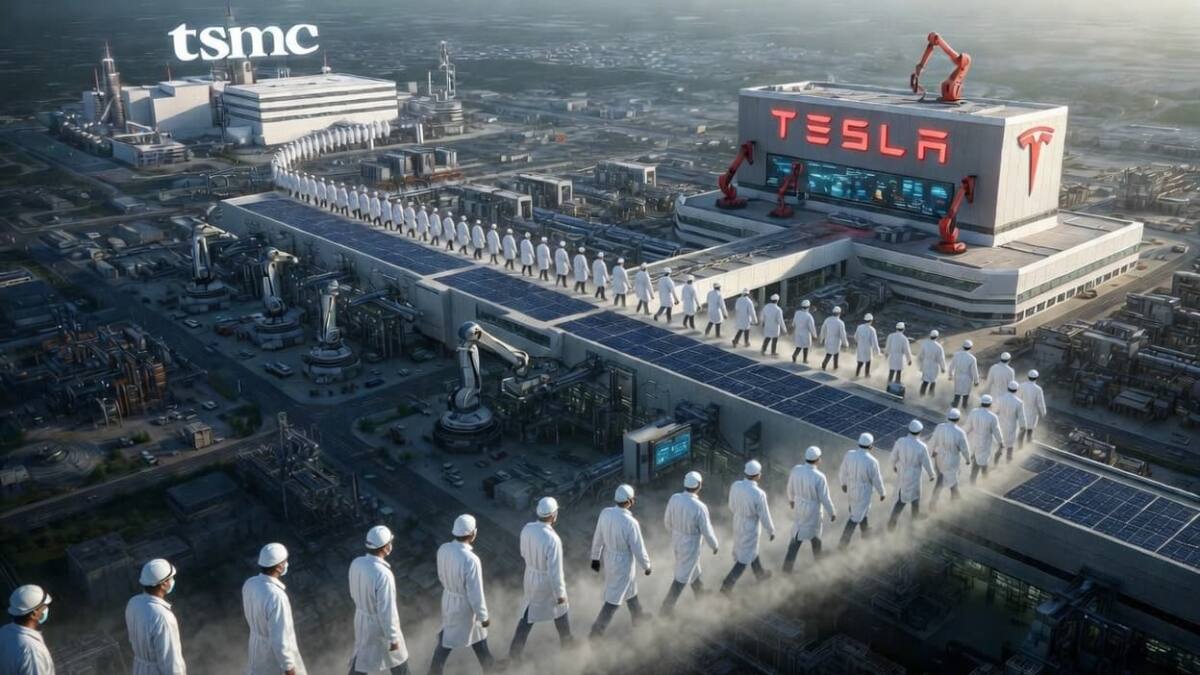
Tesla is reportedly luring TSMC engineers with a very blunt instrument: money. The company is offering senior process engineers salaries three to five times higher than what they earn at TSMC to speed up work on Terafab, its own chip plant, with annual pay starting at about 1.62 million yuan, or $240,000, plus restricted stock packages for targeted hires.
That is not subtle, but it is familiar. The semiconductor industry has long relied on talent raids to move know-how across borders, and Silicon Valley has spent years poaching Taiwanese engineers for exactly this reason: experience in scaling advanced manufacturing is hard to buy and even harder to replace.
Tesla Terafab needs speed, not theory
Terafab is supposed to help Tesla shorten the painful learning curve that usually comes with building a chip foundry from scratch. Hiring engineers who already understand advanced process technology is the fastest way to avoid months or years of trial and error. Tesla is also trying to compress the timeline for a plant that is expected to begin producing processors in 2026.
The pitch makes sense for Tesla, but it is brutal for TSMC. When a rival can offer several times the compensation, even a deep bench of specialists starts to look vulnerable. Tesla is not inventing a new playbook here; it is just applying Silicon Valley’s favorite shortcut with more cash and a bigger headline.
Why TSMC engineers are so valuable
TSMC’s engineers are prized because they bring practical manufacturing discipline, not just textbook knowledge. That matters in chip fabs, where tiny process details decide whether a line runs cleanly or turns into an expensive science experiment. It is the same reason Google and Micron have courted Taiwanese specialists for years, and why Google’s HTC-heavy hiring spree became such a benchmark for the region.
- Tesla’s reported offer: 3-5 times TSMC pay
- Annual salary: about 1.62 million yuan, or $240,000
- Extra incentive: restricted stock packages
- Terafab production target: 2026
The bigger bet behind Terafab
Tesla is not just trying to make chips for cars. The longer-term plan points to a much larger hardware ambition, including processors that would eventually feed orbital data centers, with 80% of output said to be reserved for that purpose. That is an audacious use case, and it explains why Tesla is willing to pay up now rather than wait for the talent pipeline to mature on its own.
The open question is whether high salaries alone can buy manufacturing culture. Tesla can pull in experts, but turning them into a functioning fab team is a different job entirely. That is where the real fight begins.