

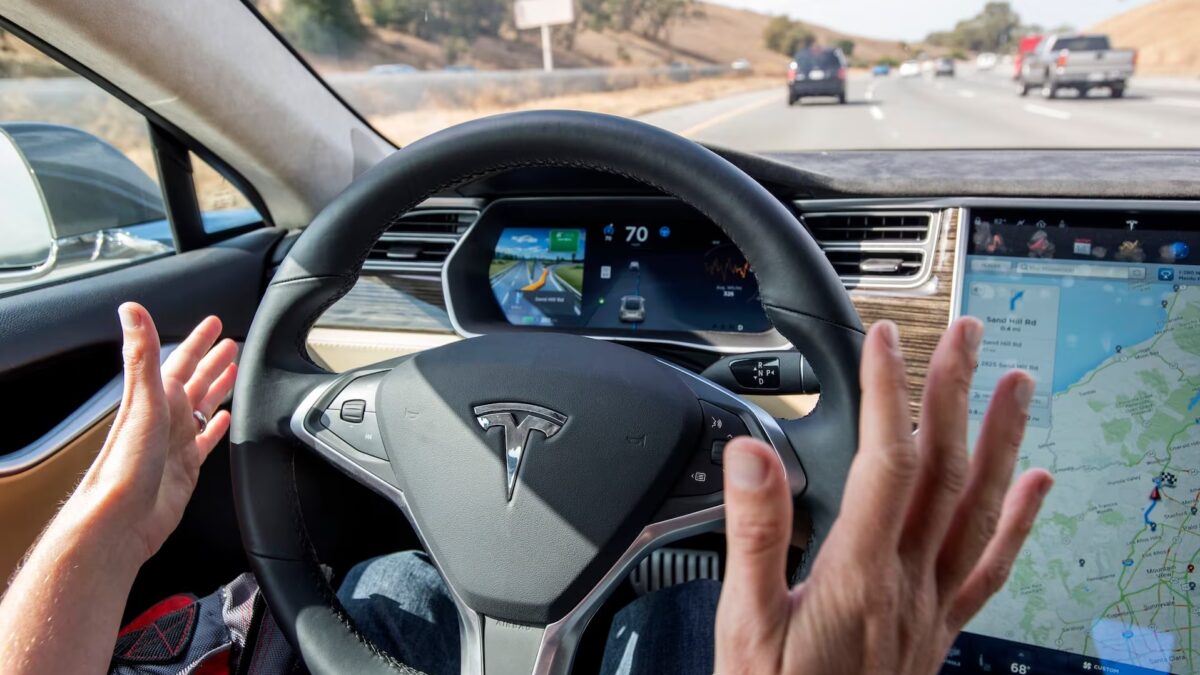
Tesla appears to be working on an identity verification feature using the cabin camera for its Full Self-Driving (FSD) system. Code discovered in an updated version of Tesla’s iOS app hints the system might scan the driver’s face before allowing supervised FSD activation.
This was first spotted by the Tesla_App_iOS account, which tracks the automaker’s app updates, and later confirmed by Electrek. The internal code suggests the camera will match the driver’s face to an ”authorized” profile. If the faces don’t match, FSD simply won’t enable, and the app will display an error message.
That said, this feature is still in the early stages-only traced in the code for now-and could be weeks or months away from public release. Moreover, Tesla will likely need to roll out both an app update and a vehicle firmware upgrade to make it work properly.
From a technical standpoint, the idea is not new. Tesla’s cabin camera, mounted above the rearview mirror, already monitors driver attention by tracking head and eye movements and detecting drowsiness. The hardware is in place. The real question is whether Tesla wants to use this sensor not just for safety but as a digital ”pass” to gate a paid feature.
This ties directly into Tesla’s commercial logic. In the U.S., subscribing to Full Self-Driving currently costs $99 per month-down from as high as $199 before. Tesla has a clear incentive to ensure that only the paying driver can access FSD, which could block unauthorized sharing of the feature within families or fleets.
While driver monitoring isn’t unique-General Motors’ Super Cruise and Ford’s BlueCruise also use cabin cameras to track driver attention-requiring face verification before enabling an assistant is much rarer. Tesla is again pushing the boundary between safety monitoring and digital identity verification.
However, there is a notable challenge: user acceptance of such biometric checks is low. A Pew Research Center study found roughly two-thirds of Americans are uncomfortable sharing personal documents with online platforms. Meanwhile, a The Zebra survey revealed that 68% of U.S. drivers oppose speed limiters that prevent speeding altogether. If Tesla moves forward with face verification for FSD access, the debate will go beyond privacy concerns. It will center on who ultimately controls paid vehicle features-the car owner or the manufacturer.
Looking ahead, Tesla’s move could signal a shift toward integrating more biometric controls into vehicle software-a practice that may become important as automakers increasingly rely on subscription-based features. How consumers respond to these measures will shape not only Tesla’s approach but also the broader direction of digital rights and user autonomy in automotive tech.