


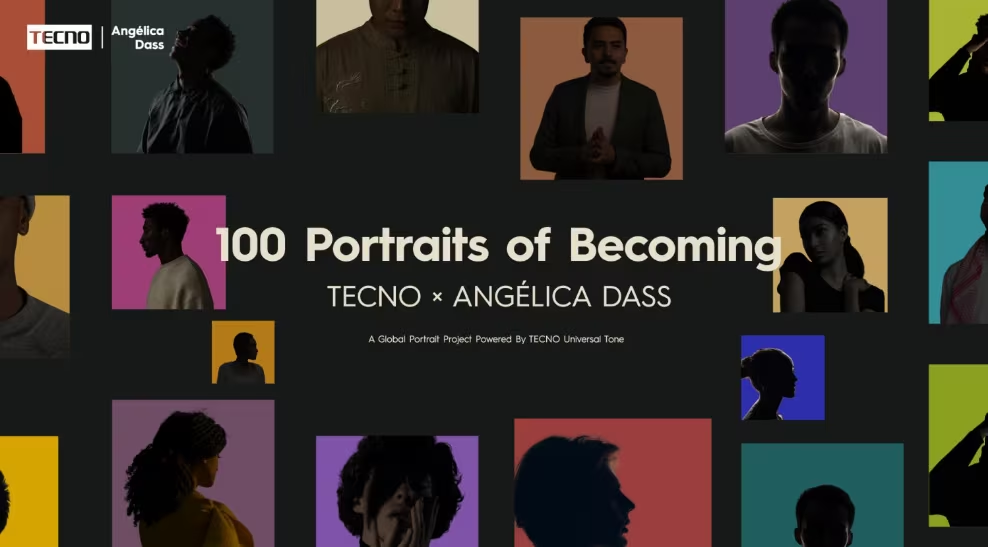
Tecno has teamed up with Brazilian-Spanish artist Angélica Dass to launch ”100 Portraits of Becoming,” a global initiative challenging bias in AI-powered smartphone cameras. Starting in Nairobi on July 4, 2026, the project will collect 100 filter-free portraits and personal stories from diverse individuals worldwide over two years, proving that AI cameras can capture real skin tones without leaning on narrow beauty standards.
The project’s journey is set to continue through the Philippines, Saudi Arabia, Turkey, and Brazil. Participants register via a dedicated website, are photographed in natural light without beauty filters, and control how they present themselves. Each portrait comes with a personal narrative about their profession, family, culture, and life experiences that shape their identity.
Tecno plans to release the first online archive in early August 2026 and emphasizes this isn’t just a marketing stunt but a ”living archive” of human experience. The goal is to shift cameras and AI away from forcing people into preset templates, towards faithfully reflecting their appearance and context.
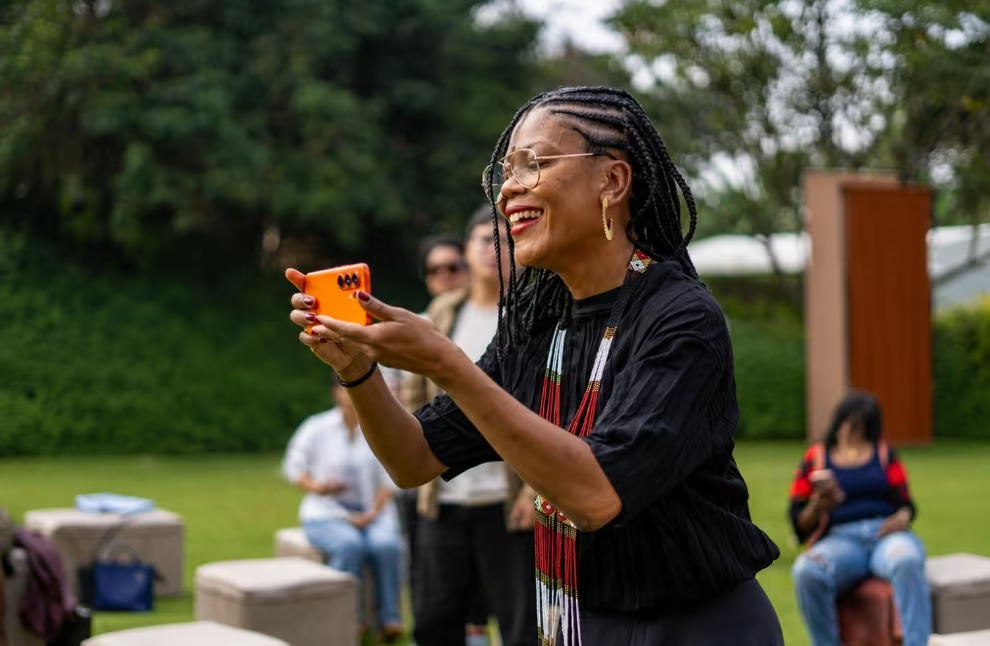
This initiative leverages Tecno’s CAMON 50 Ultra smartphone and its Universal Tone technology. The system supports 372 skin tone shades and corrects common portrait issues-like overexposure or unnatural color shifts-that have fueled criticism of AI image processing in recent years.
AI cameras and bias in portrait photography
Concerns around bias in AI camera systems are hardly new. Back in 2021, Google introduced Real Tone for Pixel phones and Google Photos to better capture darker skin tones, working with photographers and colorists to improve accuracy. Before that, camera makers, photo services, and facial recognition algorithms faced criticism for performing better on lighter skin than on darker skin.
The discussion has expanded beyond smartphones. In 2021, UNESCO member states adopted AI ethics guidelines that stress minimizing discrimination risks and algorithmic bias. These challenges largely come down to training data quality, auto-exposure calibration, HDR settings, and whose perspectives influence camera testing and AI development.
Artist Angélica Dass takes a unique approach. Known for her Humanæ project that portrays skin tones as a continuous spectrum rather than fixed categories, Dass’s work has exhibited at UNESCO and the World Economic Forum. Her 2016 TED talk has amassed over two million views. Partnering with Tecno allows her concept to reach mainstream mobile photography, while the brand gains a cultural lens for its AI messaging.
The significance of Nairobi as the project launch city
Nairobi is no random choice to launch this effort. Dubbed ”Silicon Savannah” for its booming fintech scene, young population, and vibrant mobile economy, Kenya represents a key battleground for Tecno. Its parent company Transsion has been a dominant force in African smartphones for years, competing fiercely with Samsung and Xiaomi in the budget segment.
The first wave features entrepreneurs, farmers, dancers, and creatives from Kenya, including Solutech Limited co-founder Alexander Odyambo, who emphasizes ”the right to tell one’s own story rather than being confined to pre-labeled identities.” The project faces a powerful test: if by 2028 Tecno can assemble a convincing international archive, it could prove that fair and inclusive camera AI isn’t just socially valuable but also a distinct commercial edge in smartphones.
As major tech giants continue refining their camera AI to capture true-to-life skin tones and diverse faces, Tecno and Dass’s project highlights a path where technology meets cultural sensitivity and personal storytelling. The next few years will reveal if ”100 Portraits of Becoming” can set a new standard for AI cameras and the global smartphone audience they serve.